
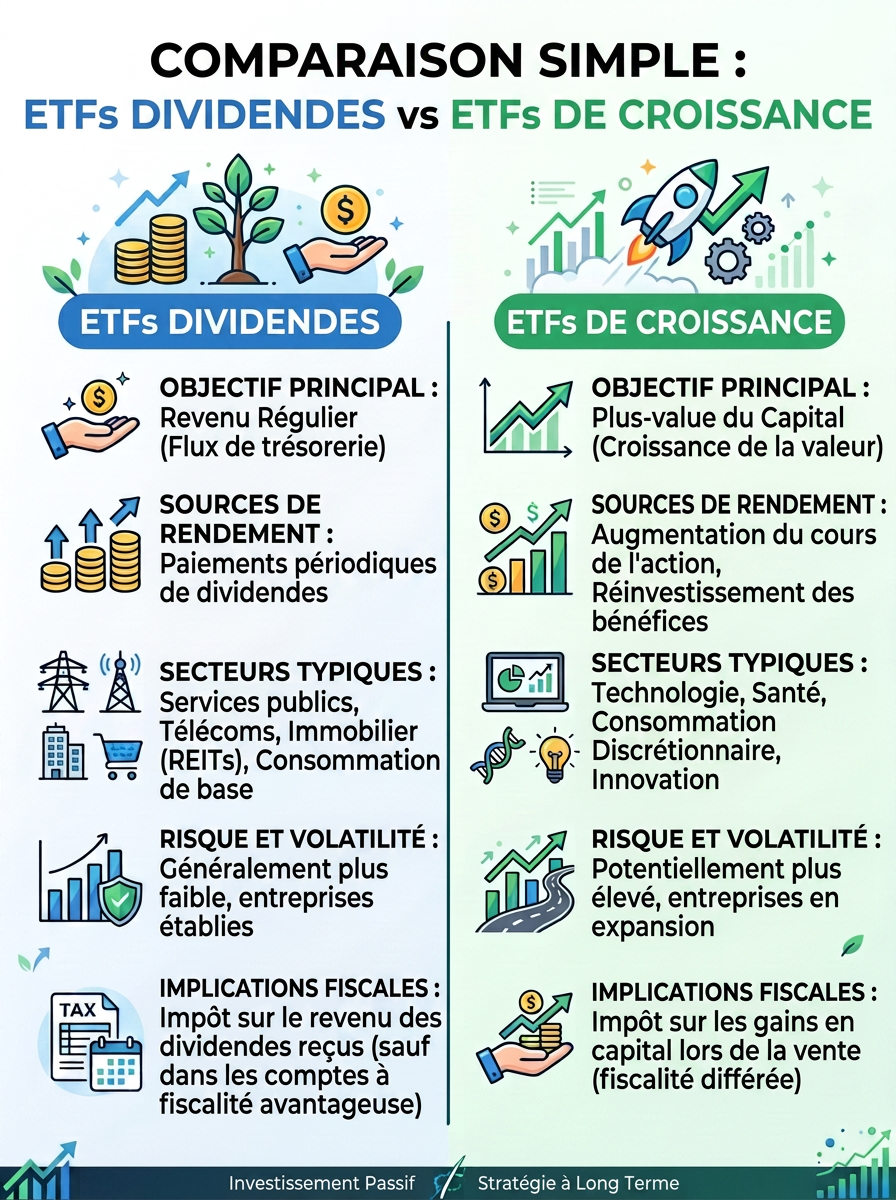
Dividend ETFs are attractive because of their regular income, while Growth ETFs focus on the capital increase in the long term. In this article, Dividend ETFs or Growth ETFs: which one really yields the most? Let's explore the strengths, weaknesses, and performance of each strategy to help you make the right choice 😉
Recommended products


Before reading this article
⚠ This article reflects only my opinion. It is not investment advice! Please note that stock market investments can result in losses. 💲
Warning ⚠ I will be posting the past performance of some ETFs. While knowing their past performance is interesting, it is not NOT a guarantee for the future ❗❕
Introduction: Dividend ETF or Growth ETF: which one really yields the most?
For a long time, I thought that an ETF distributing 4% in dividends was necessarily better than an ETF that pays almost nothing.
For a while, I was only interested in dividends, as I saw them as the best option. I thought that receiving passive income every six months in my stock account seemed like the most profitable option.
However, when I compared the overall performance of dividend ETFs with that of growth ETFs over the last ten years, I was surprised. And I realized that there are advantages and disadvantages to each type of ETF.
The two main strategies in the stock market?
There are primarily two ways to make money in the stock market. Each investor chooses their own…”team”.
High dividend ETF
In this case, you focus on the high dividend distribution of all the stocks in your ETF.
Your portfolio grows more slowly. However, you can gradually live off your investments thanks to the high dividends you receive.
Growth ETFs
In this case, generally speaking, the value of the share increases more over the long term than a high-dividend ETF.
However, the value of the ETF is more volatile and you receive fewer dividends.
With this strategy, the goal is to buy your growth ETF today and sell it for a much higher price in several years.
Here is a table summarizing these two strategies. I will go into more detail about each investment in this article.
| Criteria | High dividend ETF 💰 | Growth ETF 📈 |
|---|---|---|
| Main objective | Generate a regular income through dividends | Maximize long-term capital growth |
| Portfolio growth | ⭐⭐ Lower on average | ⭐⭐⭐⭐⭐ Higher on average |
| Dividends distributed | ⭐⭐⭐⭐⭐ Students | ⭐ Weak |
| Volatility | ⭐⭐⭐⭐ Generally weak and stable | ⭐⭐ Generally high |
| Taxation (Switzerland) | ⭐⭐ Dividends are taxable. | ⭐⭐⭐⭐ Private capital gains are generally not taxed* |
| Ideal for… | Investors who wish to supplement their income with semi-annual dividends | Investors who want to grow their wealth over the long term |

What is the best stock market strategy?
There is no universal answer. In my opinion, the strategy depends on the time frame of the financial investment.
- Short term (less than 5 years) = High dividend ETFs to receive passive income every six months
- Long term (more than 5 years) = Growth ETF to grow your financial assets over the long term
What is a high dividend or a low dividend?
Every investor will have their own opinion. In my opinion:
- Less than 1.5% per year = low dividend
- Between 1.5 and 2.5% per year = average dividend
- More than 3% per year = high dividend
Dividends are not free money.
Many investors believe that receiving a dividend is comparable to receiving an extra salary. I myself thought that way for years.
In reality, that's not exactly what's happening.
When a company pays a dividend, it distributes a portion of its cash to its shareholders. In return, the company's value decreases by the same amount.
In truth, if a share is worth 100 CHF and pays a dividend of 5 CHF, its share price will generally open around 95 CHF on the day of the dividend payment.
In other words, you are not creating additional wealth. It's simply that a portion of the value of your investment is converted into cash in the form of dividends.
It's quite similar to withdrawing money from an ATM: if you have 100 CHF in your account and you withdraw 20 CHF in cash, you end up with only 80 CHF in your bank account.
In conclusion, you haven't become any richer…
| High Dividend ETFs | Growth ETFs |
|---|---|
| Part of the return is paid out immediately in the form of dividends. | The majority of the profit remains invested in the company to promote its growth. |
| You receive an income today. | You are prioritizing a larger asset tomorrow. |
Example with several growth ETFs and high dividend ETFs
Based on past returns (2016-2025), here is a summary of the growth and dividends distributed for each ETF category.
| AND F | Objective | Growth | Dividend | Total yield approximately (dividends + growth) |
|---|---|---|---|---|
| Nasdaq* | 100 Large American Growth-Oriented Companies | ⭐⭐⭐⭐⭐ (approx. 15% per year) | ⭐ (approx. 0.5% per year) | 15.5% |
| S&P 500* | 500 largest American companies | ⭐⭐⭐⭐ (approx. 10% per year) | ⭐⭐ (approx. 1% per year) | 11% |
| VT* | Global Stock Market | ⭐⭐⭐ (approx. 7% per year) | ⭐⭐⭐ (approx. 1.5% per year) | 8.5% |
| VHYL* | Global high-dividend stocks | ⭐⭐ (approx. 4% per year) | ⭐⭐⭐⭐⭐ (approx. 3.5% per year) | 7.5% |
Over the period studied (2016-2025), growth ETFs outperformed dividend ETFs. However, they paid out fewer dividends and were more volatile. It should be noted that past performance is not indicative of future results.
Example of $10,000 USD per ETF
During this period, I considered investing $10,000 USD per ETF at the beginning of 2016, without any further contributions. What would each ETF be worth at the end of 2025?
| AND F | Value at the end of 2025 (Approximate) |
|---|---|
| Nasdaq | 42,200 USD |
| S&P 500 | 28,300 USD |
| VT | 22,600 USD |
| VHYL | 20,600 USD |
We see that the growth of stocks allows for the accumulation of a lot of money.
For example, in this comparison, the Nasdaq ETF more than doubled the VHYL ETF's return over 10 years, even though the VHYL ETF pays high dividends.
Taxation: should it favor dividends or growth?
Taxation is a factor often overlooked by investors. Yet, depending on your country of residence, it can have a significant impact on the actual return of your portfolio.
Dividend ETFs
Dividend ETFs regularly pay out a portion of companies' profits to investors (via dividends). In many countries, these dividends are heavily taxed when you receive them.
In Switzerland, for example, dividends received are generally considered taxable income. Therefore, you pay taxes on them every year, even if you automatically reinvest those dividends.
In Switzerland, dividends are initially taxed at a rate of 0 to 35% depending on the ETF's country of origin, and then, after filing the tax return, these dividends are taxed at approximately 14% in its entirety.
Growth ETFs
Growth ETFs distribute few, if any, dividends. Companies prefer to reinvest their profits to grow their business and increase their value.
In Switzerland, Capital gains realized by a private investor are subject to little taxation and in some cases are even tax-exempt. . This means that the growth of your portfolio is taxed little or not at all as long as you remain a private investor.
This tax treatment often makes growth ETFs more advantageous for Swiss investors (and also for many investors worldwide). in order to maximize their assets over the long term.
| Criteria | Dividend ETF 💰 | Growth ETF 📈 |
|---|---|---|
| Taxation of dividends (In many countries) | Medium to high (because the ETF distributes dividends) | Weak (because the ETF distributes low dividends) |
| Capital gains tax (Switzerland) | Generally exempt | Generally exempt |
| Long-term taxation | Less favorable | More favorable |
Key points to remember: In Switzerland, capital gains for private investors are generally tax-free, except for professional traders. This can vary from country to country.
My opinion: What is the ideal strategy?
In my opinion, the ideal strategy depends primarily on:
- age
- short-term or long-term objectives.
Here's how I would invest based on age:
| age | strategy |
|---|---|
| Under 24 years old | 100% Growth ETF |
| 25-35 years old | 80% Growth ETF 20% High Dividend ETF |
| 35-45 years old | 60% Growth ETF 40% High Dividend ETF |
| 45-55 years old | 40% Growth ETF 60% High Dividend ETF |
| Over 56 years old | 100% High Dividend ETF |
Here is an example of a portfolio for 35-45 year olds:
| Portfolio percentage | Purpose of the ETF | ETF Example |
|---|---|---|
| 20% | high-growth stocks (growth) | Nasdaq ETF |
| 40% | The entire American economy (growth) | S&P 500 ETF |
| 20% | The entire global economy (growth) | ETF VT |
| 40% | High dividend ETF (high dividends) | ETF VHYL |
I would summarize this topic as follows:
Many people believe that dividends make you rich. In reality, it's not dividends that create wealth, it's the growth of your assets. !
A high-dividend ETF is only attractive to investors who want immediate passive income.
However, it is certain growth ETFs that allow you to become wealthy over the long term..

Conclusion: High dividend ETF or growth ETF?
In conclusion, there is no one-size-fits-all strategy. The best choice depends on:
- your age
- your investment horizon
- your financial goals
If your goal is to grow your wealth over the long term, Growth ETFs have historically delivered the best performance.
- They distribute few dividends (which allows them to pay little tax).
- reinvest more of their profits (which promotes capital growth).
Conversely, if you are simply searching to receive a regular passive income, High-dividend ETFs can be an excellent solution because:
- They allow you to receive relatively high income 4 times a year (depending on the ETF)
- Relatively stable volatility
- However, their growth is generally more moderate.

In my opinion, the best strategy is often to adapt your portfolio to your age:
- Young investor: favor growth ETFs.
- Mid-career: combining growth and dividends.
- Near retirement: High dividend ETF
The key is to choose a strategy that you'll be able to maintain for many years. Because in the stock market, Patience is often more important than choosing between two ETFs.
FAQ – Dividend ETF or Growth ETF: which one really yields the most?
What is the difference between a dividend ETF and a growth ETF?
A dividend ETF regularly pays out a portion of a company's profits as dividends. In contrast, a growth ETF favors companies that reinvest their profits to increase their value over the long term.
Which ETF offers the best returns: dividends or growth?
Historically, growth ETFs have delivered better overall returns than dividend ETFs. However, dividend ETFs distribute a regular income to investors.
Should you choose a dividend ETF or a growth ETF?
It all depends on your goal. If you want to grow your wealth, a growth ETF is often more suitable. If you're looking for passive income, a dividend ETF might be more attractive.
Are dividend ETFs less risky?
Dividend ETFs often invest in mature companies and can be somewhat less volatile. However, they are still equity investments and carry a risk of loss.
Do growth ETFs pay dividends?
Yes, but they generally distribute much lower dividends than ETFs specializing in high dividends.
Are dividends taxable in Switzerland?
Yes. Dividends are generally considered taxable income in Switzerland. Capital gains realized by a private investor are, as a rule, tax-exempt.
Which is the best ETF for preparing for retirement?
Investors nearing retirement often favor dividend ETFs to generate a regular income. Younger investors tend to choose growth ETFs.
Can growth ETFs and dividend ETFs be combined?
Yes. Many investors build a portfolio composed of both in order to benefit from both capital growth and passive income.
What is the best dividend ETF?
There is no single best all-purpose ETF, as the ideal ETF depends on the shareholder's profile. ETFs like Vanguard FTSE All-World High Dividend Yield (VHYL) are often used by investors seeking regular income.
What is the best growth ETF?
ETFs replicating the Nasdaq-100 or the S&P 500 are among the most popular for investing in companies with strong growth potential.
Dividend ETF or Growth ETF: which one really yields the most?
Subscribe for the latest news ✍
You have a frugalist or minimalist project and you want a training? Click ”here”.
My pages
- About me
- Saving / Frugalism
- Blog
- Shop
- Contact
- Training and E-book
- Invest
- Minimalism
- My account
- Newsletter
- Basket
- Order confirmation
Lastest Post
- The best advice in the world to save
- The Neon bank, the summary
- How does digitalization influence minimalist?
- Frugalist Psychology: Planning and Celebrating Small Victories
- Essential consumption VS Non-essential consumption
How does this blog live?
Overall, this blog lives on sharing a frugal and minimalist lifestyle.
For a question of transparency towards the readers. All recommended products are in order to make life cheaper, simpler and to promote the essentials.
Basically, my only income with this blog comes:
- Trainings that I realize
- Promo codes for the products I use
- Donations that readers make in exchange for neutral information.
About me
I decided to create this blog to develop and help readers who are looking for a simpler and more economical life.
Compared to before, I was a person who consumed a lot until the day I realized that my consumption made me sadder and poorer 😑
Now I prefer the minimum of my needs to be happy and achieve my financial freedom.
Without realizingI started to focus on saving and investing to depend on a boss for as little time as possible and to speed up my personal projects.
As a result, I am getting richer in a way that I never imagined since I have an average salary in Switzerland.
What is the purpose of this blog?
The goal is to share and learn with others who seek freedom and simplicity 😉
Are you more of a minimalist or a frugalist?
I am as minimalist as I am frugalist. However, there are situations where I lean more towards an art of life.
To conclude, I think the most important thing is to feel comfortable in your lifestyle 😊
Leave a Reply