
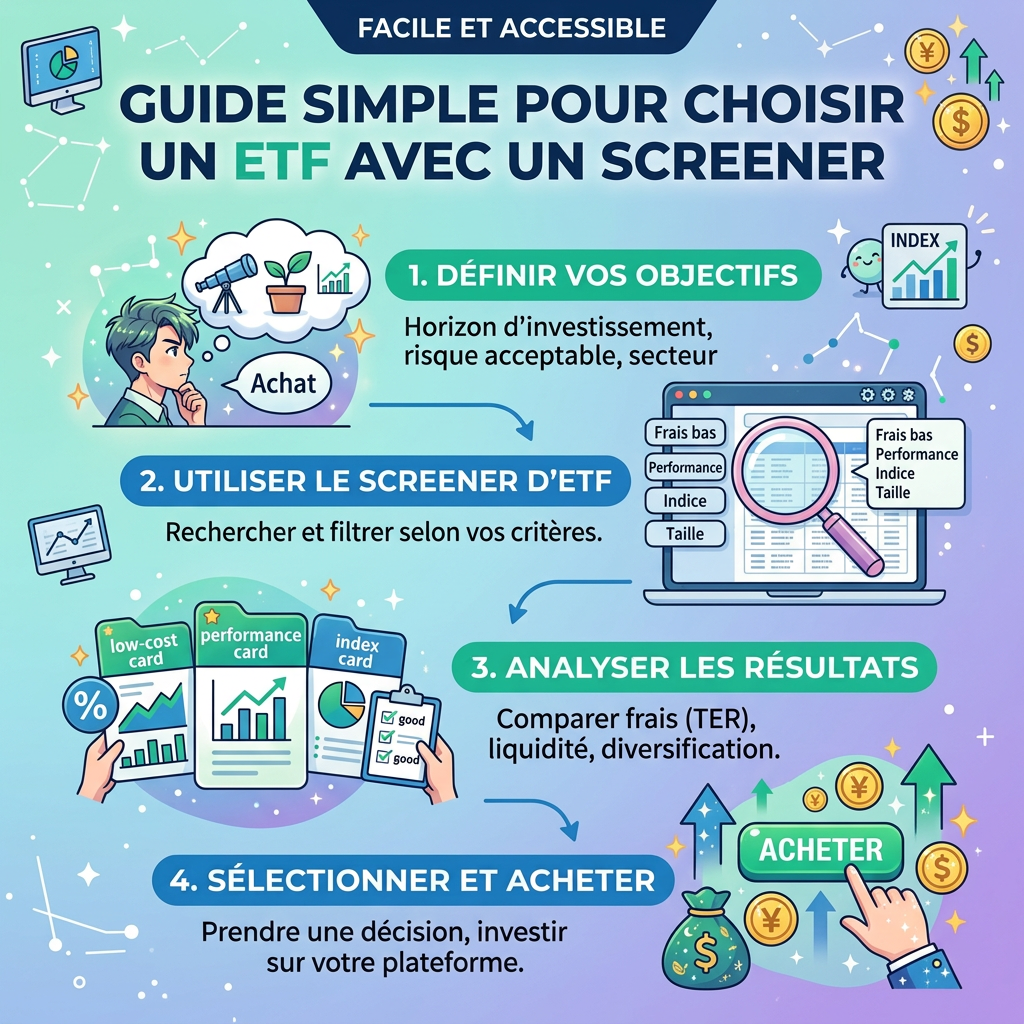
Une fois décidé une stratégie boursière avec une stratégie passive. L’étape suivante est de comprendre comment choisir les ETF? Cet article, Comment choisir un ETF avec un screener (Guide simple) va t’aider à choisir rapidement un ETF.
Recommended products


Before reading this article
⚠️ Warning : Cet article est informatif et ne constitue pas un conseil en investissement. Chaque investisseur est responsable de ses décisions et des conséquences de ses placements. Les performances passées ne garantissent pas les performances futures. Investir en bourse comporte un risque de perte d’argent.
Introduction
Today there are more than 5,000 ETF available.
How can you find the one that truly matches your strategy without comparing hundreds of funds one by one?
The solution is to use a ETF Screener.
In this article, I'm going to show you the method I use to go from 5,000 ETFs to just a few candidates in less than five minutes.
What is an ETF Screener?
Un ETF Screener est simplement un comparateur d’ETF. C’est un moteur de recherche qui permet de filtrer rapidement les ETF selon tes critères.
It allows you to filter ETFs according to various criteria such as:
- the costs (TER)
- the country
- the region
- dividends
- la performance passée
- the number of shares
De cette manière, tu peux peux éliminer rapidement tous les ETF qui ne correspondent pas à ta stratégie.
Why do I use Stock Analysis?
There are several screeners.
Personally, I use Stock Analysis ETF Screener*, because it is:
- Free
- Très simple à utiliser
- Plus de 5’000 ETF à comparer
- Beaucoup de filtres à choisir
The 7 filters I always check
Au lieu de te montrer et expliquer cinquante filtres, je t’annonce les sept filtres les plus importants selon mon opinion.
1. Volume
I always select:
Volume = more than 100k
The volume represents the average number of ETF shares traded daily on the stock exchange.
As a general rule, The higher the volume, the easier it is to buy or sell your ETF quickly..
De plus, plus un ETF a un volume élevée, mieux est la réputation de l’ETF.
An ETF with low trading volume can present several disadvantages:
- fewer buyers and sellers
- a larger gap between the purchase price and the selling price (spread)
- sometimes lower liquidity.
👉 Personally, I prefer to invest in ETFs that have au minimum 100’000 parts échangées quotidiennement. Et certains actionnaires diraient même 500’000.
2. TER
I select:
Expense Ratio = less than 0.20%
THE TER (Total Expense Ratio) corresponds to management fees automatically deducted annually by the ETF.
Plus la TER est élevée, moins l’investisseur gagne d’argent avec l’ETF.
For example :
- an ETF with a TER of 0,10% will cost you approximately €1 per year for every €1,000 invested ;
- a TER train from 0,80% will cost approximately €8 per year for every €1,000 invested.
Over several decades, this difference can represent several thousand euros lost by the shareholder.
👉 That's why I try to stay under 0,20%, especially for traditional index ETFs.
3. Asset Class
I select:
Asset Class = Equity
The asset class indicates what the ETF actually invests in.
For example :
- Equity → actions d’entreprises
- Bonds → obligations
- Commodities → matières premières (or, pétrole, etc.)
- Currencies → devises
Since my strategy is to invest in companies for the long term, I almost always choose Equity.
👉 If your goal is to invest in stocks, this filter is essential.
4. Region
Next, I choose the geographical area that interests me.
For example :
- 🌍 World
- 🇺🇸 United States
- 🇪🇺 Europe
- 🇨🇭 Switzerland
Ce filtre permet de sélectionner la région des entreprises dans lesquelles tu souhaites investir.
For example :
- un ETF mondial investira dans plusieurs milliers d’entreprises réparties dans différents pays (très diversifié)
- un ETF américain investira uniquement aux États-Unis (historiquement très rentable)
- A European ETF will focus on European companies (this may be of interest to a European resident).
👉 There is no “best” region. It all depends on your investment strategy.
5. Historical performance over 10 years
Personally, I watch:
Total Return 10Y = more than 100%
THE Total Return represents the total performance of the ETF, dividends included.
J’aime que le total return soit de minimum 10 ans.
Even if Past performance is never a guarantee of future performance, They provide an indication of the ETF's historical quality.
This filter allows me, above all, to eliminate certain ETFs that have clearly underperformed their benchmark market.
6. The number of shares
I choose:
Number of shares = More than 100
I prefer ETFs that contain at least 100 stocks.
In my opinion, investing in an ETF with fewer than 100 stocks is riskier and leads to very high volatility.
7. Dividendes (stratégie à dividendes élevés)
Si tu favorises un revenu passif plutôt que la rentabilité sur le long terme, il faut choisir des dividendes annuelles supérieures à 3% :
Dividend Yield = More than 3%
This allows for more stable volatility and the receipt of high passive income every six months.
On the other hand, if you favor stock market growth over dividends, you can ignore this filter.

Concrete example
Let's say I want to invest in a global, growth-oriented ETF.
If I look at the stock analysis comparator (ETF screener), there are initially more than 5,300 ETFs.
However, if I apply the filters written previously:
| Filtered | Value |
|---|---|
| Asset Class | Equity |
| Region | Overall |
| TER | – of 0.20 % |
| Volume | over 100k |
| Total Return 10Y | + over 100 % |
| Holding (number of shares) | over 100 |
Result: I go from over 5,300 ETFs across 18 ETFs. In just a few clicks.
Et si j’optimise certains filtres de cette manière:
| Filtered | Value |
|---|---|
| TER | – de 0.10 % |
| Volume | + de 500k |
| Total Return 10Y | + de 150 % |
Je passe de 18 à 5 ETF. En moins de 30 secondes.
Il est plus simple de comparer 5 ETF similaires que d’en comparer 5’300…
What should you look at next to choose the right ETF?
Once the list is narrowed down to a few ETFs, you'll want to select the GOOD ETF.
However, at this stage, each investor will have their own preferences. For example:
- ETF avec le nombre d’actions le plus élevé
- ETF with the largest number of countries invested
- lowest TER
At this stage, the bulk of the work is already done. But the final choice of ETF becomes very personal.
Selon mon opinion (qui n’est pas un conseil), voici mes critères complémentaires pour choisir LE bon ETF.
- Vanguard or iShares ETF (very good reputation)
- Dividendes annuels le plus faible (car je favorise la croissance)
- Steady stock market growth over the last 10 years
- TER as low as possible
- Analyser le portfolio de l’ETF

The most common mistakes beginners make when choosing an ETF
When starting out in the stock market, it is very easy to choose an ETF for the wrong reasons.
Here are the mistakes I see most often among beginner investors.
❌ Choose only the ETF with the best past performance
This is probably the most common mistake.
Many people think that an ETF that has won +300% in 10 years continuera à avoir le même rendement 10 ans après.
In reality, Past performance is never a guarantee of future performance.
For example, an ETF that has seen a strong rise thanks to the technology sector could go through several much more difficult years.
👉 Past performance is interesting, but it should never be your only selection criterion.
❌ Buy only the ETF with the highest dividend
A dividend yield of 6% or 7% initially appears very attractive.
However, a high dividend does not necessarily mean that the investment is better.
Very often, an ETF that distributes a lot of dividends sees its growth slow down.
In some cases, a very high dividend can even be a sign that some portfolio companies are experiencing difficulties.
👉 Always look at the overall return of the ETF (growth + dividends) over a long period (at least 5 years), not just the dividend.
❌ Ignore the fees (TER)
The costs sometimes seem insignificant.
However, they are being collected. each year, even when the stock market falls.
For example, between an ETF and 0,10% of expenses and another to 0,50%, The difference can represent several thousand euros over an investor's career.
👉 I personally try to stay below 0.20% of TER.
❌ Buying an ETF without knowing which index it tracks
Two ETFs can have a very similar name while investing in completely different markets.
For example :
- an ETF S&P 500 invests in approximately 500 major American companies ;
- an ETF Nasdaq-100 is much more focused on technology companies; ;
- an ETF MSCI World invests in companies in several developed countries.
Before investing, always ask yourself:
“What index is this ETF trying to replicate?”
👉 This is the index that really determines the companies you invest in.
❌ Only look at 1-year performance
An excellent year does not mean that an ETF is exceptional.
In some years, a sector can explode before correcting sharply the following year.
That's why I prefer to look at performance data on:
- 10 years
- 15 years
This allows for a much more representative view of the quality of an ETF.
👉 The longer the history, the easier it is to assess the ETF's behavior in different market conditions.
❌ Buy an ETF without checking its diversification
Two ETFs can show the same performance while presenting a very different level of risk.
For example :
- With some ETFs, the 3 main stocks represent more than 35% of the ETF
- With some ETFs, there are only 25 stocks invested (and in the same country)
In reality, some ETFs have very low diversification.
Choosing an ETF with good diversification often makes it possible to reduce risk without necessarily reducing long-term returns.
👉 Personally, I prefer ETFs with at least a hundred companies, or even several hundred when possible.

Conclusion
In reality, choosing an ETF is much simpler than you might think.
Le plus difficile n’est pas de trouver le bon ETF, mais d’éliminer ceux qui ne correspondent pas à tes objectifs.
With a few simple filters (e.g., TER, volume, region, 10-year performance), you can go from several thousand ETFs to just a few serious candidates in a few minutes.
Une fois cette présélection faite, il ne te reste plus qu’à comparer les derniers détails plus personnels (par exemple : choix de l’émetteur de l’ETF, type de réplication distribution ou capitalisation…) avant de faire ton choix.
FAQ – Comment choisir un ETF avec un screener ? (Guide simple)
Quel est le meilleur screener ETF gratuit ?
Il existe plusieurs screeners d’ETF, mais Stock Analysis fait partie des plus complets. Il est gratuit, simple à utiliser et permet de comparer plus de 5’000 ETF grâce à de nombreux filtres (TER, dividendes, région, indice, nombre d’actions, performance, etc.).
Comment choisir un ETF quand on débute ?
Pour un débutant, le plus simple est de définir d’abord sa stratégie (croissance, dividendes, ETF mondial, etc.), puis d’utiliser un screener afin de filtrer les ETF selon quelques critères essentiels : frais (TER), volume d’échange, région, nombre d’actions et historique des performances.
Quels critères faut-il regarder avant d’acheter un ETF ?
The main criteria are:
- le TER (frais de gestion de l’ETF)
- le volume d’échange
- la région ou le pays investi
- Equity (ETF d’actions)
- le nombre d’entreprises dans l’ETF
- les performances historiques
- le rendement en dividendes (si tu recherches un revenu passif)
Quel TER est considéré comme faible pour un ETF ?
Pour un ETF indiciel classique, un TER inférieur à 0,20% est généralement considéré comme faible. Certains ETF, comme l’ETF VOO par exemple, ont une TER de seulement 0,03%.
Plus les frais sont bas, meilleur sera le rendement dans ton portefeuille.
Pourquoi le volume d’un ETF est-il important ?
Un volume élevé signifie qu’il est généralement plus facile d’acheter ou de vendre l’ETF rapidement, avec un écart de prix (spread) souvent plus faible. Beaucoup d’investisseurs privilégient des ETF dont le volume quotidien dépasse 100’000 parts échangées.
Combien d’actions doit contenir un bon ETF ?
Il n’existe pas de règle absolue. Cependant, un ETF contenant au moins une centaine d’entreprises offre généralement une meilleure diversification qu’un ETF composé de quelques dizaines d’actions seulement.
Faut-il choisir un ETF avec les meilleures performances passées ?
Non. Les performances passées ne garantissent jamais les performances futures. Elles permettent simplement d’évaluer le comportement historique d’un ETF. Il est préférable d’analyser également les frais, l’indice suivi, la diversification et la stratégie d’investissement.
Quelle est la différence entre un ETF mondial et un ETF américain ?
Un ETF mondial investit dans plusieurs pays et offre une forte diversification. Un ETF américain est principalement investi aux États-Unis et dépend davantage de l’économie américaine. Le meilleur choix dépend de tes objectifs et de ta stratégie.
Comment savoir quel indice suit un ETF ?
Chaque ETF réplique un indice boursier, comme le MSCI World, le S&P 500 ou le Nasdaq-100. Cette information est indiquée dans la fiche descriptive de l’ETF. Vérifier l’indice est essentiel, car il détermine les entreprises dans lesquelles tu investis réellement.
Peut-on choisir un ETF en moins de cinq minutes ?
Oui. Avec un screener et quelques filtres bien choisis (TER, volume, région, nombre d’actions et performances historiques), il est possible de réduire plusieurs milliers d’ETF à seulement quelques candidats sérieux en quelques minutes.
Quel ETF choisir pour investir sur le long terme ?
Il n’existe pas de meilleur ETF universel. Pour un investissement à long terme, beaucoup d’investisseurs privilégient des ETF largement diversifiés, à faibles frais et suivant de grands indices boursiers comme le MSCI World, le FTSE All-World ou le S&P 500.
Comment éviter les erreurs lors du choix d’un ETF ?
Les erreurs les plus fréquentes sont de choisir uniquement le meilleur rendement passé, de se focaliser sur les dividendes, d’ignorer les frais, de ne pas vérifier l’indice suivi ou d’acheter un ETF insuffisamment diversifié. Utiliser un screener permet justement d’éviter une grande partie de ces erreurs.
How to choose an ETF using a screener? (Simple guide)
Subscribe for the latest news
You have a frugalist or minimalist project and you want a training? Click ”here”.
My pages
- About me
- Saving / Frugalism
- Blog
- Shop
- Contact
- Training and E-book
- Invest
- Minimalism
- My account
- Newsletter
- Basket
- Order confirmation
Lastest Post
- Accumulating vs. distributing ETFs: advantages, disadvantages, and taxation
- How to choose an ETF using a screener? (Simple guide)
- Dividend ETF or Growth ETF: which one really yields the most?
- ETFs vs. Stocks: Why Simplicity Wins
- The 5 mistakes to avoid when starting out in the stock market
How does this blog live?
Overall, this blog lives on sharing a frugal and minimalist lifestyle.
For a question of transparency towards the readers. All recommended products are in order to make life cheaper, simpler and to promote the essentials.
Basically, my only income with this blog comes:
- Trainings that I realize
- Promo codes for the products I use
- Donations that readers make in exchange for neutral information.
About me
I decided to create this blog to develop and help readers who are looking for a simpler and more economical life.
Compared to before, I was a person who consumed a lot until the day I realized that my consumption made me sadder and poorer 😑
Now I prefer the minimum of my needs to be happy and achieve my financial freedom.
Without realizingI started to focus on saving and investing to depend on a boss for as little time as possible and to speed up my personal projects.
As a result, I am getting richer in a way that I never imagined since I have an average salary in Switzerland.
It is for this purpose that I decided to create this blog. In order to share and learn with other people who seek freedom and simplicity 😉
Are you rather minimalist or frugal Jonny?
I am as minimalist as I am frugalist. However, there are situations where I lean more towards an art of life.
To conclude, I think the most important thing is to feel comfortable in your lifestyle 😊
How to choose an ETF with a screener?
Leave a Reply