
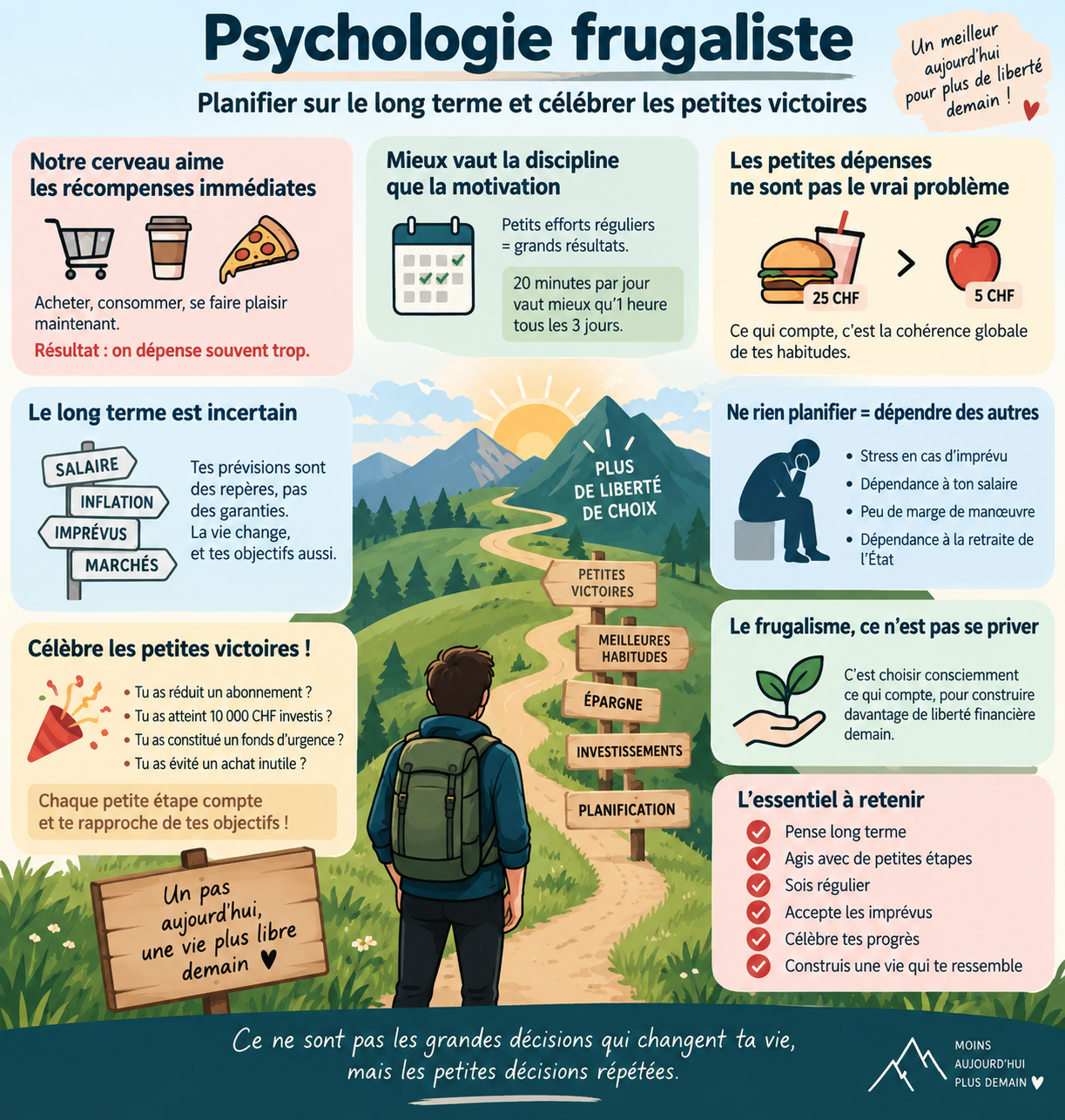
Frugalist Psychology: Planning and Celebrating Small Victories
Recommended products


Introduction: Frugal psychology: planning for the long term and celebrating small victories
Why do some people remain financially stuck despite having a decent salary?
The problem doesn't always stem from income. Sometimes it stems from our way of thinking.
Our brains crave immediate gratification: buying something, ordering food, going on vacation, or simply treating ourselves now. Conversely, saving 200 CHF a month for a goal that will be achieved in ten or fifteen years seems much less exciting.
That's precisely where the frugal psychology comes into play.
Frugalism involves, among other things, accepting to forgo certain immediate rewards in order to build something more important in the long term: a safety net of savings, assets, more freedom or, for some, financial independence.
But there's a catch: If you spend fifteen years waiting for a single major victory, you are likely to find the road particularly long. And you run a serious risk of giving up along the way.
The objective is therefore twofold: plan for the long term and learn to appreciate the small victories along the way.

Short term versus long term
We tend to think that a goal can be achieved quickly if we make enough effort.
And in some cases, that's true.
- Do you want to run a marathon? You can follow a training program for several months.
- Do you want to learn a new skill? You can dedicate several hours a week to your learning.
But personal finances are different.
They depend on many things that you don't control: your salary, inflation, financial markets, unexpected expenses, your family situation, or the professional opportunities that come your way.
Imagine that you decide to invest 1,000 CHF every month to reach 600,000 CHF in several years.
On paper, you can do a nice simulation with an average annual return and get an approximate date.
But in reality, your salary can change. You might have a major medical or car expense. The markets could fall sharply. You might decide to work fewer hours. Or simply change your goals in ten years.
A financial projection is therefore a tool to guide you, but in truth, it is not a promise concerning your future.
This is an important distinction.
Discipline versus motivation
Another essential element of frugal psychology is the difference between motivation and discipline.
Motivation works very well… when it is present.
You can, for example, decide one Monday morning to eliminate all your unnecessary expenses and save 50 % of your salary.
The problem is that this motivation is likely to disappear a few weeks later.
The discipline works differently.
It consists of establishing habits that are simple enough to maintain even when you are not particularly motivated.
Let's take an example.
You want to play sports. You can:
- decide to have a one-hour session every three days
- You can do 20 minutes each day.
The second solution may seem less impressive. However, 20 minutes a day represents approximately 122 hours of exercise over a year.
Indeed, this habit of a few minutes a day allows you to do more than 120 hours of sport per year.
It's exactly the same principle with money.
Saving 500 CHF once can be satisfying. But automatically saving 200 CHF every month for several years can have a much greater impact.
Therefore, frugality relies less on spectacular, temporary sacrifices. It is based primarily on simple habits repeated long enough.
Small, occasional expenses are not the real problem.
This does not mean that every penny should be hunted down.
It's even sometimes counterproductive.
Let's take an example: you go to the supermarket and you refuse to buy fruit because it costs 5 CHF more than planned in your budget.
Then, two hours later, you order a 25 CHF meal because you don't feel like cooking.
In this case, you saved 5 CHF… only to then spend 25 CHF.
In reality, the real challenge is to build a overall coherence in your financial habits.
If you want to become more frugal, ask yourself instead:
- What expenses recur each month?
- Which ones truly add value to my life?
- Which subscriptions do I almost never use?
- Can I reduce certain expenses without significantly decreasing my quality of life?
- Is my savings automated?
For example, cancelling a subscription of CHF 10 per month represents CHF 120 per year.
It's not spectacular. But it's a small improvement that repeats itself automatically.
And if you think about it, saving 120 CHF per year means saving 2,400 CHF over 20 years. That's not insignificant!
Your financial goal may change
There is another thing that financial simulations easily overlook: You will change.
- At 25, you can dream of retiring at 40.
- At 35, you might still want to work, but four days a week.
- At 45, you might prefer to dedicate more money to travel, your family, or a personal project. But continue to work part-time.
In truth, your priorities are changing.
And your finances must therefore be able to evolve with them.
This is why I consider financial independence calculations as reference points, and not like dates set in stone.
Let's take as an example the famous 4 % rule, widely used in discussions around FIRE.
It can serve as a starting point for considering the size of assets needed to finance certain expenses. But it doesn't allow you to know your future precisely.
Financial markets do not move in a steady direction. Future returns are uncertain and your personal circumstances may change.
Planning, therefore, does not mean predicting. Planning means giving yourself a direction and regularly checking if that direction still corresponds to your situation.

Failing to plan anything also has a cost
After reading the previous chapter, you might think that if planning is just a path, why plan at all?
In truth, not planning anything can make you much more dependent on your current income.
Imagine that you earn 5,000 CHF per month and that you systematically spend the 5,000 CHF.
- Everything is fine as long as your salary arrives every month.
- Everything is fine as long as you don't have any unexpected financial problems.
But what happens if your income decreases or if you have an unexpected event?
For example, your car breaks down. A large bill arrives. Your professional activity slows down. You have to take a few months off.
Without savings, every unexpected event immediately becomes a source of stress.
Conversely, having a safety net and a source of income other than your salary gives you more flexibility.
The benefits of frugality begin today
Many people believe that financial freedom is only useful once they are financially free. That is, once passive income pays their bills.
In reality, Frugality is useful from the start.
For example :
- Having enough savings to pay for several months of unemployment
- Having some money on hand in case your car breaks down
- Having 100 CHF per month in passive income is equivalent to a promotion in your job
Every passive income or every CHF saved reduces your dependence on your next salary and gives you a safety margin for unexpected financial situations.
Celebrate the small victories
This is probably the most important point of this article.
Don't make the mistake of waiting for a single big win to be proud of your financial journey.
For example, if your goal is to reach 600,000 CHF invested, waiting until that day to celebrate potentially means waiting decades.
In the meantime, you will have accomplished many important things:
- Create your first emergency fund.
- Repaid a debt.
- Start investing your first CHF.
- Perhaps you will have reached your first 10,000 CHF.
- Reduce your monthly expenses by 100 CHF.
- Generate your first passive income.
All these steps matter.
You can celebrate this victory without destroying your financial effort.
For example, cook a nice meal at home with someone you enjoy. Go for a hike. Treat yourself to an activity you love.
Celebrating a saving of 100 CHF by immediately spending 150 CHF would obviously be counterproductive.
But celebrating 300 CHF of monthly passive income by enjoying a 200 CHF weekend with someone you love? Why not?
The idea is to celebrate your progress without ruining it.

My mistake: Thinking that frugality is a sprint
At the beginning of my own frugal journey, I tended to view financial freedom as the only true victory.
I thought that the day my assets were large enough to cover all my expenses would be the moment I could finally say, "I've succeeded."«
I had forgotten that frugality is a marathon, not a sprint.
In hindsight, I find this way of thinking problematic.
- Why wait twenty years to recognize the benefits of a strategy that is already improving your life today?
- If your savings allow you to pay an unexpected bill without stress, that's already a victory.
- If your investments generate enough to pay a small bill, that's already a victory.
- If your new habits allow you to work a little less or to choose a job that you like more, that is also a form of freedom.
Financial independence is therefore not just a destination. The journey itself can already improve your life.
Conclusion: Plan far ahead, act today
Frugal psychology can ultimately be summarized quite simply.
Think big, but act small repeatedly.
- Set yourself a long-term goal.
- Calculate approximately how much you need to save.
- Automate part of your savings.
- Invest according to a strategy you understand.
- Accept that your predictions may be changed by reality.
And above all, don't despise small victories.
Your goal could be to become financially independent in fifteen, twenty, or twenty-five years.
But your next victory could be much closer:
save an extra 100 CHF this month, cancel an unnecessary subscription, build your first emergency fund or simply manage not to buy something you don't really need.
Long-term success is built through small, repeated decisions.
And the more you learn to appreciate these small steps, the less you feel like you're depriving yourself today for a hypothetical future.

Frugalist Psychology: Planning for the Long Term and Celebrating Small Victories
FAQ – Frugal psychology and long-term vision
What is frugal psychology?
Frugal psychology involves understanding one's consumption behaviors in order to spend more intentionally, reduce excess, and build a more financially free life.
Why does thinking long-term improve finances?
Long-term thinking helps avoid impulsive purchases, promotes saving, and allows you to build stronger financial habits.
Does frugality mean living in deprivation?
No. Frugalism is primarily about optimizing one's resources and eliminating expenses that do not provide real value.
How to develop a frugal mindset?
By analyzing one's expenses, setting clear objectives, and prioritizing future benefits over immediate pleasures.
What is the link between minimalism and frugal psychology?
Minimalism primarily affects objects and the environment. Frugal psychology focuses more on habits, decisions, and the relationship with money.
Frugalist Psychology: Planning for the Long Term and Celebrating Small Victories
Subscribe for the latest news
You have a frugalist or minimalist project and you want a training? Click ”here”.
My pages
- About me
- Saving / Frugalism
- Blog
- Shop
- Contact
- Training and E-book
- Invest
- Minimalism
- My account
- Newsletter
- Basket
- Order confirmation
Lastest Post
- After 10 years of investing in ETFs: which ETF would I choose?
- Financial freedom: why the first 100,000 are the hardest
- The best advice in the world to save
- The Neon bank, the summary
- How does digitalization influence minimalist?
How does this blog live?
Overall, this blog lives on sharing a frugal and minimalist lifestyle.
For a question of transparency towards the readers. All recommended products are in order to make life cheaper, simpler and to promote the essentials.
Basically, my only income with this blog comes:
- Trainings that I realize
- Promo codes for the products I use
- Donations that readers make in exchange for neutral information.
About me
I decided to create this blog to develop and help readers who are looking for a simpler and more economical life.
Compared to before, I was a person who consumed a lot until the day I realized that my consumption made me sadder and poorer 😑
Now I prefer the minimum of my needs to be happy and achieve my financial freedom.
Without realizingI started to focus on saving and investing to depend on a boss for as little time as possible and to speed up my personal projects.
For several years I have felt happy and I have become richer in a way that I would never have imagined given that I have an average salary in Switzerland.
It is for this purpose that I decided to create this blog. In order to share and learn with other people who seek freedom and simplicity 😉
Are you rather minimalist or frugal Jonny?
I am as minimalist as I am frugalist. However, there are situations where I lean more towards an art of life.
To conclude, I think the most important thing is to feel comfortable in your lifestyle 😊
Frugalist Psychology: Planning and Celebrating Small Victories
Frugalist Psychology: Planning and Celebrating Small Victories
Leave a Reply