
We all consume every day, but not all spending is necessary. There's a difference between essential and non-essential spending. Understanding this difference helps you manage your money better and avoid unnecessary expenses. This article will explain how to distinguish between them and why we tend to overspend. 😉
Recommended products


Introduction: Essential or non-essential consumption?
Every day, you make decisions about your money: grocery shopping, paying your rent, taking public transport, buying clothes, or ordering a meal. Some expenses are necessary for your daily life, while others are more about what you want.
Understanding this difference can help you better manage your budget and make more informed decisions.
Need or desire: what's the difference?
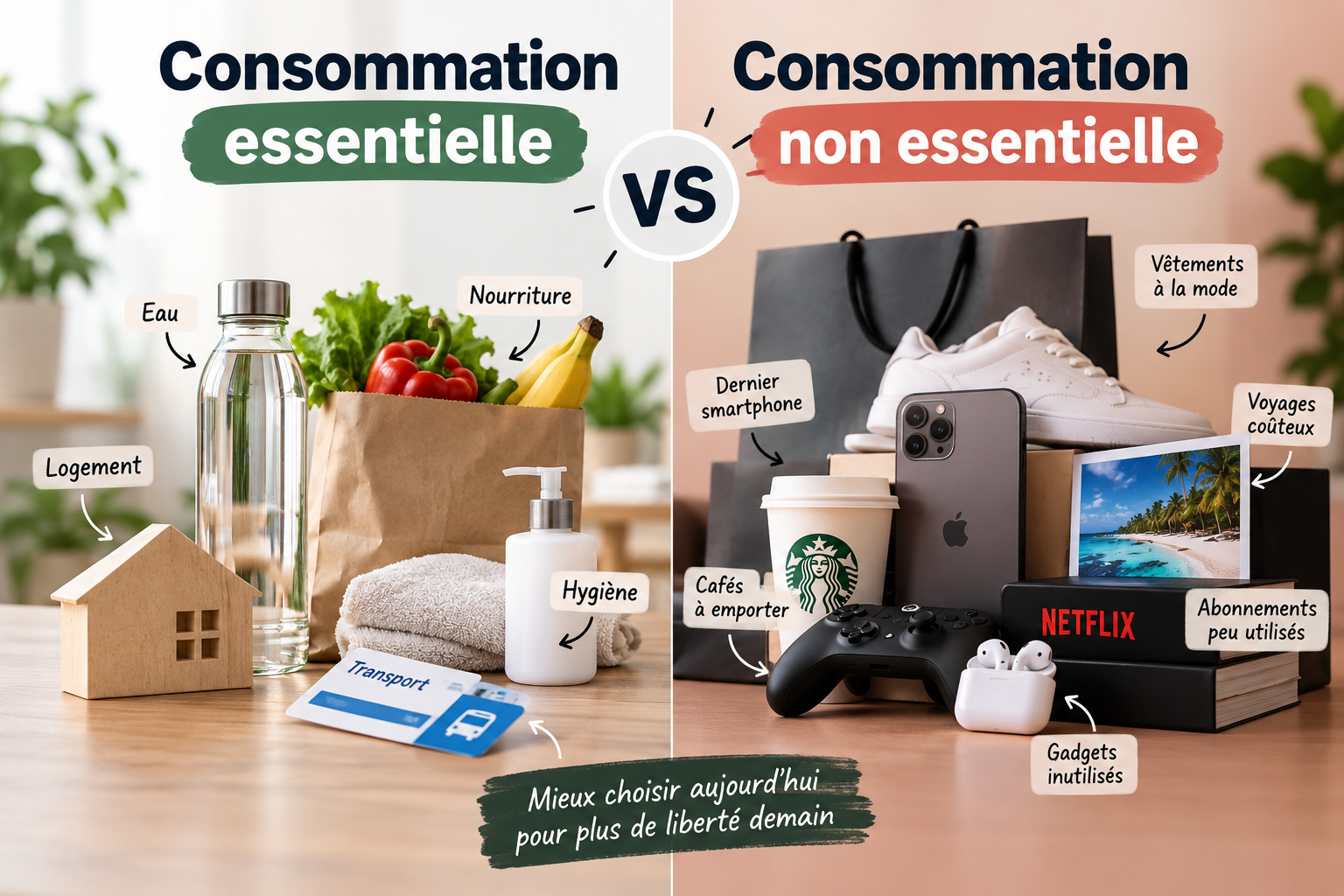
A essential consumption This generally corresponds to an expense necessary for your daily life. It can relate to your housing, food, hygiene, healthcare, energy, or even transportation.
For example, buying food to prepare your meals is a necessary expense. Paying your rent or your transport pass can also be.
Conversely, a non-essential consumption This is more like an expense you could do without without compromising your basic needs.
For example, buying a new smartphone when the one you have still works, subscribing to several streaming services that you rarely use, or regularly buying clothes simply because they are fashionable are expenses you could probably do without.

Why do we sometimes buy more than necessary?
Our consumption decisions do not depend solely on our needs. They can also be influenced by our environment.
Advertising and promotions
Companies use different techniques to attract your attention and encourage you to buy.
You've probably already seen messages like this:
- «"Offer valid until tonight!"»
- «"Buy two, get the third one free!"»
- «"Last few pieces available!"»
- «"-40 % only today!"»
These offers can be attractive when they concern a product you genuinely need. But if you had no intention of buying that product before seeing the promotion, the savings are minimal.
For example, if you buy an item for 70 CHF instead of 100 CHF when you didn't need it, you haven't really "saved" 30 CHF: you've mostly spent 70 CHF.
Social media and influence
Social media can also influence your consumption habits. You can discover new clothes, restaurants, travel, electronic devices, or products presented as essential on a daily basis.
An influencer might, for example, present a new smartphone as particularly appealing. This could tempt you to buy it even if your current phone still perfectly meets your needs.
This doesn't mean that all advertising or recommendations are bad. It's simply helpful to take a few seconds to ask yourself:
«"Did I really want to buy this product before seeing it?"»
The search for immediate gratification
Buying something can provide a feeling of satisfaction. The problem arises when buying regularly becomes a response to boredom, stress, or frustration.
You can then enter a simple cycle:
Desire → purchase → satisfaction → new desire.
This mechanism doesn't mean that every purchase is compulsive or problematic. However, if you frequently buy things you don't need and then regret it, that could be an interesting sign to watch for.

What impact will this have on your budget?
The difference between essential and non-essential consumption becomes particularly important when your budget is limited.
Imagine you win 3,500 CHF per month.
If your accommodation, food, insurance, transport and other necessary expenses amount to CHF 2,500, you have CHF 1,000 left for your other expenses, savings and projects.
You could use these 1,000 CHF in different ways: going out, holidays, shopping, saving or investing.
But if you gradually spend those 1,000 CHF on purchases you hadn't really planned for, you'll have less money for your future projects.
Conversely, reducing certain non-essential expenses can allow you to build up savings.
For example, cancelling three subscriptions of CHF 15 per month represents 45 CHF saved each month, either 540 CHF per year.
The goal is not to systematically eliminate all small expenses. It's more about understanding that Several small, repeated expenses can eventually add up to a significant sum..
Consume less to have more choices
Saving can also give you more opportunities.
Let's say you regularly save 300 CHF per month. After a year, this amounts to 3,600 CHF, not including any interest or returns.
This sum could be used to finance a holiday, build up a safety net, pay for training or fund a personal project.
That's why financial management isn't just about "spending less." It's also about choose what you want to do with your money.
A 100 CHF expense can be very valuable if it addresses a priority for you. Conversely, a 20 CHF expense can be of little value if it's repeated without any real purpose.
How can you better control your purchases?
I will discuss this in other articles.
There are several simple methods to take a step back before consuming.
The 15-day rule
One method is to wait before making an unnecessary purchase.
When you want to buy something, simply note the product and its price in your phone. Then wait 15 days.
For example :
«"Headphones: 180 CHF"»
After two weeks, look at your list. You might find that some of your desires have disappeared.
Calculate the annual cost
For recurring expenses, look at their cost over a year.
A subscription of 12 CHF per month may seem insignificant. However:
12 × 12 = 144 CHF per year.
If you have five similar subscriptions, the bill can quickly exceed several hundred francs.
This method allows for a better visualization of the real impact of certain expenses.
Create a budget
A budget can also help you distinguish between your essential expenses and your discretionary expenses.
You can start simply by grouping your expenses into a few categories:
- accommodation
- food
- transportation
- insurance and charges
- hobbies
- purchases
- savings
- investments
The goal isn't necessarily to control every penny. It's mainly about knowing How much do you spend, on what, and why?.

Minimalism and frugality
Minimalism and frugality are an advantage in distinguishing the essential from the non-essential.
- THE minimalism This involves, in particular, placing more importance on the usefulness and value of possessions rather than their quantity.
- There frugality It consists of using your money thoughtfully and avoiding expenses that bring little value compared to their cost.
Conclusion
Distinguishing between essential and non-essential consumption is not about determining which expenditures are "good" or "bad".
It's mainly about understanding Why do you spend your money and what impact do these expenses have on your budget?.
Before making a purchase, ask yourself a few simple questions:
- Is it a need or a desire?
- Do I really need it now?
- How much will this expense cost me over a year?
- Does this expense align with my priorities?
You don't need to cut out all pleasures to manage your money better. However, learning to postpone certain purchases, comparing their usefulness, and creating a budget can help you to consume more consciously.
Ultimately, the goal is to consume what truly has value for you.

Essential consumption VS Non-essential consumption
Subscribe for the latest news ✍
Do you have a frugalist project and would you like training? Click”here” and filled out the form
I suggest you read my tab”Frugalist” to read the main changes to save and become financially independent as quickly as possible.
My pages
- About me
- Saving / Frugalism
- Blog
- Shop
- Contact
- Training and E-book
- Invest
- Minimalism
- My account
- Newsletter
- Basket
- Order confirmation
Lastest Post
- After 10 years of investing in ETFs: which ETF would I choose?
- Financial freedom: why the first 100,000 are the hardest
- The best advice in the world to save
- The Neon bank, the summary
- How does digitalization influence minimalist?
How does this blog live?
Overall, this blog lives from sharing a frugal and/or minimalist lifestyle.
For the sake of transparency towards readers, all the products recommended are intended to make life cheaper and simpler.
Essentially, my only income from this blog comes from the training courses I conduct, promo codes for products I use, and donations readers make in exchange for neutral information.
About me
Faced with not very effective financial education, as was my case before. I actually decided to create this blog following a change in my life since my early adult life.
Compared to before, I was a person who consumed a lot until the day I understood that my consumption was making me sadder and poorer. From now on, I prioritize the minimum of my needs to be happy and achieve financial freedom.
Without realizing it, I also began to prioritize savings and investments to depend on a boss for as short a time as possible and to accelerate my personal projects.
For several years I have felt happy and I have become richer in a way that I would never have imagined given that I have an average salary in Switzerland.
It is for this purpose that I decided to create this blog. To share, learn and teach with others who seek freedom, simplicity and long-term wealth.
Are you rather minimalist or frugal Jonny?
I am both a minimalist and a frugalist. However, there are situations where I lean more towards an art of living.
To conclude, I think the most important thing is to feel comfortable in your life and I have found a balance between these lifestyles without reaching the extremes.
Leave a Reply