
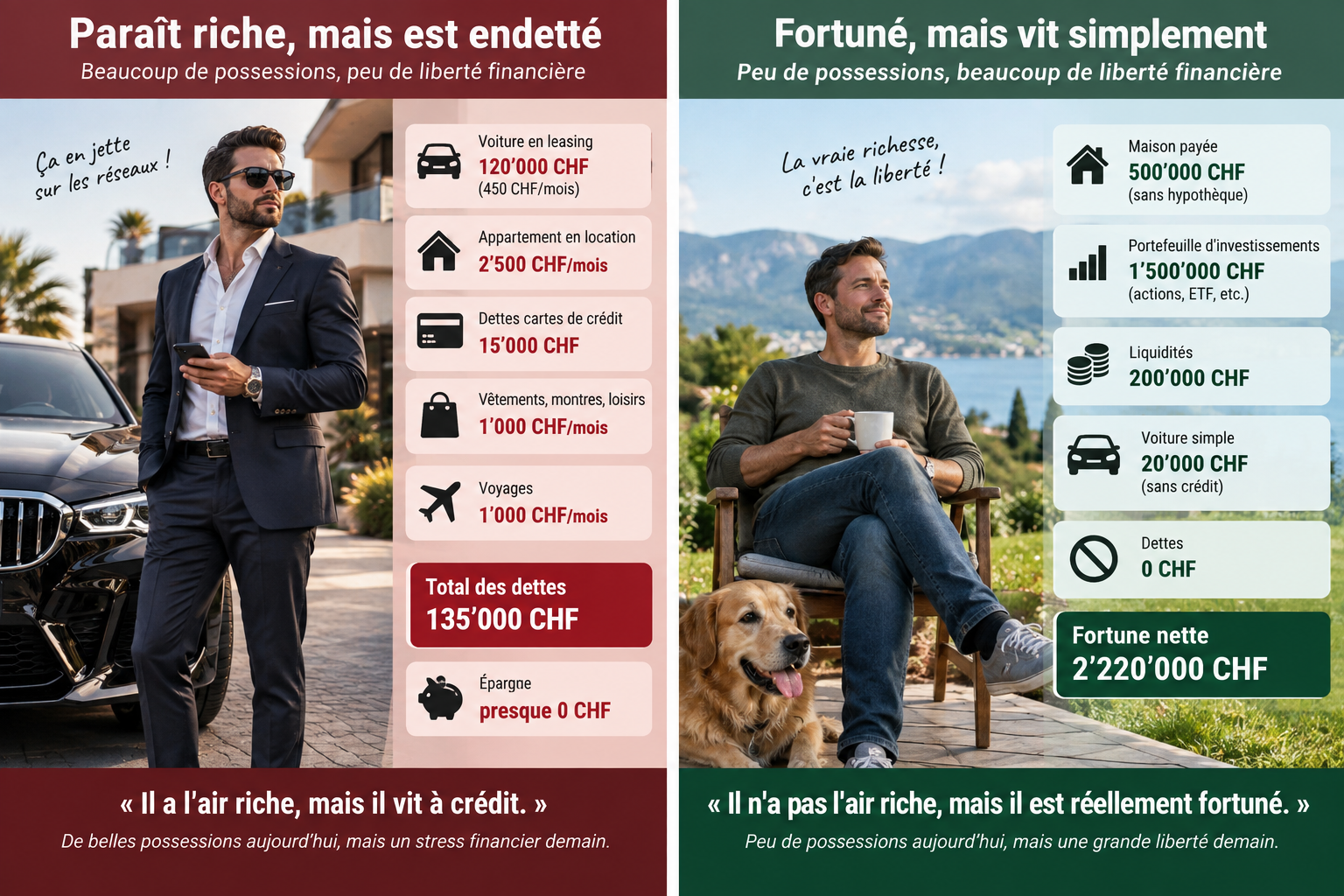
What is the difference between a rich person and a wealthy person? Understanding this distinction is essential for a minimalist and frugal approach to achieving financial freedom.
Recommended products


Introduction: Rich person vs. wealthy person: what is the difference?
When you see someone driving a CHF 150,000 car, living in a large house, and wearing a CHF 30,000 watch, you can easily think:
«"This person is rich."»
But is that really the case? Not necessarily.
A person can have a very luxurious lifestyle while having little wealth. Conversely, a person can possess several hundred thousand francs in savings and investments while living very simply.
This is where the difference needs to be made between appear rich And to be wealthy. And to understand why wealthy people live like the middle class.
Rich and wealthy: two different concepts
There is no universal threshold at which one becomes "rich" or "wealthy." It all depends on the country, the standard of living, and the person with whom you compare your situation.
But to simplify:
- A rich person can be perceived as rich because of her standard of living and possessions.
- A wealthy person possesses significant financial and/or real estate assets, ideally with little debt.
The essential point is therefore the following:
What you hold is not necessarily what you actually possess.
Why? Because debts must be taken into account.
A very simple example
Imagine two people.
Person A:
- car: 100,000 CHF
- house: CHF 500,000
- Outstanding mortgage balance: CHF 450,000
- car loan: CHF 80,000
- savings: CHF 10,000
Person B:
- car: 15,000 CHF
- Apartment: CHF 250,000
- no debt
- Savings and investments: CHF 200,000
One might think that person A is much richer.
Indeed, from the outside, you can see his large house and a luxury car.
But if you look at net worth, the situation is very different.
Person A owns a lot of assets, but a large part of them is financed by debt.
Person B has fewer visible assets, but much more real estate available for consumption.
This is precisely what appearances cannot reveal.
Owning something does not mean being wealthy.
This is probably one of the biggest illusions about money.
We tend to automatically associate:
expensive object = rich person.
But this reasoning doesn't always work.
Today, you can buy a lot of things without actually having the money to pay for them immediately.
For example :
- a car with a lease
- an apartment with a mortgage
- a phone with installment payment
- clothes with a credit card
- vacations paid for in installments
In truth, if you have a relatively high salary, banks allow you to take on large debts. But paying for expensive items while carrying a large debt doesn't make that borrower wealthy.

Example: a car costing 100,000 CHF
Imagine you earn 6,000 CHF per month.
You have 25,000 CHF, but you absolutely want to drive a 100,000 CHF car.
With car financing or leasing, purchasing a car can become possible.
So you could find yourself driving an extremely expensive car while having a debt of 75,000 CHF.
And above all, the car then leads to other expenses:
- monthly payments
- comprehensive insurance
- fuel or electricity
- interview
- taxes
- parking
- depreciation
- etc
The car therefore gives a impression of wealth, but on the contrary, it is an important source of cash outflow.
The problem: most objects lose value
Another fundamental difference between a financial asset and a consumer good concerns its value over time.
Let's take a smartphone bought for 1,000 CHF.
You pay 1,000 CHF today.
But how much will it be worth in a few years?
Probably much less.

The same principle applies to:
- a car
- a computer
- furniture
- clothes
- electronic equipment.
Of course, there are exceptions: certain works of art, watches, collectibles or real estate can increase in value.
But this is not the case for the majority of everyday consumer goods.
In reality, most of the things we buy lose value. And many people don't understand this expense.
Let's take the example of two people
Person A spends 1,000 CHF on a new smartphone.
Person B keeps his 1,000 CHF and invests it in a financial asset.
After several years:
- Person A = smartphone worth 250 CHF
- Person B = their assets are worth CHF 2,000
Person B saw their investment double, while person A saw their smartphone decrease in value by 75 %.
This obviously doesn't mean you should never buy a smartphone. Smartphones can be very useful.
On the other hand, the real reasoning is rather:
When you spend money, you exchange your capital and your working time for a good or service.
Indeed, it is only when you invest your money that you risk increasing its value.
A more telling example: 12 CHF per day
Let's now take a much more mundane example.
Imagine you spend every day:
| Expense | Price |
|---|---|
| Croissant | 3 CHF |
| Soda | 3.50 CHF |
| Biscuit | 3.50 CHF |
| Snack | 2 CHF |
| Total | 12 CHF |
12 CHF seems insignificant.
But :
12 × 30 days = 360 CHF per month
12 × 365 days = 4,380 CHF per year
Over 10 years, without even taking into account any potential return, this represents:
- 43,800 CHF.
Do you understand the problem?
These small, repeated expenses become significant enough to prevent the accumulation of savings or investments.

This is a crucial difference.
- A person who earns little but saves regularly can gradually build up wealth.
- A person who earns a lot but spends almost all of it can end up with very little wealth.
A high salary does not guarantee a large fortune
This topic is often misunderstood.
Imagine two people.
Person A
Salary : 10,000 CHF/month
Expenses : 9,800 CHF/month
Savings: 200 CHF/month
Person B
Salary : 5,000 CHF/month
Expenses : 3,500 CHF/month
Savings: 1,500 CHF/month
Person A earns twice as much. Yet, person B puts 7.5 times more money saved each month.
In the long term, this difference can become considerable.
That is why income and wealth are two different things.
Salary indicates how much you earn. Wealth indicates what you have accumulated.
Fortune is hard to see
That is why it is dangerous to judge someone's financial situation solely based on their appearance.
You can see:
- his car
- his house
- his clothes
- his watch
- his vacation
- his phone
- his restaurants on his social network.
But you don't usually see:
- his bank account
- his investment portfolio
- his debts
- his net real estate assets
- his savings level
- his passive income
- his inherited or passed-on assets
In other words:
Visible wealth is easy to observe. True fortune is much harder to know.
A person can therefore appear extremely well-off while being heavily in debt.
And another woman may seem perfectly ordinary even though she possesses considerable wealth.
The paradox of the discreet millionaire
Imagine a person who owns:
- 1 million CHF in investments
- no debt
- a used car
- a modest apartment
- ordinary clothes
Next to her, another person owns:
- a car worth 150,000 CHF
- a watch worth 30,000 CHF
- luxury clothing
- a high-end apartment
- but 600,000 CHF in debt.
Which one seems the richest?
The second one.
Which one has the largest net worth?
The first one.
Perhaps this is the secret weapon of discreet millionaires: to appear poor and be rich where it really counts.
Why do some millionaires choose to remain discreet?
Having a lot of money doesn't necessarily mean wanting to show it off.
Some millionaires deliberately choose to maintain an appearance similar to that of the middle class. The reasons can be economic, but also personal and social. For example:
Discretion and security
Displaying your wealth can attract attention. A luxury car, an expensive watch, or a large house easily allows others to guess that you have significant assets.
Conversely, an ordinary appearance allows one to remain much more discreet. This can, in particular, limit unwanted attention or reduce exposure to the risks of theft and burglary.
Protecting your family
Some parents also want their children to grow up without being constantly confronted with their family heritage.
They may prefer that their children understand the value of work and money rather than growing up with the idea that everything is automatically accessible to them.
Avoid solicitations
When a person is known to be wealthy, they may receive more requests: loans, investments, gifts, or financial assistance.
Remaining discreet sometimes allows you to maintain more natural relationships with those around you.
Simply loving the simple life
Finally, we must not underestimate a much simpler reason: Some people genuinely enjoy living simply..
If a car costing 15,000 CHF perfectly meets your needs, why spend 100,000 CHF just to have a more prestigious car?
The discreet millionaire may prefer to use his money to buy time, freedom, and security rather than social status.
Ultimately, Having a fortune gives you the opportunity to not have to show it off.
Wealth can be displayed. Fortune, however, can remain completely invisible.

The real objective: to increase one's net worth
If your goal is to build a fortune, you can simplify the reasoning into three steps.
1. Increase your income
The more money you earn, the more potential savings capacity you have.
This can involve:
- a salary increase
- a new skill
- an independent activity
- a company
- additional income
2. Control your spending
Spend as little as possible (but remain reasonable).
It's not about living like a monk.
It is rather a matter of distinguishing:
- what truly gives you value
of
- what you buy simply because you can afford it.
For example, simply cancelling an unnecessary subscription can save you thousands of CHF over 10 years. If your subscription costs, say, 15 CHF and you cancel it, that means a saving of 1,800 CHF over 10 years.
3. Turn your savings into wealth
The money that is not spent can be used to build up a safety reserve and then, depending on your goals and risk tolerance, to invest.
It is this third step that gradually transforms income into wealth.
Rich today or wealthy tomorrow?
Finally, here is the question that summarizes this article.
You can use 50,000 CHF to buy a car.
- You will immediately have something very visible.
- Everyone will be able to see your car.
- But no one will know how much money you have in your account.
- And you will have significant costs to pay
Conversely, you can keep those 50,000 CHF, invest them and continue to drive a 10,000 CHF car.
- No one will necessarily see your assets.
- But financially, you will have retained capital that can generate income.

Conclusion: Don't confuse appearance with heritage
The main difference between a person who looks rich and a person wealthy is included in his net worth.
A person can own a luxurious house, an expensive car, and designer clothes while still having a huge amount of debt.
Another woman may have an ordinary car, modest housing and few luxury items while possessing significant financial assets.
The question is therefore not simply:
«"What does this person own?"»
But most importantly:
«"How much does she actually own after her debts are deducted?"»
This is a fundamental distinction in financial management.
- Consumption helps improve your standard of living.
- Saving and investing allow you to build your wealth.
And the more you manage to find a balance between the two, the more you can gradually increase your financial freedom.
Don't just aim to appear rich. Focus primarily on building wealth that gives you more freedom.
Difference between a rich person and a wealthy person?
Subscribe for the latest news ✍
Do you have a frugalist project and would you like training? Click”here” and filled out the form
I suggest you read my tab”Frugalist” to read the main changes to save and become financially independent as quickly as possible.
My pages
- About me
- Saving / Frugalism
- Blog
- Shop
- Contact
- Training and E-book
- Invest
- Minimalism
- My account
- Newsletter
- Basket
- Order confirmation
Lastest Post
- After 10 years of investing in ETFs: which ETF would I choose?
- Financial freedom: why the first 100,000 are the hardest
- The best advice in the world to save
- The Neon bank, the summary
- How does digitalization influence minimalist?
How does this blog live?
Overall, this blog lives from sharing a frugal and/or minimalist lifestyle.
For the sake of transparency towards readers, all the products recommended are intended to make life cheaper and simpler.
Essentially, my only income from this blog comes from the training courses I conduct, promo codes for products I use, and donations readers make in exchange for neutral information.
About me
Faced with not very effective financial education, as was my case before. I actually decided to create this blog following a change in my life since my early adult life.
Compared to before, I was a person who consumed a lot until the day I understood that my consumption was making me sadder and poorer. From now on, I prioritize the minimum of my needs to be happy and achieve financial freedom.
Without realizing it, I also began to prioritize savings and investments to depend on a boss for as short a time as possible and to accelerate my personal projects.
For several years I have felt happy and I have become richer in a way that I would never have imagined given that I have an average salary in Switzerland.
It is for this purpose that I decided to create this blog. To share, learn and teach with others who seek freedom, simplicity and long-term wealth.
Are you rather minimalist or frugal Jonny?
I am both a minimalist and a frugalist. However, there are situations where I lean more towards an art of living.
To conclude, I think the most important thing is to feel comfortable in your life and I have found a balance between these lifestyles without reaching the extremes.
Difference between a rich person and a wealthy person?
Difference between a rich person and a wealthy person?
Minimalist frugal
Difference between a rich person and a wealthy person?
Leave a Reply