
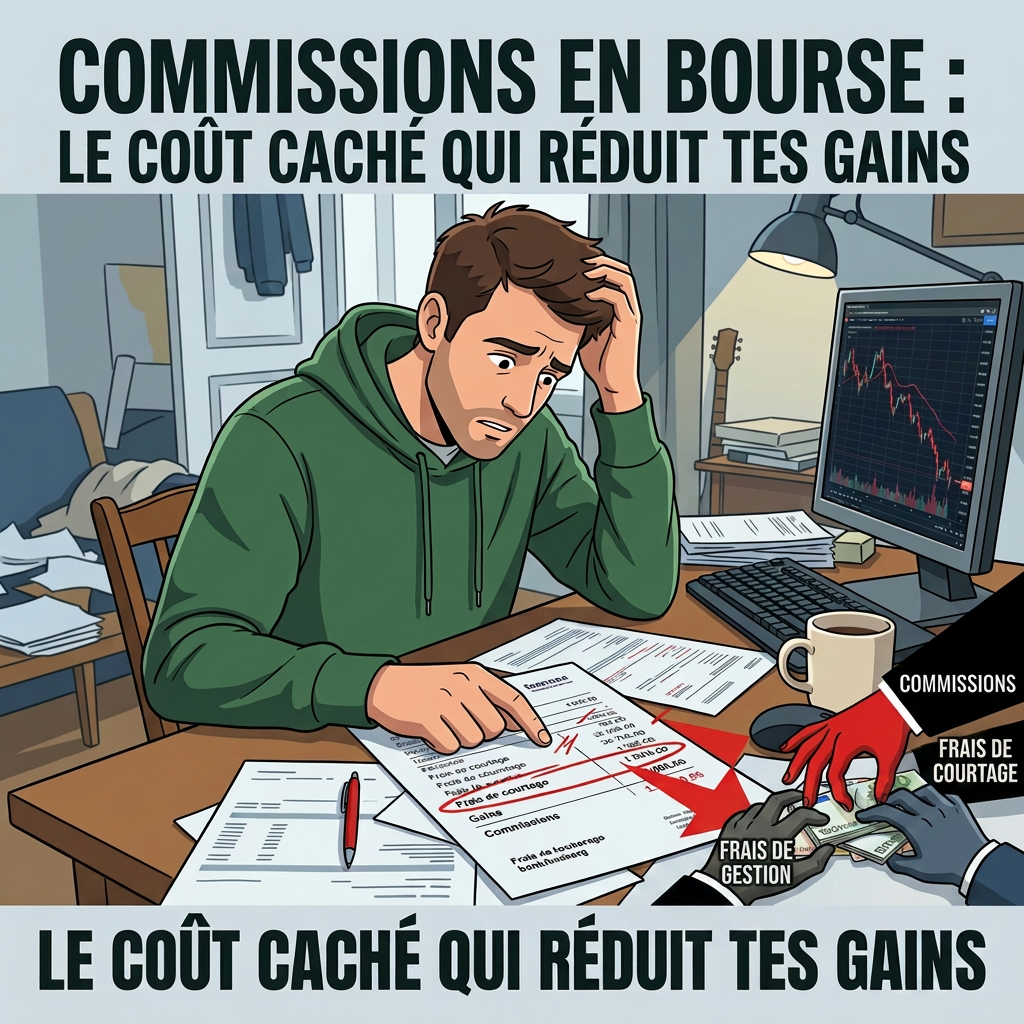
Stock market commissions are often invisible, but they can cost you thousands of francs in the long run. In this article, "Stock Market Commissions: The Hidden Cost That Reduces Your Earnings," discover why choosing low fees is essential to maximizing your returns. !
Recommended products


Introduction: Stock Exchange Commissions
Many beginners are looking for the best ETF, but they forget a much more important element: the costs.
At first glance, a difference in 0.20% or 0.50% seems insignificant.
Yet, Over several decades, these few tenths of a percentage can represent thousands, or even tens of thousands of francs.
In this article, you will understand why commissions are one of the most important criteria when you invest in the stock market.
Fees: the invisible return
When you invest in an ETF, you don't just pay the purchase price.
There are various expenses that gradually reduce your net worth.
The two main costs are:
- there TER, which corresponds to the ETF management fees
- THE broker commissions, paid during purchases or sales.
👉 Taken separately, these costs seem small. However, added together over 20, 30 or 40 years, they can amount to several thousand francs.
What is the TER?
There TER (Total Expense Ratio) represents the annual management fees charged by the ETF manager.
They are used in particular to finance:
- the administration of the fund
- management
- operational costs
Each ETF has management fees and commissions. The TER commission is charged to clients to finance the fund.
The TER (Territorial Expense Ratio) is deducted directly from the fund's performance. Therefore, you never receive an invoice for this fee. However, this fee is taken from your return.
In reality, the fees simply reduce your return each year.
This is why many novice investors don't even realize they are paying this commission.
Why is a low-speed TER (Regional Express Train) so important?
Let's take a deliberately simple example.
Let's assume an initial investment of 5,000 CHF.
Here are the costs after 20 years with different commissions.
| TER | Costs after 20 years* |
|---|---|
| 0,10 % | 100 CHF |
| 0,50 % | 500 CHF |
| 1 % | 1,000 CHF |
*Without taking compound interest into account.
At first glance, the difference already seems significant. But in reality, it is even greater.
Why? Because every franc paid in fees can no longer generate a return.
In reality, you lose money twice if your ETF has a high TER:
- In the annual TER committees of your ETF
- but also the compound interest lost because of the TER commission.
👉 Therefore, don't underestimate TER fees! They influence the profitability of your ETF.
The broker's commissions
The fees are not solely related to the ETF. Your broker also charges commissions.
Let's take an example:
- investment : 200 CHF per month
- duration : 20 years
- annual yield: 5%
| Monthly commission | Final value of your investment after 20 years |
|---|---|
| 3 CHF | 84,023 CHF |
| 5 CHF | CHF 82,995 |
| 10 CHF | 80,936 CHF |
Between 3 CHF And 10 CHF of monthly fees, the difference exceeds 3,000 CHF in 20 years.
Only 7 CHF difference each month are enough to reduce your assets by several thousand CHF after a few years.
👉 That's why choosing a broker is almost as important as choosing an ETF.
What is a cheap stock market account?
A cheap stockbroker account is a broker that allows you to invest while minimizing fees.
In general, several elements need to be compared:
- buying and selling commissions
- currency exchange fees if you invest in another currency
- any potential childcare or inactivity fees
Let's take an example.
You want to invest 500 CHF per month in an American ETF.
Broker A
- 2 CHF commission per purchase
- 0.25% exchange fee
Broker B
- 10 CHF commission per purchase
- 1% exchange fees
Even though both allow you to buy exactly the same ETF, the second broker will cost you much more each month.
Over one or two transactions, the difference seems small. But after several hundred purchases made over 20 or 30 years, it represents several thousand francs in additional fees.
In my opinion, the 3 main criteria for choosing a good brokerage account are:
Low commissions on buying and selling
Here is my personal list regarding the price of buying or selling an ETF
- Less than 2.5 CHF = Good price
- Between 2.5 and 3.5 CHF = Fair price
- More than 3.5 CHF = Price too high
Therefore, I refuse brokers who ask for more than 3.5 CHF to buy an ETF.
Exchange fees included
Most brokers charge currency exchange fees if the ETF is in a currency other than that of the investor.
In my opinion, as long as the total cost (purchase + exchange fees) remains below 3.5 CHF, it is not a problem.
No hidden fees
I always check if the brokerage account has any hidden fees, for example:
- inactivity fees
- account maintenance fees
- commission for receiving dividends
In my opinion, if a broker has fees in addition to commissions for buying or selling ETFs, it is not a reliable brokerage account.

The costs of a pillar 3a
The same reasoning applies to pillar 3a.
A difference of 1% of fees per year seems weak.
However, over an entire career, the consequences are enormous.
According to Viac's simulations*, invest CHF 4,008 per year for 40 years, can represent nearly 90,000 CHF difference between a low-cost solution and a more expensive one.
In other words: It's not just the return that counts. You also have to be able to maintain that return with low costs.
Concrete example: two investors, two very different results
Let's take two investors who follow exactly the same strategy.
They both invest:
- 500 CHF per month
- for 30 years
- with an average yield of 71.3 tons per year
The only difference? The fees.
Investor A: low fees
- ETF with a TER of 0,10 %
- Broker with 2 CHF commission per purchase
- No hidden fees
Investor B: high fees
- ETF with a TER of 0,80 %
- Broker with 10 CHF commission per purchase
- Higher exchange fees and additional charges
Both investors contribute exactly the same amount each month. Yet, year after year, investor B sees a portion of their return disappear into fees.
These fees not only reduce his net worth: they also diminish the compound interest that this money could have generated.
After 30 years, the difference between the two portfolios can represent several tens of thousands of francs.
| Investor A | Investor B | |
|---|---|---|
| TER | 0,10 % | 0,80 % |
| Commission per purchase | 2 CHF | 10 CHF |
| Monthly investment | 500 CHF | 500 CHF |
| Duration | 30 years | 30 years |
| Gross yield | 7 % | 7 % |
| Final Heritage | ≈ 598,085 CHF 📈 Higher | ≈ 521,908 CHF 📉 Several tens of thousands of CHF saved |
The most surprising thing is that this difference does not stem from a better choice of ETF or a higher return.
Both investors purchased the same investment. However, investor A simply paid less in TER (Tax on Expenses) and broker fees.
The difference is significant. In this example, we're talking about over 76,000 CHF earned… by choosing the right brokerage account and the right ETF.
👉 The moral is simple: reducing fees is one of the few levers an investor can control. Every dollar saved today continues to work for you for decades.
How to reduce costs?
Fortunately, a few good habits are all it takes.
I recommend:
- choose ETFs whose TER is less than 0,20%
- Use a broker that charges low commissions (less than 3.5 CHF commission per purchase)
- Use a broker that doesn't have unnecessary fees (inactivity fees, annual commission)
- Avoid buying or selling ETFs unnecessarily.
- to maintain investments over the long term (more than 10 years)
Every commission saved today can represent thousands of extra francs in your pocket in 20 years.

Conclusion
Fees are often invisible, but they are among the most important criteria when investing in the stock market.
To maximize your returns, remember these four essential rules:
- choose an ETF with a low TER (ideally less than 0.20%); ;
- uses a broker with competitive commissions
- avoids unnecessary transactions
- Allow time for compound interest to do its work (preserve your investment for the long term).
A high yield is a great thing… but retaining more of that yield is even more important.
Over 20, 30 or 40 years, a few tenths of a percentage of fees can represent thousands, even tens of thousands of francs. Choosing low fees is therefore one of the most profitable decisions an investor can make.
FAQ: Stock market commissions: the hidden cost that reduces your earnings
Why are commissions important in the stock market?
Commissions directly reduce the return on your investments. Even if they seem small, they accumulate year after year and can represent several thousand francs lost in the long term.
What is the TER of an ETF?
The TER (Total Expense Ratio) represents the annual management fees of an ETF. These fees are automatically deducted from the fund's performance. The lower the TER, the more of your gains you keep.
Which TER should I choose for an ETF?
For passive investing, it is generally recommended to favor ETFs with a TER (Total Efficiency Ratio) lower than 0,20 %. Low management fees allow for improved performance over several decades.
What are the fees for a stock market account?
A brokerage account can incur several types of fees: buy and sell commissions, currency exchange fees, custody fees, inactivity fees, and even certain dividend commissions. It's best to choose a broker that minimizes these costs.
How to choose a cheap stock market account?
A good brokerage account offers low commissions, competitive exchange rates, and no hidden fees. Comparing these different costs can save you thousands of francs in the long run.
Do brokerage fees have a real impact on performance?
Yes. A difference of a few francs per transaction may seem negligible, but repeated every month for 20 or 30 years, it significantly reduces the final value of your portfolio thanks to the effect of compound interest.
Are the fees for a pillar 3a significant?
Absolutely. In a Pillar 3a investment in the stock market, a difference of just 1 % in annual fees can represent tens of thousands of francs in retirement. Choosing a Pillar 3a with low fees is therefore essential.
How to reduce costs when investing in the stock market?
To limit costs, favor ETFs with low TERs, choose a broker with reduced commissions, avoid hidden fees, and keep your investments for the long term. These good habits will help you maximize your wealth over the years.
Stock market commissions: the hidden cost that reduces your earnings
Subscribe for the latest news
You have a frugalist or minimalist project and you want a training? Click ”here”.
My pages
- About me
- Saving / Frugalism
- Blog
- Shop
- Contact
- Training and E-book
- Invest
- Minimalism
- My account
- Newsletter
- Basket
- Order confirmation
Lastest Post
- The best advice in the world to save
- The Neon bank, the summary
- How does digitalization influence minimalist?
- Frugalist Psychology: Planning and Celebrating Small Victories
- Essential consumption VS Non-essential consumption
The purpose of this blog?
The goal of the blog is to help each other lead a simpler life, keep only the essentials and earn money.
How does this blog live?
In reality, this blog lives from sharing a frugal and minimalist lifestyle.
For a question of transparency towards the readers. All recommended products are in order to make life cheaper, simpler and to promote the essentials.
Basically, my only income with this blog comes:
- Training courses that I provide
- Promo codes for products I use (affiliation)
- Donations that readers make in exchange for neutral information.
About me
I decided to create this blog to develop and help readers who are looking for a simpler and more economical life.
Compared to before, I was a person who consumed a lot until the day I realized that my consumption made me sadder and poorer 😑
Now I adopt a minimalist lifestyle to be happy and achieve financial freedom.
Are you rather minimalist or frugal Jonny?
I am as minimalist as I am frugalist. However, there are situations where I lean more towards an art of life.
To conclude, I think the most important thing is to feel comfortable in your lifestyle 😊
Stock market commissions: the hidden cost that reduces your earnings
The impact of commissions in a stock market investment
Leave a Reply