
If you want to own an ETF, there are mainly 2 categories of replication. In this article, we will analyze the differences between a physical ETF and a synthetic ETF.
Recommended products


Physical ETF or synthetic ETF: what are the differences?
When starting out in the stock market, people often compare the fees, performance, or dividends of an ETF. However, another criterion deserves your attention: the replication method.
An ETF can replicate its index in two ways:
- thanks to a Physical ETF
- thanks to a Synthetic ETF
Both pursue the same goal: to replicate the performance of a stock market index. However, they don't use the same method. And this difference can have a significant impact on your stock portfolio.
Let's look at their differences.
What is an ETF?
An ETF (Exchange Traded Fund), also called tracker, is an investment fund that seeks to replicate the performance of a stock market index.
For example :
- S&P 500
- MSCI World
- Nasdaq-100
- STOXX Europe 600
Instead of buying each stock individually, you invest in a single ETF that groups together dozens, or even hundreds, of companies.
So, you track the average return of all the stocks in your ETF.
Why are there several types of ETFs?
Almost all ETFs pursue the same objective: to track an index.
However, the difference lies in how the manager replicates this performance.
There are two main methods:
- physical replication
- synthetic replication
Let's analyze the differences together.
The physical ETF
👉 A physical ETF actually buys the stocks that make up the index.
Let's take an example.
If an ETF tracks the S&P 500, the ETF manager buys shares of the 500 American companies included in that index.
The investor therefore indirectly owns the same companies as the index.
This is the simplest and most transparent method.
Two types of physical ETFs
Not all physical ETFs work in exactly the same way.
There are two replications:
Full replication
The ETF manager buys all the shares in the index.
Example :
ETF S&P 500 = purchase of the 500 companies.
This is the most reliable method.
Sampling
When the index contains several thousand stocks, buying each company becomes expensive.
With a physical ETF sampling, the manager then selects only the most representative stocks.
The objective remains the same: to replicate the performance of the index as closely as possible. But by buying only a portion of the stocks that make up the index.
This method is common on global ETFs, for example, because replicating all actions of a broad index, such as the MSCI World (This index contains thousands of international stocks), would be too costly and complicated because of the large number of stocks in these ETFs.
Thus, the manager selects a representative sample of companies in order to best reproduce the performance of the index, which allows for follow the clue with sufficient accuracy, while reducing costs and simplifying fund management.

Full replication or sampling: which to choose?
If you have a choice, prioritizes complete replication. The ETF buys all the shares in the index, which generally allows its performance to be tracked with the greatest fidelity.
Synthetic ETF
A synthetic ETF works very differently from a physical ETF.
He doesn't necessarily buy the shares in the index. Instead, he signs a financial contract called a swap with a bank.
Thanks to this contract, the bank commits to paying out a similar performance to the index.
The investor therefore obtains market performance without the fund directly owning the shares.
ETF -> Bank Swap Contract -> S&P 500 Performance
What is a swap?
A swap is a contract between the ETF and a bank.
In exchange for various assets held by the fund, the bank guarantees the performance of the tracked index.
The investor sees no difference in their day-to-day operations:
- if the index rises by 10 %, the ETF rises by approximately 10 %; ;
- If the index falls by 15 %, the ETF also falls.
The difference is simply “behind the scenes”.
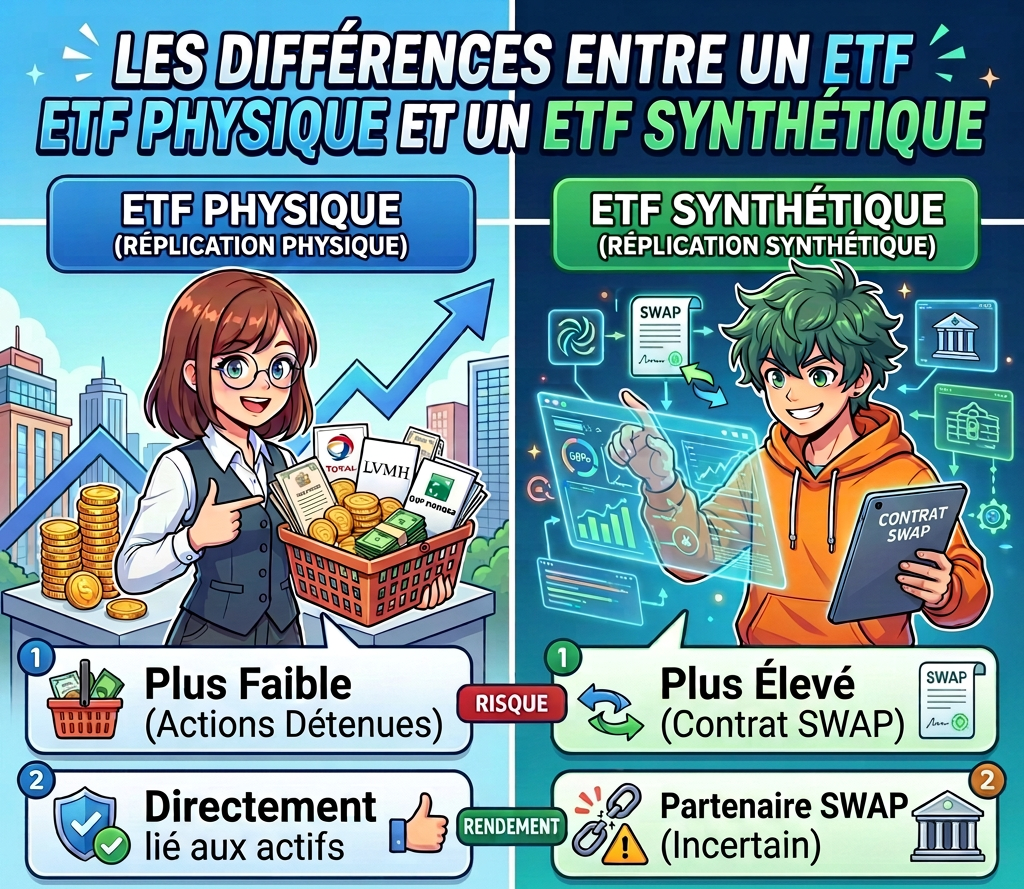
Here is an image to summarize a physical ETF and a synthetic ETF.

Physical or synthetic ETF: which one tracks its index best?
Many believe that a synthetic ETF tracks the index less closely than a physical ETF. But the truth is more debatable.
A synthetic ETF doesn't necessarily track its index less well. In some cases, it manages to track it almost perfectly.
Therefore, there is no universal rule for knowing which replication is best.
In my opinion, to track an index, I favor physical ETFs with a very low TER. But that's just my opinion.
Check the tracking error
If you choose a physical or synthetic ETF, it is important to examine the tracking error history of your ETF.
What is the tracking error The tracking error measures the difference between the performance of the ETF and that of its index.
The lower it is, the more closely the ETF replicates its index.
In truth, ETFs with excessive tracking errors should be avoided.
Contrary to popular belief, a physical ETF does not always have a better tracking error than a synthetic ETF. It all depends on the quality of the fund's management.
The advantages and disadvantages of each ETF
| Physical ETF or synthetic ETF? | |
|---|---|
| Better Transparency | Physical ETF |
| Actually owns the shares | Physical ETF |
| Improved Investment Security | Physical ETF |
| The most used by passive investors | Physical ETF |
| Best ETF for beginners | Physical ETF |
In your opinion, is a physical or synthetic ETF preferable?
In my opinion, A physical ETF is preferable., because:
- The investor actually owns the companies in the ETF (full replication physical ETF)
- Better legal security
- Easier to find and buy
- TER fares are generally lower

However, synthetic ETFs may not be bad.
They can replicate certain markets or certain raw materials.
But in my opinion, If you invest in traditional indices like the S&P 500, MSCI World, or FTSE All-World, a physical ETF will perfectly meet your needs. Plus, it will be more transparent.
How can you tell if an ETF is physical or synthetic?
It's very simple.
You can consult:
- the official factsheet of the ETF
- the DIC (Key Information Document)
- or specialized sites like JustETF or Moning.
The replication method is always indicated.
On the website moning.co for example, it is written next to the title.

Physical ETF vs Synthetic ETF: Is there a difference for dividends?
No.
Whether an ETF is physical or synthetic does not change the distribution of divides.
It all depends on whether the ETF is distributing or accumulating.
Conclusion
The choice between a physical ETF and a synthetic ETF depends primarily on the method used to replicate an index, and not on the quality of the investment.
👉 For the majority of individual investors, a physical ETF is the simplest choice and the best option, thanks to its transparency and easy-to-understand operation.
THE Synthetic ETFs However, they remain an excellent solution in certain specific cases. They can even offer more faithful replication of certain indices through swap contracts.
However, in my opinion, I always prefer physical ETFs to synthetic ETFs.
However, it is important not to forget to analyze other costs such as: the TER, trading fees or the exchange rate.
FAQ: The differences between a Physical ETF and a Synthetic ETF
What is a physical ETF?
A physical ETF is an index fund that actually buys the stocks or assets that make up the index it tracks. For example, a physical ETF on the S&P 500 holds the shares of the companies in that index, either in full or through a representative sample.
What is a synthetic ETF?
A synthetic ETF is a fund that does not necessarily hold the stocks in the index. It uses a financial contract called swap with a bank in order to replicate the performance of the index.
What is the difference between a physical ETF and a synthetic ETF?
The main difference lies in the replication method. A physical ETF buys the index's underlying assets, while a synthetic ETF replicates its performance using a swap contract. Both aim for a similar outcome, but their mechanisms are very different.
Is a synthetic ETF riskier than a physical ETF?
A synthetic ETF presents an additional risk called counterparty risk, because it depends on the bank providing the swap. However, this risk remains limited by European regulations (UCITS), which impose strict guarantees and limits.
Does a physical ETF offer better performance?
Not necessarily. A physical ETF can track its index very closely, but some synthetic ETFs sometimes achieve a tracking error even lower. The quality of replication depends primarily on the ETF manager.
How can you tell if an ETF is physical or synthetic?
You can consult the Factsheet, THE Key Information Document (KID) or specialized sites like JustETF or Moning. The type of replication is always indicated there.
Should we choose full replication or sampling?
When possible, full replication is generally preferable, as it more accurately reproduces the index. Conversely, sampling is often used for very large indices to reduce costs while maintaining similar performance.
Do physical ETFs pay out more dividends than synthetic ETFs?
No. Dividend payments do not depend on the type of replication. An ETF can be physical or synthetic while still being distributing Or capitalizing.
Which ETF should a beginner investor choose?
For most beginner investors, a physical ETF is often the simplest choice. Its operation is more transparent, it is easy to understand, and it is an excellent solution for long-term investing.
Should synthetic ETFs be avoided?
Not necessarily. Synthetic ETFs are perfectly suited to certain situations, particularly for replicating hard-to-access markets or certain commodities. However, for major stock market indices like the S&P 500 or the MSCI World, many investors prefer physical ETFs for their simplicity and transparency.
The differences between a Physical ETF and a Synthetic ETF
Subscribe for the latest news
You have a frugalist or minimalist project and you want a training? Click ”here”.
My pages
- About me
- Saving / Frugalism
- Blog
- Shop
- Contact
- Training and E-book
- Invest
- Minimalism
- My account
- Newsletter
- Basket
- Order confirmation
Lastest Post
- 2nd pillar: The basics to understand
- Top 5 tips to make money from home
- How to invest 1200 CHF – Simplified version
- How to invest on a small budget?
- REIT: Investing in Passive Real Estate
How does this blog live?
Overall, this blog lives on sharing a frugal and minimalist lifestyle.
For a question of transparency towards the readers. All recommended products are in order to make life cheaper, simpler and to promote the essentials.
Basically, my only income with this blog comes:
- Trainings that I realize
- Promo codes for the products I use
- Donations that readers make in exchange for neutral information.
About me
I decided to create this blog to develop and help readers who are looking for a simpler and more economical life.
Compared to before, I was a person who consumed a lot until the day I realized that my consumption made me sadder and poorer 😑
Now I prefer the minimum of my needs to be happy and achieve my financial freedom.
Without realizingI started to focus on saving and investing to depend on a boss for as little time as possible and to speed up my personal projects.
Are you rather minimalist or frugal Jonny?
I am as minimalist as I am frugalist. However, there are situations where I lean more towards an art of life.
The differences between a Physical ETF and a Synthetic ETF
The differences between a Physical ETF and a Synthetic ETF
Leave a Reply