
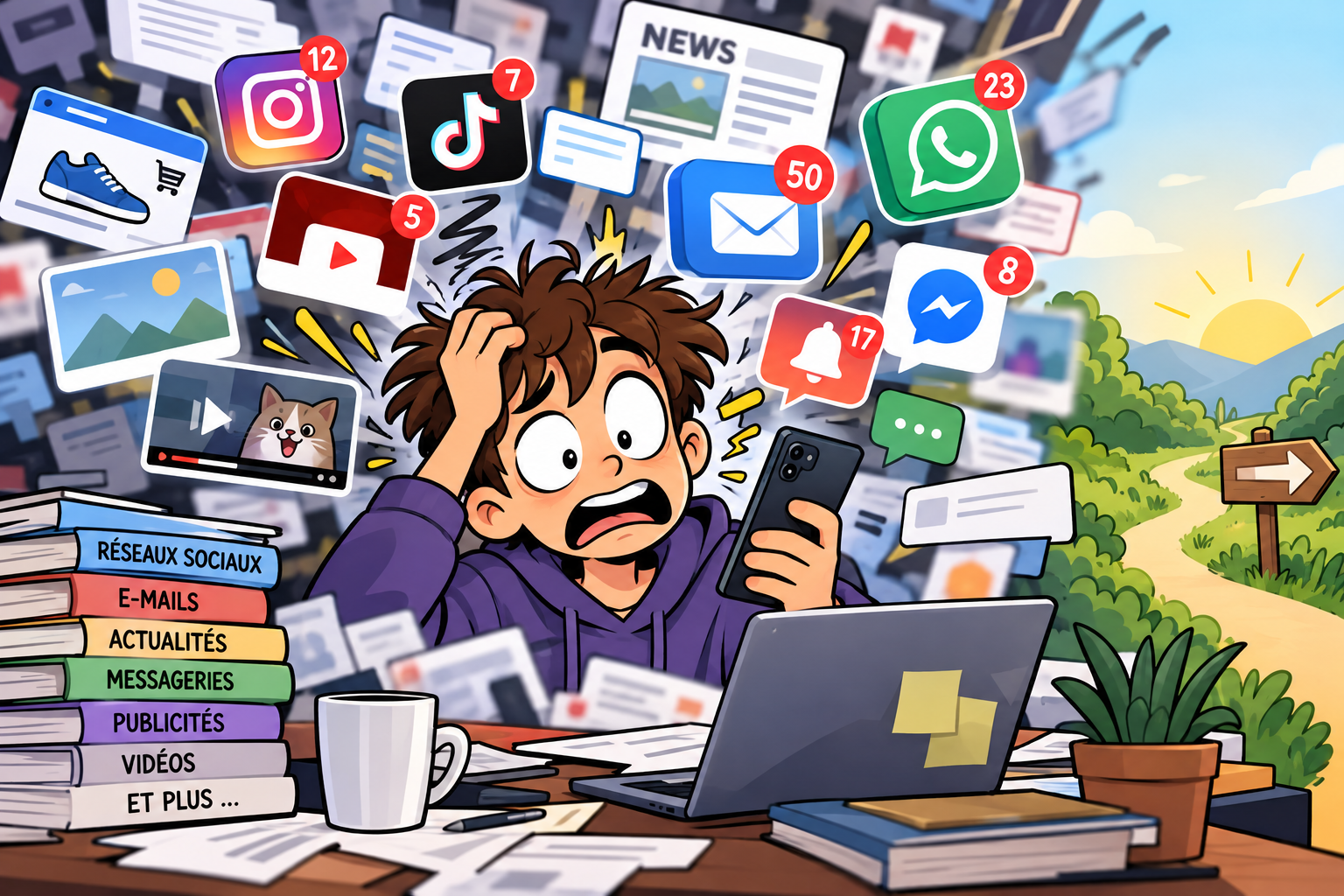
Why are we overloaded with information, and how can we reduce it?
Recommended products


Introduction: Access to information vs. information abundance
Nowadays, we have extremely easy access to information.
In just a few seconds, you can check the weather, watch the news, find a recipe, read an article, watch a video, view a message, or search for the answer to almost any question.
This is obviously a tremendous step forward.
But there is a problem: We have such easy access to information that we often receive far too much of it.
For example, according to a website*, We receive approximately 1,200 advertising messages per day. That's enormous!
And when there is abundance, it becomes necessary to sort.
Imagine you walk into a supermarket and someone gives you hundreds of free products you don't need. Even though these products are free, you'll quickly find yourself with a problem: where to put them? How to choose which ones are actually useful?
It's pretty much the same with information.
We need to learn to select what truly deserves our attention.
This is precisely where minimalist philosophy can help us.
▶ In minimalism, the first step is often elimination. To reduce information overload, you must therefore remove what is not essential.
The goal is not to live without information. The goal is to to receive less unnecessary information so that more attention can be paid to important information.
Every day, we receive a huge amount of information
Even without using the internet or a smartphone, you already receive a huge amount of information during a single day.
For example :
- in the street, with the advertising billboards
- at work, with emails, meetings and professional documents
- in stores, with promotions and advertisements
- in public transport, with posters and announcements
- on television, with the news and advertisements
When you walk down a shopping street, your brain can be exposed to dozens of advertising messages in a matter of minutes.
You didn't ask to know all this information. It just happens to come to you.
And this phenomenon has been considerably amplified with digital tools.

The smartphone: a veritable information machine
The smartphone is probably one of the tools that has most transformed our relationship with information.
Originally, its objective was rather positive: to communicate, work, search for something quickly or facilitate certain tasks.
But Used without limits, it can become a permanent source of demands.
Just look at what can happen in a single day:
- You receive an Instagram notification.
- A few minutes later, an email arrives.
- Then a WhatsApp message.
- Next, a news notification.
- You open your browser to search for something and you see an advertisement.
- You watch a short video… then a second… then a third. (scroll)
- And before you even realize it, twenty or thirty minutes have disappeared.
The problem is therefore not necessarily the smartphone itself.
The problem is the amount of information it allows us to receive at any given time.
Social networks
Social media is particularly effective at keeping us in a constant flow of information.
You can start by looking at a single post for one minute.
Then the algorithm suggests another one.
Then another one.
And yet another one.
Some publications are interesting, but many are of no real importance to your life.
For example, you can spend five minutes watching a funny video about someone you don't even know.
At the moment, it's not a big deal.
But if you repeat this action ten, twenty or thirty times a day, the time spent on useless information becomes considerable.
Emails
Emails are another significant source of overload.
Imagine you receive 50 emails a day.
Even if you only answer some of them, your brain should regularly ask itself:
«"Is this important? Should I reply? Should I keep this message?"»
This small decision, repeated dozens of times, eventually consumes your attention and energy.
Messaging groups
WhatsApp groups or other messaging services can also become very intrusive.
In a group of twenty people, a conversation can generate dozens of messages in a few hours.
And you obviously don't need to read every message immediately.
However, a notification can prompt you to pick up your phone, interrupt your activity and see what's going on.
In truth, the problem is not the message itself, but the time and energy it requires.

Information overload
We are literally bombarded with information every day.
The most surprising thing is that the majority of this information we receive every day is not actually useful to us.
For example :
- an insignificant post on a social network
- an advertisement for a product you don't need
- News that doesn't change anything about your day
- a promotional email
- a conversation in a group that you didn't need to participate in
- a video that you watch simply because it appears in your feed
Information may seem insignificant when it arrives on its own.
But the problem arises when These hundreds of small pieces of information accumulate day after day.
Your brain has to constantly process this information
It is important to understand something: even when you are not consciously memorizing information, your brain often has to give it at least a small amount of attention.
Let's take a very simple example.
- You are working on an important report.
- Your phone is displaying a notification.
- You glance quickly at the screen.
- This is just an insignificant message.
- Then you return to your report.
- But your attention has just been interrupted.
- You now need to find out what you were doing.
If this happens ten or twenty times a day, you can easily understand why you may feel like you are constantly busy without actually making progress on your important tasks.
The problem is therefore not only the amount of information you consume, but also the number of times it interrupts your attention.
What are the consequences of information overload?
Constant exposure to information and solicitations can have various consequences on your daily life.
You may experience, in particular:
- more stress
- difficulty concentrating
- a drop in productivity
- mental fatigue
- difficulties in completing certain tasks
Imagine you are trying to read a book for thirty minutes.
But every five minutes, you look at your smartphone.
Even if each interruption only lasts a few seconds, your reading experience is completely different.
Conversely, if you put your phone on silent and leave it in another room, you can much more easily stay focused on your book.
Reducing unnecessary information is therefore also a way to protect your attention.
And your attention is a limited resource
Minimalism applied to information
This is where minimalism becomes particularly interesting.
Minimalism is generally known for its principles concerning objects:
owning less in order to enjoy more of what really matters.
But why not apply exactly the same principle to information?
You can start very simply.
Ask yourself:
«"Is this information actually useful to me?"»
For example :
- Do I need to receive a notification for each new post?
- Do I need to watch the news several times a day?
- Do I need to receive all the promotions from a store?
- Do I need to be notified immediately when an email arrives?
The answer will often be no.
You can then delete unnecessary notifications, unsubscribe from newsletters you never read, leave certain groups and limit the time spent on social media.
The goal is not to completely remove your smartphone.
On the contrary.
A smartphone used correctly can be a great tool for saving time.
The real objective is to ensure that You should be the one using your smartphone, not the other way around.

Conclusion: Less information for more time
The main objective of this article is to make you aware of a problem that has become almost normal in our society:
We receive too much information.
And the smartphone considerably amplifies this phenomenon.
Every notification, every email, every video and every post can seem insignificant.
But their accumulation can gradually invade your attention and your time.
The minimalist solution, therefore, consists of starting with eliminate.
- Delete the information you don't need.
- Disable unnecessary notifications.
- Reduce the number of apps that waste your time.
- Choose the information you actually want to receive.
And above all, don't forget that You don't need to know everything. What you really need to know is what's important to you.
👉 Less information. Fewer distractions. Less screen time. More focus, more time, and more life.
Subscribe for the latest news
You have a frugalist or minimalist project and you want a training? Click ”here”.
My pages
- About me
- Saving / Frugalism
- Blog
- Shop
- Contact
- Training and E-book
- Invest
- Minimalism
- My account
- Newsletter
- Basket
- Order confirmation
Lastest Post
- The Dangers of Newsletters for Minimalists
- Is your search engine compatible with minimalism?
- Avoid distractions: Limit unnecessary notifications
- Smartphone: how to avoid information overload and save time?
- Why are we overloaded with information and how can we reduce it?
How does this blog live?
Overall, this blog lives on sharing a frugal and minimalist lifestyle.
For a question of transparency towards the readers. All recommended products are in order to make life cheaper, simpler and to promote the essentials.
Basically, my only income with this blog comes:
- Trainings that I realize
- Promo codes for the products I use
- Donations that readers make in exchange for neutral information.
About me
I decided to create this blog to develop and help readers who are looking for a simpler and more economical life.
Compared to before, I was a person who consumed a lot until the day I realized that my consumption made me sadder and poorer 😑
Now I prefer the minimum of my needs to be happy and achieve my financial freedom.
Without realizingI started to focus on saving and investing to depend on a boss for as little time as possible and to speed up my personal projects.
For several years I have felt happy and I have become richer in a way that I would never have imagined given that I have an average salary in Switzerland.
It is for this purpose that I decided to create this blog. In order to share and learn with other people who seek freedom and simplicity 😉
Are you rather minimalist or frugal Jonny?
I am as minimalist as I am frugalist. However, there are situations where I lean more towards an art of life.
To conclude, I think the most important thing is to feel comfortable in your lifestyle 😊
How to Eliminate Information Overload?
Leave a Reply