
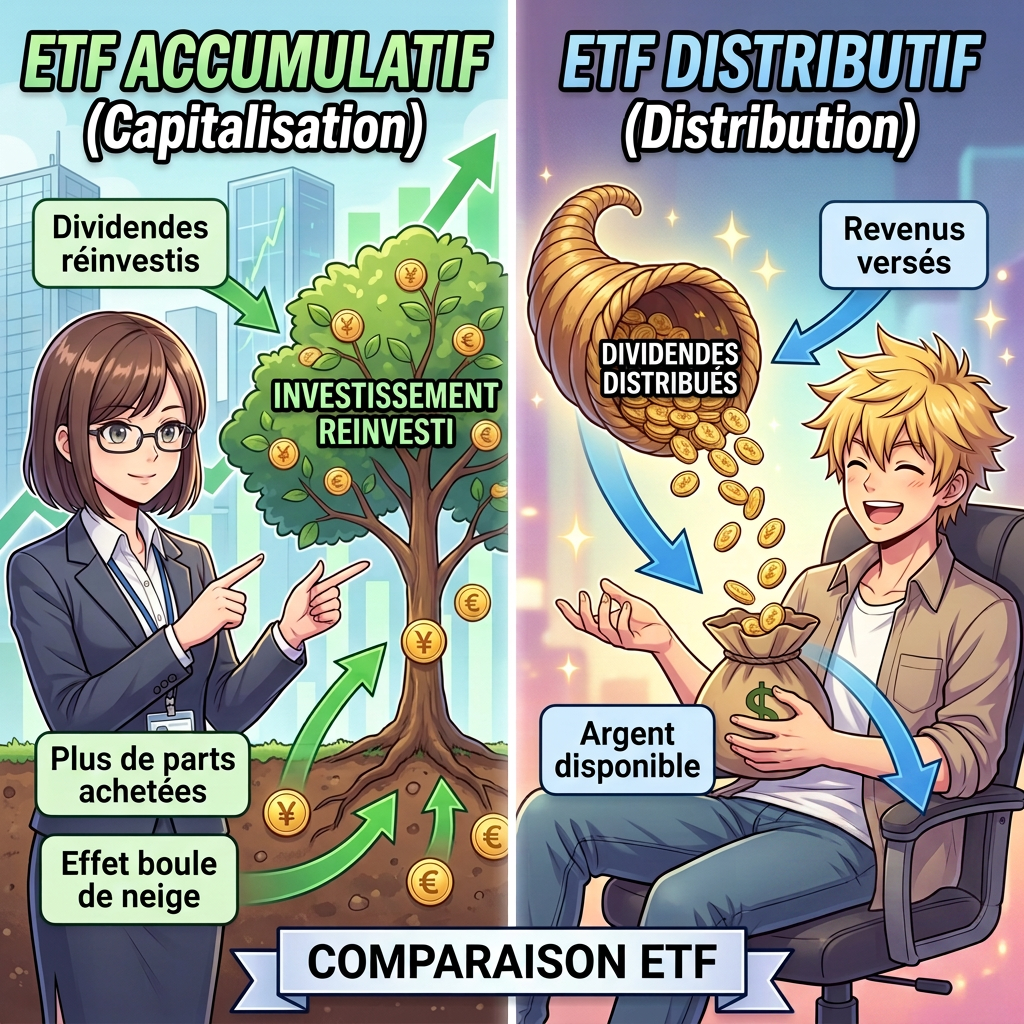
When you invest in an ETF, you must choose between an accumulating ETF and a distributing ETF. This article, Accumulating vs. Distributing ETFs: Advantages, Disadvantages, and Taxation, will help you do just that., This presents the differences between these two types of ETFs to help you choose the one that best suits your investment strategy.
Recommended products


Introduction: Distributive or accumulative ETF
When you invest in an ETF, you can usually choose between two versions :
- A Accumulator ETF (Acc) ;
- A Distributive ETF (Dist).
At first glance, these two ETFs appear identical. However, they do not distribute dividends in the same way.
In this article, you will discover:
- The difference between an accumulating and a distributing ETF
- which one is the most profitable
- Which one to choose depending on your goal?
- if there is a tax advantage
What is an accumulative or distributive ETF?
First of all, let us remember that an ETF is a basket of stocks that follows a stock market index, such as the S&P 500, the MSCI World or the Nasdaq-100.
In the ETF, the companies held pay dividends.
In reality, The only real difference between an accumulating ETF and a distributing ETF is the way dividends are distributed.
Accumulator ETF (Acc)
An accumulating ETF don't pay the dividends into your account. Instead, it automatically reinvests them in the fund. And your fund increases in value.
In other words, your investment grows without you needing to do anything, because the dividends are automatically redistributed within the ETF.
This is the principle of compound interest: dividends themselves generate new dividends over time.
👉 With an accumulating ETF, you do not receive money in your account.

Distributive ETF (Dist)
A distributing ETF does exactly the opposite.
Dividends are paid directly into your securities account.
With your dividend received, you can then, for example:
- Spend on your hobbies
- Reinvest in the same ETF
- Buy another ETF
👉 In this case, you have more freedom to decide what you do with your dividends.

Simple Example
Let's imagine you own €1,000 of an ETF that distributes €30 in dividends.
| Accumulating ETF | Distributing ETF |
|---|---|
| ETF value: €1,030 | ETF value: €1,000 |
| Dividends received: €0 | Dividends received: €30 |
In both cases, your assets are worth 1 030 €.
The only difference is where the dividends are located.
With a distributing ETF, you receive 30 € in your account, whereas with an accumulating ETF, the ETF increases by 30 € and you don't receive any dividends in your securities account.
This is the point that many beginners don't understand.

Does an accumulating ETF yield higher returns?
It all depends on what you do with a distributing ETF.
If you systematically reinvest all dividends from a distributing ETF, the performance will be almost identical to that of an accumulating ETF.
The accumulating ETF is simply more convenient if you want to accumulate wealth, since it performs this reinvestment automatically.
A distributing ETF is more practical if you want to receive a regular passive income.
Which ETF should I choose?
It depends on your goal.
Choose an accumulating ETF if you:
- invested for the long term
- wish to maximize the growth of your assets
- don't want to reinvest the dividends yourself
- I do not want passive income in the short term
Choose a distributing ETF if you:
- wish to receive a regular passive income
- prepare for retirement in the near future
- You want to decide for yourself where to invest your dividends

Taxation differences between a distributing ETF and an accumulating ETF
There is a lot of discussion on the internet about optimizing dividend taxation via a distributing ETF or accumulating ETF.
In Switzerland, the choice between an accumulating and distributing ETF generally does not change not the taxation of dividends.
Even if an accumulating ETF does not pay dividends into your account, these dividends generally remain taxable.
In other words, choosing an accumulating ETF does not allow you to avoid dividend tax.
However, tax rules vary depending on the country of residence.
How to distinguish between an accumulative and a distributive ETF?
It's usually very simple.
Most transmitters indicate directly:
- Acc = Accumulating
- Dist = Distributing
If it is not specified, look at the official factsheet.
It will be written:
- Accumulating
Or
- Distributing
Beginner mistakes
I often see these mistakes made by beginners in the stock market:
❌ Thinking that an accumulating ETF yields more
Many beginners think that an accumulating ETF is more profitable, simply because it automatically reinvests dividends.
In reality, it is not the distribution method that increases yield.
If you reinvest the dividends of a distributing ETF yourself, you will generally obtain a performance very close to that of an accumulating ETF.
👉 The difference is therefore primarily practical: an accumulating ETF automatically reinvests dividends for you, while a distributing ETF distributes dividends into your cash account..
❌ Believing that dividends are “free” money”
This is probably one of the most widespread misconceptions.
When a company pays a dividend, it does not create additional wealth.
In reality, it is simply distributing a portion of its cash reserves to its shareholders. In return, the value of the company (and therefore of the stock or ETF) generally decreases by the same amount.
For example, if a stock is worth 100 € and pays a dividend of 5 €, his course will often open around 95 € the day the dividend is detached.
In other words, it's like having 100 euros in your bank account, going to an ATM and withdrawing 10 euros. You'll have 90 euros left in your account and 10 euros in cash.
👉 A dividend does not make you richer: it simply means that part of the value of your investment is converted into cash.
❌ Thinking that a distributing ETF performs worse
Some investors believe that a distributing ETF underperforms because it pays out dividends instead of reinvesting them.
In reality, it all depends on what you do with those dividends.
If you spend them, your wealth will indeed grow more slowly. However, if you systematically reinvest them in the same ETF or in another investment, the overall performance will generally be very close to that of an accumulating ETF.
👉 It is not the distributing ETF that performs less well, but the fact of not reinvesting dividends.
❌ Forgetting that dividends can be taxable
Many shareholders believe that accumulating dividends are not taxable because the dividends are not paid into the cash account.
Governments aren't that stupid…
In some countries, this technique may be feasible. But this is not the case in many countries.
In Switzerland, for example, dividends generally remain taxable in the same way, even when they are automatically reinvested by an accumulating ETF.
👉 Just because you don't see dividends deposited into your account doesn't mean they're tax-free. It's therefore important to check the tax rules of your country of residence.

Conclusion
If you're looking to grow your wealth over several decades, I would recommend a Accumulating ETF : dividends are automatically reinvested and you fully benefit from compound interest.
Conversely, if your sole objective is to generate a regular income, a Distributing ETF will often be more suitable*.
With regard to taxation, in many countries there is no difference between a distributing ETF and an accumulating ETF.
👉 In practice, both versions can offer very similar performance. The best choice depends primarily on your investment objective and how you plan to reinvest or spend dividends.
FAQ – Accumulator vs. Distributor ETFs: Advantages, Disadvantages, and Taxation
What is the difference between an accumulating ETF and a distributing ETF?
An accumulating ETF (Acc) automatically reinvests dividends in the fund, while a distributing ETF (Dist) pays dividends directly into your investment account. The main difference, therefore, lies in how the dividends are used, not in the ETF's composition.
Is an accumulating ETF more profitable than a distributing ETF?
Not necessarily. If you systematically reinvest the dividends from a distributing ETF, the performance will generally be very close to that of an accumulating ETF. Accumulating ETFs are simply more practical for long-term investors because reinvestment is automatic.
Should you choose an accumulative or distributive ETF?
It all depends on your goal. If you want to grow your wealth over the long term, an accumulating ETF is often more suitable. If you prefer to receive a regular passive income, a distributing ETF might be a better choice.
Do accumulating ETFs pay dividends?
Yes. The companies held in the ETF do pay dividends. The difference is that these dividends are automatically reinvested in the fund instead of being paid into your account.
Are distributing ETFs underperforming?
No. A distributing ETF isn't inherently less efficient. However, if you spend the dividends instead of reinvesting them, your net worth will generally grow more slowly than with an accumulating ETF.
Are dividends from accumulating ETFs taxable?
In many countries, yes. In Switzerland, for example, dividends are generally still taxable even when automatically reinvested in an accumulating ETF. It's advisable to check the applicable tax laws in your country of residence.
How to distinguish between an accumulative and a distributive ETF?
Most transmitters indicate directly Acc (Accumulating) or Dist (Distributing) in the ETF name. If not specified, the information is available in the fund's official factsheet.
Can a distributive ETF be transformed into an accumulative ETF?
No. They are two different funds. If you wish to change the dividend distribution method, you will generally have to sell your current ETF and then buy the corresponding accumulating or distributing version.
Do accumulative ETFs benefit from compound interest?
Yes. Because dividends are automatically reinvested, they themselves generate new dividends and contribute to portfolio growth over the years. This is one of the main advantages of accumulating ETFs for long-term investment.
Which ETF should I choose to prepare for retirement?
If you're still far from retirement, an accumulating ETF is often preferred to maximize capital growth. As retirement approaches, some investors prefer distributing ETFs to receive a regular income through dividends.
Accumulating vs. distributing ETFs: advantages, disadvantages, and taxation
Subscribe for the latest news
You have a frugalist or minimalist project and you want a training? Click ”here”.
My pages
- About me
- Saving / Frugalism
- Blog
- Shop
- Contact
- Training and E-book
- Invest
- Minimalism
- My account
- Newsletter
- Basket
- Order confirmation
Lastest Post
- The best advice in the world to save
- The Neon bank, the summary
- How does digitalization influence minimalist?
- Frugalist Psychology: Planning and Celebrating Small Victories
- Essential consumption VS Non-essential consumption
How does this blog live?
Overall, this blog lives on sharing a frugal and minimalist lifestyle.
For a question of transparency towards the readers. All recommended products are in order to make life cheaper, simpler and to promote the essentials.
Basically, my only income with this blog comes:
- Trainings that I realize
- Promo codes for the products I use
- Donations that readers make in exchange for neutral information.
About me
I decided to create this blog to develop and help readers who are looking for a simpler and more economical life.
Compared to before, I was a person who consumed a lot until the day I realized that my consumption made me sadder and poorer 😑
Now I prefer the minimum of my needs to be happy and achieve my financial freedom.
Without realizingI started to focus on saving and investing to depend on a boss for as little time as possible and to speed up my personal projects.
As a result, I am getting richer in a way that I never imagined since I have an average salary in Switzerland.
What is the purpose of this blog?
The goal is to share and learn with others who seek freedom and simplicity 😉
Are you rather minimalist or frugal Jonny?
I am as minimalist as I am frugalist. However, there are situations where I lean more towards an art of life.
To conclude, I think the most important thing is to feel comfortable in your lifestyle 😊
Leave a Reply