
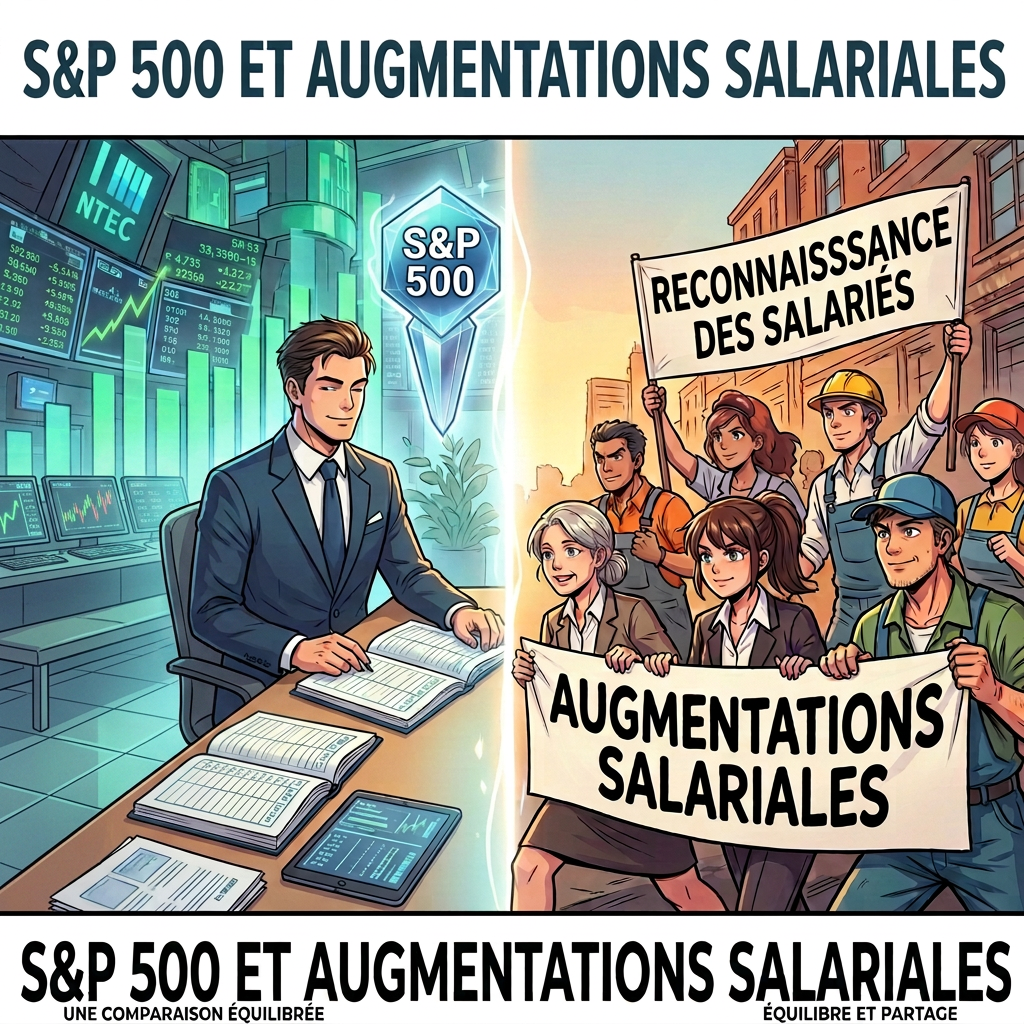
Throughout our careers, our wealth evolves in various ways. We can increase our income through our work or through investing. But what grows our wealth most rapidly in the long term? A salary increase of a few percent per year or the financial markets? In this article, S&P 500 vs. Salary Increases: Who Earns More? I compare a salary increase of 2,130 per year at the historical growth of the S&P 500 to see the differences between these two approaches to wealth creation.
Recommended products


⚠️ This article contains past data that are not guarantees for the future. Investing involves a risk of losing money!
Introduction: S&P 500 vs. Salary Increases: Who Earns More?
We all like to receive a raise. But an interesting question arises: In the long run, is it more profitable to get salary increases or to invest your money in the stock market?
At first glance, an increase of a few percent each year may seem attractive and more profitable. But when compared to the power of compound interest over several years, the difference can become considerable.
To try and answer this, let's compare two fictional situations.

⚠️ Attention : This comparison uses historical data. Past performance is not indicative of future results. Investing in the stock market involves a risk of capital loss.
Simulation: Salary increase vs. S&P 500
Let's imagine two people: Rock And Jacques.
Five years ago, Pierre:
- winning 65,000 $ per year
- He then received a salary increase of 2 % per year
Jacques, for his part:
- had 65,000 $ that he invested in an ETF replicating the S&P 500 (VOO)
- He didn't add any new money and simply let his investment grow.
The question is therefore simple: Who earned the most money after five years?
Pierre: a salary increase of 2.13T per year
Let's start with Pierre.
With an increase in 2 % each year, His salary is gradually increasing:
| Year | Annual salary | Cumulative winnings vs 65,000 $ |
|---|---|---|
| Departure | 65,000 $ | — |
| 1 | 66,300 $ | 1,300 $ |
| 2 | 67,626 $ | 2'626 $ |
| 3 | 68,978 $ | 3,978 $ |
| 4 | 70,358 $ | 5,358 $ |
| 5 | 71,765 $ | 6'765 $ |
After five years, Pierre therefore earns approximately 6,765 $ more per year than initially. But if we add up all the raises received over the five years, the total cumulative gain is approximately 19,500 $.
Jacques: What would have happened with the S&P 500?
Let's now turn to Jacques.
He invested the same 65,000 $, but in a VOO ETF replicating the S&P 500.
To illustrate this simulation, let's take the annual performances from 2019 to 2023:
| Year | Performance |
|---|---|
| 2019 | +31,46 % |
| 2020 | +18,35 % |
| 2021 | +28,66 % |
| 2022 | -18.15 % |
| 2023 | +26,25 % |
Something important is immediately apparent: Stock market performance is much more erratic than a salary increase.
The portfolio can grow significantly in some years, then lose some of its value the following year. However, over this specific period, the 65,000 $s would have increased considerably!
With annual returns capitalized, the capital would have reached approximately 120,000 $, resulting in a total gain of approximately 55,000 $.
Therefore, the American stock market would have largely exceeded Pierre's 19,500 cumulative increases over this period.
But before saying "”The S&P 500 is better than salary increases.’‘'Let's analyze this comparison as a whole.
Past performance may change
To say that "the S&P 500 has returned much more than 2 % per year" is historically true over certain periods. But the result depends heavily on the period chosen.
Between 2019 and 2023, for example, the S&P 500 experienced several exceptionally strong years. However, other periods were much less favorable.
The end result will be very different if you start investing before or after a sharp rise in the markets.
A serious comparison should ideally be tested over several periods: 5 years, 10 years, 15 years, or even more.
So why not compare over 15 years?
15 years of comparison
The VOO ETF, which tracks the S&P 500, was created at the end of 2010. So I compared the period from January 2011 to December 2025, i.e. 15 years.
| Year | Total VOO yield |
|---|---|
| 2011 | +2,09 % |
| 2012 | +15,98 % |
| 2013 | +32,33 % |
| 2014 | +13,63 % |
| 2015 | +1,35 % |
| 2016 | +11,93 % |
| 2017 | +21,78 % |
| 2018 | -4.42 % |
| 2019 | +31,46 % |
| 2020 | +18,35 % |
| 2021 | +28,66 % |
| 2022 | -18.15 % |
| 2023 | +26,25 % |
| 2024 | +24,98 % |
| 2025 | +17,84 % |
VOO Historical Data — Vanguard
Over the entire period, these performances represent an annualized compound return of approximately 14.0 % per year.
Let's imagine a person who invests 65,000 $ subscriptions in VOO at the beginning of 2011, without adding any money and by reinvesting the dividends.
After 15 years, the 65,000 $s would have become approximately… 465,500 $.
For comparison, if we analyze only the money earned regarding the salary increases of 2 % per year During the 15 years, the employee would have earned only about… 86,000 $.
| After 15 years | Amount |
|---|---|
| Starting salary | 65,000 $ |
| Earnings obtained | ≈ 86,500 $ |
The difference is spectacular.
With a VOO ETF, the investor would have earned approximately USD 400,000, while the employee would have only obtained approximately USD 86,000 with his raises.
| Amount after 15 years | |
|---|---|
| VOO S&P 500 ETF | 465,000 $ |
| 2% of annual salary | ≈ 86,500 $ |
However, it's important to keep in mind that we are comparing here invested capital with a salary income These are not two identical investments.
Swiss salaries vs S&P 500: what happened between 2011 and 2025?
According to SECO data based on the Swiss Wage Index from the FSO, the Nominal wages in Switzerland have increased on average by about 0.9 per year over the period 2010–2025.
For comparison, the VOO, which tracks the S&P 500, has recorded a total annualized return of approximately 14 % per year, dividends included.
The difference is therefore considerable:
| Between 2011 and 2025 | Wage increase in Switzerland | S&P 500 / VOO |
|---|---|---|
| Average annual growth | ≈ 0.9 % | ≈ 14 % |
| Period analyzed | 15 years | 15 years |
| Dividends included | — | Yes |
| Return after 15 years (starting at 65,000)* | ≈ 74,400 | ≈ 465,000 |
| Nature | Income from work | Capital invested |
* Theoretical simulation: 65,000 CHF/$ increased or invested for 15 years, without taking into account taxes, fees, inflation or exchange rate differences.
This helps to better understand why Capitalization can have a significant long-term impact.. In truth, average wages have not kept pace with the growth of the S&P500 (not by a long shot).
But be careful: 14 % is not a guaranteed yield, nor even a "normal" return every year. VOO has experienced very positive years, but also negative years, such as 2022 with a decrease of 18.15%.
From a tax perspective, should we favor wage increases or stock market growth?
Taxation makes the comparison even more complicated.
In Switzerland, in particular, a distinction must be made income And fortune.
- A salary constitutes taxable income.
- Holding shares or ETFs falls into the category of taxable wealth.
- Dividends are considered taxable income.
The exact situation depends, however, on the canton, personal circumstances, income, deductions and the nature of the investments.
Example: Salary vs. stock market assets
Let's simply take an illustrative example from the canton of Vaud.
A single person, without children, living in Nyon.
Let's imagine two situations:
- Salary earnings of CHF 65,000
- An ETF with 65,000 CHF of financial assets, without receiving a salary.
In the simulation performed with VaudTax, the taxed amounts were very different:
| Simulated situation | Tax |
|---|---|
| 65,000 CHF salary (income) | 10'191 CHF |
| CHF 65,000 in stock market assets | 82.50 CHF |
But dividends must also be taken into account.
If we consider a dividend yield of approximately 1.4 % per year, The CHF 65,000 invested generates approximately:
65,000 × 1.4 % = 910 CHF of dividends per year.
These dividends constitute taxable income.
On the other hand, since our investor has no other income, the additional tax on these 910 CHF remains relatively low.
We can therefore estimate its total annual tax burden at approximately 100 to 120 CHF in this scenario.
| Situation | Estimated annual amount |
|---|---|
| Market capitalization: CHF 65,000 | ≈ 82.50 CHF |
| Dividends: ≈ 910 CHF | ≈ 20–40 CHF |
| Estimated total | ≈ 100–120 CHF |
For comparison, our previous simulation estimated at 10'191 CHF the tax for a person with a salary of 65,000 CHF (without taking into account tax deductions).
The difference therefore remains considerable:
| Estimated annual tax | |
| 65,000 CHF salary | 10'191 CHF |
| CHF 65,000 in ETFs + dividends | ≈ 100–120 CHF |
However, it should not be said that” Salary income is 10 times more taxable than S&P 500 gains.”. Because this comparison does not take deductions into account, which greatly influences taxation.
Furthermore, each tax situation is different and depends on several factors.
However, this comparison highlights an important point: Generally speaking, stock market assets without dividends are less taxable than receiving a salary.
Is investing in an S&P 500 ETF less risky than relying on one's salary?
Many people think: ” Investing in S&P 500 ETFs is riskier than receiving a salary ”But in truth, not necessarily.
These are different risks.
The S&P 500 is made up of hundreds of large, multi-sector American companies and therefore offers significant diversification.
But diversification does not mean absence of risk. An S&P 500 ETF can sometimes experience a sharp decline and carries risks of losing money.
On the other hand, a salary can also decrease; for example, it is possible that tomorrow:
- You become unemployed and your salary decreases
- Your employer goes bankrupt and fires you
- Your employer doesn't give you a raise every year.
In my opinion, the two situations therefore carry different risks.
In truth, it would be incorrect to say that:
- The S&P 500 is "safe" simply because it has historically made significant gains over the long term.
But it is also incorrect to say:
- A job is more "safe" than an S&P 500 ETF, especially these days when the job market is uncertain.
They are simply different risks.
The most negotiable? S&P 500 ETF vs. salary increases
Another aspect to understand is that increasing one's salary or stock market assets does not require the same requirements.
For an S&P 500 ETF, you just need to invest regularly and trust in the long-term growth of the markets.
In reality, no negotiation is necessary: it is a passive strategy, accessible to all, which is based on the overall performance of the global economy.
Indeed, you don't need anyone's approval! You just need to be disciplined in order to remain committed.
However, A salary increase depends on external and often unpredictable factors. For example :
- Your employer's desire Even if you deserve a raise, it also depends on the will of your superior or the company's salary policy.
- The financial health of your company : If the company's financial results are not up to par, increases may be frozen, or even non-existent.
- Your sector of activity Some sectors offer more competitive salaries than others, depending on demand, skills scarcity, or the economic situation.
- Labor market conditions If talent is scarce in your field, you'll have more leverage to get a raise. Conversely, in a saturated market, employers have less incentive to increase salaries because you're very easily replaceable.
Therefore, investing in an ETF like the S&P 500 is easier to increase your capital, because you only depend on yourself.
Comparative Table: S&P 500 vs. Salary Increases
| Criteria | Salary increase of 2.%/year or VOO S&P 500 ETF? |
|---|---|
| Most profitable over 5 years (2019-2023) | S&P 500 ETF |
| The most profitable over 15 years (2011-2025) | S&P 500 ETF |
| Wages or SP500, which has increased the most (2011-2025) | S&P 500 ETF |
| The most regular | Salary increase |
| The riskiest | Different risks |
| The most independent way to earn money | S&P 500 ETF |
| The one with the best tax system | S&P 500 ETF |

Conclusion
It is difficult to compare a salary increase and the growth of the S&P500.
A salary increase of 2,130 per year is attractive, but the effect of compound interest is very small. An investment in an S&P 500 ETF, on the other hand, can significantly grow your capital over the long term thanks to the compounding effect of approximately 101,300 per year.
Historically, the S&P 500 has experienced periods of very high returns, but also years of sharp declines. However, the average return from 2011 to 2025 is very high (+141% annualized).
If we analyze between 2019 and 2023, an S&P 500 ETF generated gains well above 2% of annual salary increase (unless you have a millionaire salary).
It is also worth noting that it is easier to obtain raises through the long-term growth of an S&P 500 ETF, as this depends only on your willingness to invest, unlike salary increases, which depend on many external factors.
The best strategy may not be to choose between the two, but to get both!
- Request and, if possible, obtain salary increases every year.
- Invest your salary increases in an S&P 500 ETF to grow your wealth through compound interest.
⚠️ The historical performance figures presented in this article are not indicative of future results. Investing involves the risk of capital loss.
FAQ: S&P 500 vs. Salary Increases: Who Earns More?
Is the S&P 500 more profitable than a salary increase?
Historically, the S&P 500 has outperformed the average salary increase. However, past performance is not indicative of future results, and investing carries the risk of capital loss.
What is the average return of the S&P 500?
The S&P 500's performance varies significantly from year to year. Over some long historical periods, its annualized return has exceeded 10, but it can also experience years of sharp decline.
How much does a salary increase of 2 % per year bring in?
With an annual increase of 2,000, a salary of 65,000 reaches approximately 87,500 after 15 years. The increase is compounded, but remains much more gradual than that of capital benefiting from a high stock market return.
Is it better to invest your salary in an S&P 500 ETF?
Regularly investing a portion of your salary in a diversified ETF can be an effective strategy for building long-term wealth. This allows you to combine two drivers: increased professional income and growth of your invested capital.
Should you choose between increasing your salary and investing in the stock market?
No. The two strategies are complementary. Developing skills and increasing income allows you to save more, while investing those savings can allow capital to grow thanks to compound interest.
S&P 500 vs. Salary Increases: Who Earns More?
Subscribe for the latest news
You have a frugalist or minimalist project and you want a training? Click ”here”.
My pages
- About me
- Saving / Frugalism
- Blog
- Shop
- Contact
- Training and E-book
- Invest
- Minimalism
- My account
- Newsletter
- Basket
- Order confirmation
Lastest Post
- Investing Abroad: What the Exchange Rate Doesn't Tell You
- How to optimize your 2nd pillar?
- 2nd pillar: The basics to understand
- Top 5 tips to make money from home
- How to invest 1200 CHF – Simplified version
How does this blog live?
Overall, this blog lives on sharing a frugal and minimalist lifestyle.
For a question of transparency towards the readers. All recommended products are in order to make life cheaper, simpler and to promote the essentials.
Basically, my only income with this blog comes:
- Trainings that I realize
- Promo codes for the products I use
- Donations that readers make in exchange for neutral information.
About me
I decided to create this blog to develop and help readers who are looking for a simpler and more economical life.
Compared to before, I was a person who consumed a lot until the day I realized that my consumption made me sadder and poorer 😑
Now I prefer the minimum of my needs to be happy and achieve my financial freedom.
Without realizingI started to focus on saving and investing to depend on a boss for as little time as possible and to speed up my personal projects.
Are you rather minimalist or frugal Jonny?
I am as minimalist as I am frugalist. However, there are situations where I lean more towards an art of life.
S&P 500 vs. Salary Increases: Who Earns More?
S&P 500 vs. Salary Increases: Who Earns More?
Salary Increases vs SP500 Profits
Leave a Reply