
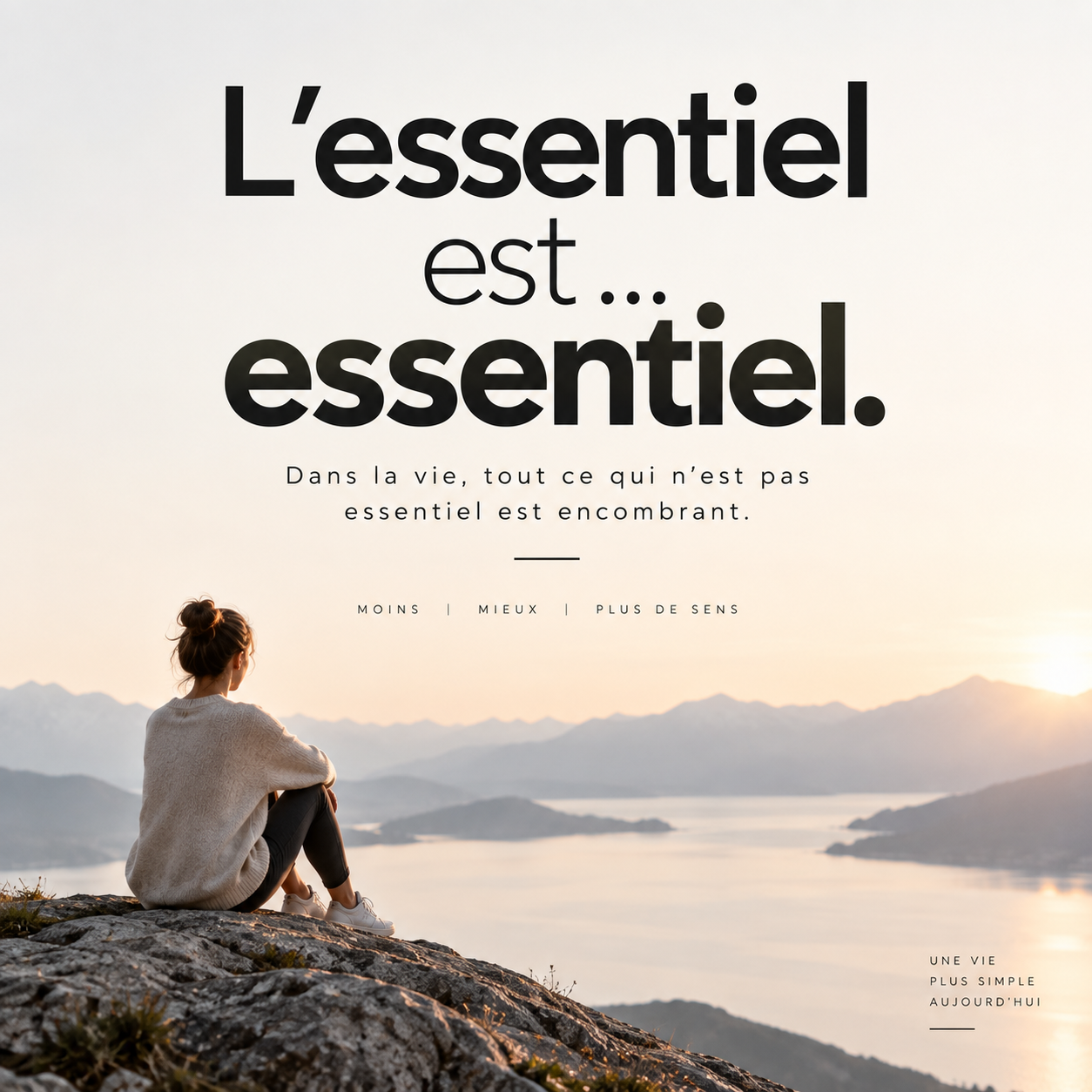
In order to avoid too much in our lives, it is better to be content with the essentials. Why? Because the essential is... essential.
Recommended products


Introduction: The essential thing is… essential
We spend a large part of our lives seek to have more.
More money.
More items.
But also…
More activities.
No more friends.
And, initially, that seems logical.
We have goals, we work to achieve them, and sometimes we treat ourselves to things that make us happy. There's nothing wrong with that.
The problem begins when "more" becomes a habit. Because by constantly adding things to our lives, we can end up forgetting a crucial question:
What do I really need to live well?
This is where essentialism becomes interesting: Do less, but better, by dedicating your time and energy to what really matters.
And this reflection can be applied to almost every area of our lives.

1. Money: how much is really needed?
Money is probably one of the most universal goals.
We want to earn more to have a more comfortable life, buy a house, travel, help our loved ones or simply feel safe.
And that's perfectly understandable.
But there is a catch: Money has no limit.
If our goal is simply to "earn more", we can always push back the threshold.
- €3,000 per month becomes €5,000.
- €5,000 becomes €10,000.
- Then €10,000 no longer seemed sufficient.
The problem, therefore, is not wanting to make money.
The problem is that we never define what "enough" means.
What if we reversed the question?
Instead of asking:
«"How can I keep earning more?"»
We could ask:
«"How much do I really need to live the life I want?"»
This is one of the interesting ideas behind the FIRE philosophy: to gradually reach a financial situation solid enough that money ceases to be a constant worry.
The goal is no longer to become ever richer.
The goal is to have enough to be able to devote one's energy to something else.
This is a fundamental difference.
2. Social relationships: less is more
We need each other.
Social relationships are important for our well-being, our balance, and our sense of belonging.
But again, Quantity is not necessarily synonymous with quality.
Imagine two situations.
Situation A
You have 300 contacts in your phone, several discussion groups, numerous invitations, and a huge number of people to respond to.
You are rarely alone. But do these discussions bring you any value?
How many of these relationships are truly deep?
Situation B
You only have a few close people.
You see them regularly, you talk to them honestly, and you know you can count on them.
The second situation may seem much less impressive. Yet, these are much deeper relationships.
We sometimes forget that’Having a large number of relationships also requires time and energy.
Every relationship may require messages, dates, compromises, birthdays, invitations…
And our time is limited.
Sometimes, a dozen genuine relationships can bring more than a multitude of superficial ones.
In human relationships, quality should often take precedence over quantity.
3. Objects: when what was meant to help us starts to clutter our lives
We usually buy things for a good reason.
- A pair of shoes is for walking.
- A vacuum cleaner is used for cleaning.
- A computer is used for work and entertainment.
- A car is used for getting around.
Initially, The object is therefore at the service of our life.
But something strange can happen when we accumulate.
-> The object eventually requires our time and maintenance.
It needs to be put away.
Clean it.
Maintain it.
To repair it.
Replace it.
Sometimes even to protect it.
Let's take a very simple example:
You own 20 pairs of shoes. Therefore, you need to:
- store them somewhere.
- organize them.
- Half of the shoes are rarely worn.
- And when you buy a new pair, you have to find a place for it.
Conversely, if you only own a few pairs suited to your needs, management is much simpler.
The object was supposed to make our lives easier. But beyond a certain threshold, it can produce the opposite effect.
This is one of the paradoxes of minimalism:
The more we own, the more we complicate our lives and the more things we have to manage.
4. The calendar: our most difficult resource to recover
There is a resource that we cannot buy, produce, or store.
- Time.
A day has 24 hours.
Not 25. And tomorrow, today's hours will have disappeared.
Yet, we sometimes fill our schedules as if our time were unlimited.
- An appointment.
- Then another one.
- An urgent task.
- An invitation accepted (sometimes without really wanting to)
- An additional project.
And ultimately, we end up with such a full schedule that we no longer have time for… ourselves.
The most surprising thing is that we often know our schedule is already full.
But we continue to say:
«"Yes, I will find the time."»
Except that time is not found. It is freed.
And to free up time, Sometimes you have to learn to say no.
Minimalism as a tool, not as a goal
This is where minimalism can become particularly interesting.
Minimalism isn't necessarily about owning as little as possible. But it's an excellent filtered.
Before adding anything to our lives, we can ask ourselves:
Is it essential?
Before buying an item:
«"Does this object actually improve my life?"»
If you have a date proposal:
«"Do I really want to dedicate my time to this?"»
Before pursuing a financial objective:
«"What amount would be sufficient for my needs?"»
Before entering into a relationship:
«"Is this relationship really important to me?"»
And sometimes, the answer will be yes. In that case, let's keep it.
But sometimes, the answer will be no. And if the answer is no, it's because it's not essential. Quite simply!

Conclusion: Choosing the essentials is… essential
We live in a society that often encourages us to add.
But neither our time, nor our space, nor our energy are unlimited.
We are alive and we have limits.
-> That's why learning how to withdraw can be just as important as learning how to obtain!
Minimalism helps us to remove the superfluous.
Essentialism helps us identify what deserves to remain.
And when we begin to make this distinction, one thing gradually becomes clear:
The goal of life is not to tick all the boxes.
The goal is to choose the boxes that truly deserve to be filled.
The main thing is… essential
Subscribe for the latest news
Do you have a frugalist project and would you like training? Click”here” and filled out the form
I suggest you read my tab”Frugalist” to read the main changes to save and become financially independent as quickly as possible.
My pages
- About me
- Saving / Frugalism
- Blog
- Shop
- Contact
- Training and E-book
- Invest
- Minimalism
- My account
- Newsletter
- Basket
- Order confirmation
Lastest Post
- After 10 years of investing in ETFs: which ETF would I choose?
- Financial freedom: why the first 100,000 are the hardest
- The best advice in the world to save
- The Neon bank, the summary
- How does digitalization influence minimalist?
How does this blog live?
Overall, this blog lives from sharing a frugal and/or minimalist lifestyle.
For the sake of transparency towards readers, all the products recommended are intended to make life cheaper and simpler.
Essentially, my only income from this blog comes from the training courses I conduct, promo codes for products I use, and donations readers make in exchange for neutral information.
About me
Faced with not very effective financial education, as was my case before. I actually decided to create this blog following a change in my life since my early adult life.
Compared to before, I was a person who consumed a lot until the day I understood that my consumption was making me sadder and poorer. From now on, I prioritize the minimum of my needs to be happy and achieve financial freedom.
Without realizing it, I also began to prioritize savings and investments to depend on a boss for as short a time as possible and to accelerate my personal projects.
For several years I have felt happy and I have become richer in a way that I would never have imagined given that I have an average salary in Switzerland.
It is for this purpose that I decided to create this blog. To share, learn and teach with others who seek freedom, simplicity and long-term wealth.
Are you more of a minimalist or a frugalist, Jo?
I am both a minimalist and a frugalist. However, there are situations where I lean more towards an art of living.
To conclude, I think the most important thing is to feel comfortable in your life and I have found a balance between these lifestyles without reaching the extremes.
Leave a Reply