
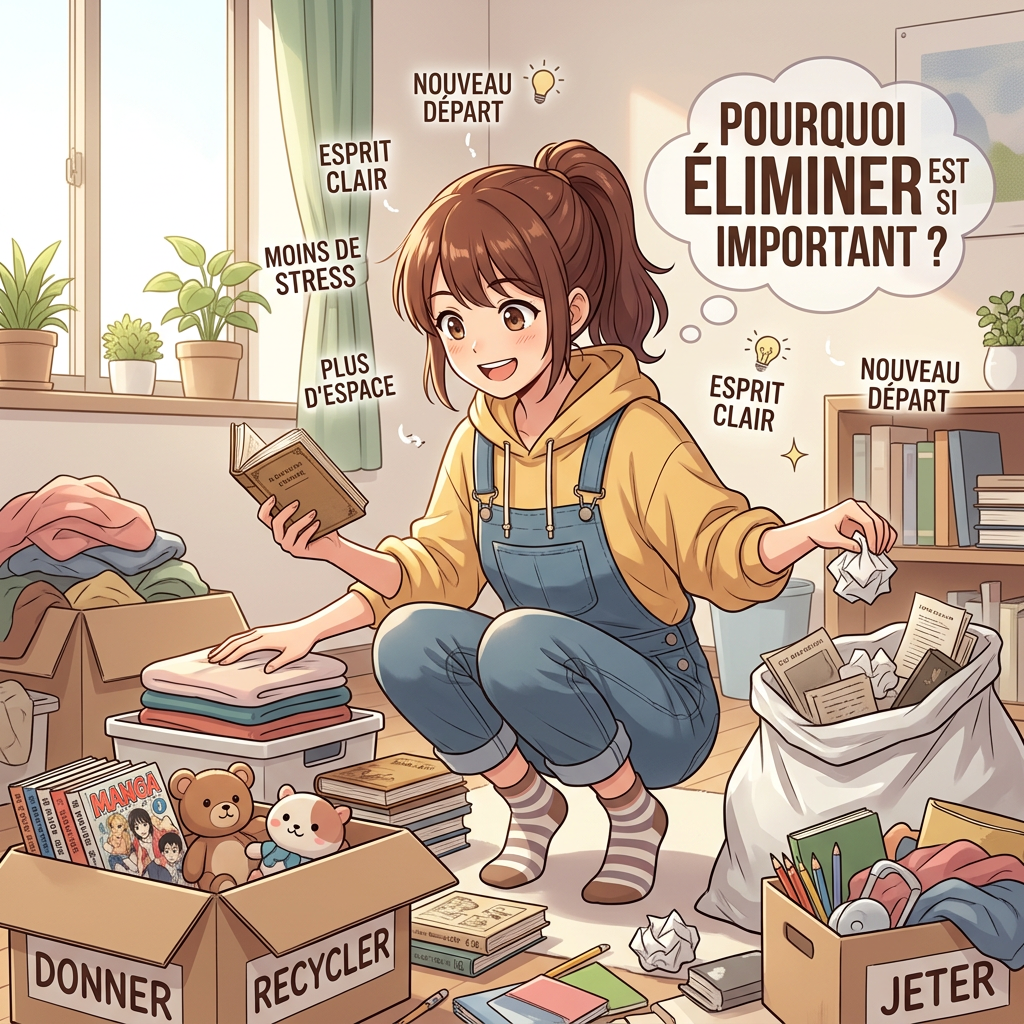
In this article, we will analyze the most important step in minimalism: elimination, the key to a simplified life.
Recommended products


Introduction
When we want to organize, simplify our daily lives, become minimalist, or simply regain control of our time, we often think that we need to better organize.
However, there is an even more important step:
👉 Eliminate what is not necessary.
Before trying to improve tidying, planning, or organization, sometimes you need to start by asking yourself:
«"Do I really need everything I own and everything I do?"»
It's a simple question, but it can have a considerable impact on our daily lives.
Why eliminate the superfluous?
We easily accumulate objects, tasks, commitments, and habits.
The problem is that everything we keep usually demands something in return: time, energy, space, or money.
According to an Ipsos study reported by Le Figaro, the French own on average approximately 200 kg of unused items at their home.*
Furthermore, a Harris Interactive study indicates that 65% of respondents (%) report lacking the time to accomplish what they truly want to do during their day..
These figures illustrate two different problems, but which may have one thing in common: We devote a portion of our resources to things that are not necessarily essential.
The more time and energy we devote to the superfluous, the less we have left for what really matters.
This is where the elimination becomes interesting.

The 7 main benefits of elimination
Eliminating does not necessarily mean throwing everything away.
This means above all making the choice to keep only what is truly useful, valuable or important to us.
This is why this step is so important.
1. Understand what is essential
It is difficult to determine what is truly important when everything seems important.
Imagine your wardrobe filled with clothes.
If you own 80 items of clothing that you rarely wear, it can be difficult to know which ones are truly essential.
On the other hand, when you gradually reduce your wardrobe, you begin to see more clearly what you really need.
Eliminating things therefore allows us to better distinguish the essential from the superfluous.
And this logic doesn't only apply to clothing. It can be applied to objects, applications, tasks, commitments, or even certain habits.
2. Save time
Every item has a small, invisible cost.
Sometimes it needs to be put away, cleaned, moved, maintained, searched for, or simply thought about.
An object can therefore occupy space in our home, but also in our schedule.
By eliminating the unnecessary, you mechanically reduce some of these tasks.
And the time saved can be devoted to something more important to you.
3. Gain energy and lightness
Decluttering is not just about physical space.
A very busy environment can also give the impression of constantly having something to manage.
Conversely, when your environment is simpler, you may feel like you have less to manage.
- Fewer things to store.
- Less to maintain.
- And also, fewer decisions to make.
Eliminating things brings a kind of mental lightness.
The goal is not to have an empty house, but an environment that truly meets your needs.
4. Make better decisions
The more choices we have, the more difficult some decisions can become.
Imagine you have ten tasks to complete today.
You can spend a lot of time thinking about the order in which to do them.
Now, imagine that you eliminate the seven least important tasks. In that case, only three remain.
The decision immediately becomes simpler.
Eliminating noise therefore reduces noise and restores clarity.
This is one of the reasons why the principle of "less is more" can be so powerful.
5. Save money
Elimination can also make us aware of our consumption habits.
When we own a lot of unused items, it can be interesting to ask ourselves:
«"Why did I buy all this?"»
The first time I actually tidied my room, I put on my desk the things I had bought but used less than three times in several years.
Adding up their purchase prices, I realized that it represented approximately… 1,000 CHF.
This experience made me understand something important:
A purchase is not necessarily a good expense simply because we like the item at the time we buy it.
The best way to save money is often to not buy what we don't really need.
6. Reduce distractions
An object can also be a source of distraction.
A smartphone, a television, notifications, apps, games, or simply a desk full of things can attract our attention.
The more cluttered our environment is, the harder it can be to stay focused on what we really want to do.
Eliminating can therefore also consist of removing certain digital distractions or unnecessary habits.
In truth, minimalism isn't just about what's in our closets. It can also concern which is what occupies our attention.
7. Give a second life to what is no longer needed
Finally, eliminating does not necessarily mean throwing away.
An object that is no longer useful to us can be:
- given
- sold
- recycled
The goal is therefore not to produce more waste.
The goal is to circulate items that we no longer use instead of keeping them unnecessarily.
Elimination: the first step towards minimalism
In my opinion, Elimination is the basis of minimalism.
It is difficult to simplify one's lifestyle while continuing to accumulate.
Minimalism is not about owning a specific number of objects. Rather, it's about keeping what is truly useful or important to you and gradually reducing the rest.

How do I start eliminating?
If you want to try it, there's no need to empty your entire house in one day.
Here are three simple methods.
Method 1: The fake move
Imagine you have to move tomorrow.
Put the items you're not sure you need in boxes. For the next 15 days, only retrieve the items you actually need.
At the end of this period, look at what's still in the boxes.
You might discover that some items have never been used.
You can then decide to sell them, give them away, or recycle them.
Method 2: One item per day
You can also start much more slowly.
Each day, simply eliminate one item.
This could be:
- an item of clothing that you no longer wear
- a broken object
- a duplicate
- an unused gadget
- a document that has become useless
Throwing away a single item each day may seem insignificant. But one item a day represents 365 items over one year.
The advantage of this method is that it requires almost no effort.
Method 3: Start with a small area
You don't have to start with your whole house.
Simply choose:
- a drawer
- a shelf
- your office
- your wardrobe.
Take everything out. Look at each object. Then classify them into three categories:
- I keep / I give away/sell / I throw away/recycle.
Once the area is finished, move on to the next one.
This approach allows you to progress without feeling overwhelmed.

Conclusion
Eliminating things is a fundamental step towards simplifying one's life.
This can allow us to:
- better understand his needs
- save time
- reduce secondary tasks
- lighten its environment
- make decisions more easily
- avoid unnecessary expenses
- reduce distractions
- giving a second life to objects that are no longer needed
But above all, Eliminating things makes room for what really matters.
It's not about trying to own as little as possible. It's about do not let the superfluous take the place of the essential.
And that's probably one of the most important ideas of minimalism.

Elimination: the key to a simpler life
Subscribe for the latest news ✍
You have a frugalist or minimalist project and you want a training? Click ”here”.
My pages
- About me
- Saving / Frugalism
- Blog
- Shop
- Contact
- Training and E-book
- Invest
- Minimalism
- My account
- Newsletter
- Basket
- Order confirmation
Lastest Post
- After 10 years of investing in ETFs: which ETF would I choose?
- Financial freedom: why the first 100,000 are the hardest
- The best advice in the world to save
- The Neon bank, the summary
- How does digitalization influence minimalist?
Elimination: the key to a simpler life
How does this blog live?
Overall, this blog lives on sharing a frugal and minimalist lifestyle.
For a question of transparency towards the readers. All recommended products are in order to make life cheaper, simpler and to promote the essentials.
Basically, my only income with this blog comes:
- Trainings that I realize
- Promo codes for the products I use
- Donations that readers make in exchange for neutral information.
About me
I decided to create this blog to develop and help readers who are looking for a simpler and more economical life.
Compared to before, I was a person who consumed a lot until the day I realized that my consumption made me sadder and poorer 😑
Now I prefer the minimum of my needs to be happy and achieve my financial freedom.
Without realizingI started to focus on saving and investing to depend on a boss for as little time as possible and to speed up my personal projects.
For several years I have felt happy and I have become richer in a way that I would never have imagined given that I have an average salary in Switzerland.
What is the objective of this blog?
The goal is to share and learn with others who seek freedom and simplicity 😉
Are you more of a minimalist or a frugalist??
I am as minimalist as I am frugalist. However, there are situations where I lean more towards an art of life.
To conclude, I think the most important thing is to feel comfortable in your lifestyle 😊
Leave a Reply