
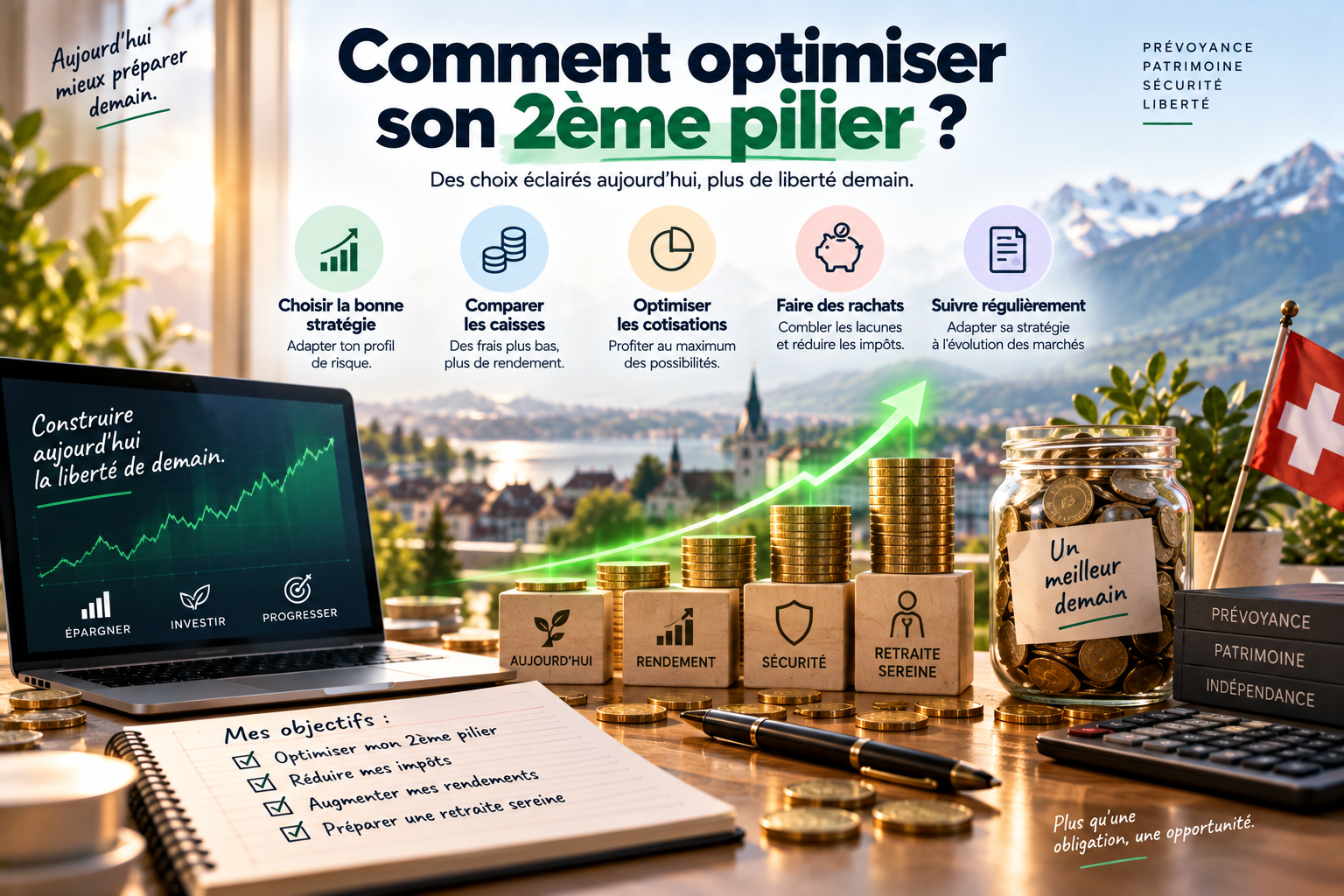
Once you understand the basics and how the 2nd pillar works. The question is how to optimize your 2nd pillar? 😉
Recommended products


Before reading this article
Before we begin, I recommend you read my article on the foundations of the 2nd pillar.
The objective here is different: to understand how to practically optimize your second pillar and avoid mistakes that can be costly in the long run.
Your second pillar pension plan can represent several hundred thousand francs over the course of your career. It therefore deserves to be monitored like any other important investment.
Here are 7 concrete strategies to optimize your 2nd pillar.
1. Start with your insurance certificate
Before trying to optimize anything, start by looking what you actually own.
Each year, your pension fund sends you a pension certificate. It will include, among other things:
- your retirement savings
- your contributions
- your employer's contributions
- your estimated future annuity
- your buyback capacity
- benefits in case of disability or death
👉 First thing to do: check your certificate at least once a year.
This is also important when you change jobs, as benefits can vary greatly from one fund to another.
2. Compare the 2P when you change jobs
You generally cannot freely choose your pension fund when you are employed. However, you can sometimes choose your employer.
For example, if two companies offer the exact same salary, analyze each company's benefits plan. Sometimes you can earn money with your second pension plan.
For example :
Company A
- salary: 100,000 CHF; ;
- Employer contributions: minimum stipulated by the plan.
Company B
- salary: 100,000 CHF; ;
- employer: takes on a larger share of the contributions; ;
- better pension benefits.
👉 In this case, the salary is similar, but you win with your 2P services.
Over a career spanning several decades, the difference can amount to tens of thousands of CHF.
3. Explore the possibility of making buybacks
THE buyback of 2nd pillar is one of the main levers for optimization.
If you have a buyback capacity, you can voluntarily contribute money to your pension fund to increase your retirement savings.
You can have a buyback capacity if you:
- started working late
- worked abroad for several years
- has experienced periods with lower income
- has reduced your activity rate
The available amount is usually shown on your pension certificate.
Why might a buyout be beneficial?
Because he may have two effects :
- increase your retirement savings
- allow, under certain conditions, a tax deduction
For example, if you make a redemption of CHF 20,000, this amount can generally be deducted from your taxable income, subject to applicable tax rules.
👉 But be careful: A buyout is not automatically the best solution.
In particular, you need to take into account your tax situation, your time horizon until retirement, your liquidity needs and your other investment options.
4. Don't necessarily make your purchase all at once.
Let's assume your certificate indicates a buyback capacity of 100,000 CHF. You could therefore pay the 100,000 CHF immediately.
But it may also be worthwhile to consider a buyback spread over several years.
For example :
- 20,000 CHF this year; ;
- 20,000 CHF next year; ;
- etc.
For what ?
Because tax savings depend in particular on your taxable income. In certain situations, spreading out the buybacks therefore allows you to make better use of the tax deduction.
⚠️ Beware of the 3-year rule
Second pillar buybacks are subject to specific rules in the event of a capital withdrawal.
If you make a redemption and then quickly withdraw your capital, the tax consequences can be significant.
👉 Before making a large purchase, always check the tax implications and the rules applicable to your bank.
5. Is it possible to invest one's second pillar pension in the stock market?
This is a very common question.
In a traditional pension fund, You generally don't choose the investments yourself.
It is the fund that collectively invests the insured's assets.
So you can't just ask:
«"I want my CHF 200,000 invested 100% in a global ETF."’
However, there are some special situations.
Vested benefits
If you leave your job and do not immediately join a new pension fund, your assets must generally be transferred to a vested benefits solution.
Some foundations then allow this money to be invested according to different strategies.
For example, pension offers free passage solutions allowing the choice of different investment strategies, including strategies with high exposure to equities.
This can be particularly interesting for someone with an investment horizon of several decades.
⚠️ But a more dynamic strategy also implies more risks.
The plans 1e
For some people with high salaries, the employer may offer a plan 1e.
The major difference is that the insured can generally choose their investment strategy from those offered by the plan.
This therefore allows for more personalisation than a traditional pension fund.
👉 But again, More freedom does not automatically mean more productivity..
A strategy heavily exposed to equities can suffer significant losses during a stock market crisis.
6. Do not neglect your vested benefits
When you change jobs several times, it is important to check that your old pension assets have been transferred.
If you don't immediately enter a new till, your money could end up in a free passage solution.
And not all solutions are the same.
There may be differences regarding, in particular:
- the costs
- remuneration
- investment opportunities
- the services offered
👉 If you have held a vested benefits account for several years, check where it is located and how it is invested. This is sometimes one of the simplest optimization levers.
7. Also optimizes the exit from the 2nd pillar
Optimizing your second pillar does not just mean trying to accumulate the largest possible amount of capital.
We also need to think about what you're going to do with it in retirement.
Depending on your bank's rules, you can usually choose between:
- an annuity
- a capital withdrawal
- or a combination of both
Let's summarize the three options:
The annuity
It provides a regular income and offers greater protection against the risk of living a very long life.
Capital
Your 2P is transferred to your bank account, allowing you to manage your assets yourself.
Capital/annuity mix
Some pension funds allow you to combine capital withdrawal and annuity.
For example, if you have 100,000 CHF in your 2P, you can receive 50,000 CHF as a lump sum and receive a small monthly annuity.
And what about the taxation of 2P?
Taxation can also play an important role.
A capital withdrawal from the 2nd pillar is generally subject to a separate income tax, the amount of which depends in particular on the canton and the amount withdrawn.
That's why it can be useful to run a simulation before making a large withdrawal.
In certain situations, planning withdrawal over several years or between different types of pension plans can also have a tax impact.
👉 So don't just think about the amount you're going to withdraw: also think about the amount you'll actually have left after taxes.
And if you want to buy a home?
Your second pillar can also be used, under certain conditions, to finance your main residence.
Two mechanisms exist in particular:
- the advance payment
- the pledge
This can help reduce the equity needed to buy a home. But one thing must be kept in mind:
👉 The money used for your housing is no longer available in the same way for your retirement.
Before using your 2nd pillar to buy a house or apartment, compare the real cost of this decision with the benefits obtained.
Common mistakes to avoid
Optimizing your second pillar is not necessarily about seeking maximum return.
Conversely, some mistakes can be very costly.
❌ Making a buyback solely to save on taxes
The tax benefit is attractive, but you also need to look at what happens to your money and the restrictions related to withdrawal.
❌ Choosing a cash register solely because it performed exceptionally well last year
Good one-off performance is not enough to judge a pension fund.
Also look at the benefits, the return on assets, the conversion rate, the fees, the 10-year return and the financial strength.
❌ Forgetting a previous vested benefit
After several job changes, always check where your old assets are located.
❌ Taking too many risks just to get a better return
In my opinion, making your 2P profitable is something to analyze, however, it is important to keep part of your assets defensive, that is to say, having a good part of the 2P in cash or in bonds.
A dynamic strategy can be useful in the long term, but only if you are young and can withstand capital fluctuations over a long period.
As you get older, it's best to adopt a defensive strategy with your 2P.
❌ Waiting until 64 or 65 to think about leaving
The choice between an annuity and a lump sum should be considered several years before retirement. If you wait until you're 64 to optimize your second-floor apartment, it's too late.
How much can you earn by optimizing your second pillar?
It's difficult to quantify, because each situation is different.
However, compound interest shows why small differences can become important.
Let's simply imagine a capital of 100,000 CHF invested for 25 years :
| Average annual yield | Capital after 25 years |
|---|---|
| 2 % | ≈ 164,000 CHF |
| 4 % | ≈ 267,000 CHF |
| 5 % | ≈ 339,000 CHF |
⚠️ These figures are purely illustrative. They do not represent a forecast or a guaranteed return.
The goal is simply to show that a difference in yield of a few percent can have a considerable impact over several decades.
But optimization doesn't only come from efficiency. It can also come from:
- contributions from your employer
- buyouts
- tax savings
- managing your vested benefits
- investment opportunities
- and taxation at the time of withdrawal.
30, 40, 50 or 60 years old: is it better to invest 500 CHF per month or to buy back your 2nd pillar?
This is probably the most interesting question when discussing the optimization of the 2nd pillar.
Let's imagine four people:
- 30 years
- 40 years old
- 50 years
- 60 years old
They all have the same savings capacity: 500 CHF per month, up to age 65.
We will compare two strategies:
Strategy A: Invest 500 CHF per month in a global ETF
To simplify, we assume an average return of 7 % per year, with reinvestment of returns.
Strategy B: contribute 500 CHF per month to your 2nd pillar
For this simulation, let's assume an average yield of 2.5 % per year on pension assets.
⚠️ These figures are purely illustrative. An ETF obviously does not guarantee 7 % per year and the return of a pension fund depends on its remuneration and its provident plan.
Furthermore, the repurchase of 2nd pillar assets can generate a tax saving. We do not include it directly in the table in order to first compare the effect of yield and time.
The result is spectacular
| Age today | Savings period | Global ETF at 7 % | 2P to 2.5 % |
|---|---|---|---|
| 30 years | 35 years | ≈ 900,500 CHF | ≈ CHF 335,200 |
| 40 years old | 25 years | ≈ CHF 405,000 | ≈ 208,100 CHF |
| 50 years | 15 years | ≈ CHF 158,500 | ≈ 109,100 CHF |
| 60 years old | 5 years | ≈ CHF 35,800 | ≈ CHF 31,900 |
These figures show one essential thing:
👉 The earlier you start, the greater the difference in performance becomes.
At age 30, both people pay exactly the same amount each month.
However, after 35 years, the theoretical difference exceeds CHF 565,000.
Why? Because the ETF benefits for several decades from the’effect of compound interest.
But be aware: the 2P benefits from an advantage that our table does not show
Buying back 2nd pillar is not simply an investment at 2.5 %.
Under certain conditions, the amount paid into the 2P is deductible from taxable income.
Let's imagine, for example, that you pay 6,000 CHF per year into your 2P and that this operation allows you to save 1,500 CHF in taxes.
Your actual cost is therefore not necessarily 6,000 CHF.
You have : 6,000 CHF deposited into your 2P
but also: CHF 1,500 in taxes saved.
Your actual financial effort is therefore potentially 4,500 CHF.
This is a very important factor when comparing an ETF investment with a 2nd pillar buyback.
So, who wins? Investing in a Global ETF or in your second pillar?
The answer depends mainly on your age and your tax situation.
🟢 At 30 years old
At 30, you potentially have 35 years before retirement.
That's huge.
Assuming an annual yield of 7 %, Investing 500 CHF each month could theoretically grow to around 900,000 CHF at 65 years old.
Buying back 2P can obviously be attractive thanks to the tax deduction, but you must also take into account that your money is much less flexible.
👉 At this age, Long-term investment can have a considerable advantage thanks to compound interest..
But that does not necessarily mean that buybacks should be avoided.
🟡 At 40 years old
There are approximately 25 years left before age 65.
The effect of compound interest remains significant.
In our simulation:
- ETF: ≈ 405,000 CHF
- 2P: ≈ 208,000 CHF
The difference therefore remains significant.
However, at 40, tax situation and buyback capacity may start to play a much more important role.
👉 The comparison becomes less obvious than at 30 years old.
It may be advantageous to combine the two strategies rather than exclusively choosing one or the other.
🟠 At 50 years old
There are only 15 years left before retirement age.
The effect of compound interest is therefore much less powerful.
In our example:
- ETF: ≈ 158,500 CHF
- 2P: ≈ 109,000 CHF
The gap is significantly smaller.
Furthermore, I haven't factored in tax savings in the table. In this case, the difference between the 2P and the Global ETF is even less clear.
👉 Therefore, At 50, investing in a global ETF or buying back 2P shares is a similar investment..
🔴 At 60 years old
There are only five years left.
In our example:
- ETF: ≈ 35,800 CHF
- 2P: ≈ 31,900 CHF
The difference becomes relatively small.
Moreover, if we take into account the tax savings, the final result will very likely be similar.
Why? Because there simply isn't enough time left for the effect of compound interest to radically transform the amounts.
Not to mention, in 5 years, the stock market can have a very bad year, and you won't have time to make up for that loss.
👉 Therefore, at 60 years old, It is better to buy back your 2P than to invest in an offensive investment.
The trap: comparing only yields
It would therefore be dangerous to conclude:
«"The overall ETF yields an average of 7 % per year, so you should always choose the ETF."»
It's not that simple.
The second pillar has several advantages that our simulation does not fully take into account:
- The buybacks may be tax-deductible.
- The employer contributes to the contributions under the professional plan
- Insurance can provide benefits in the event of death or disability.
So, what should you choose at 30, 40, 50 or 60 years old?
Here is a very simplified way to choose (not investment advice):
| Age | Priority to analyze | Investing in a Global ETF or buying back your 2P |
|---|---|---|
| 30 years | Long-term horizon, compound interest, diversification | Investing in Global ETFs |
| 40 years old | Compare returns, taxation, and buybacks | Investing in Global ETFs |
| 50 years | Buyouts and taxation become particularly important | Combine the 2 |
| 60 years old | Preparing for retirement: taxation and annuities/capital | Buy back 2P (but wait 3 years before withdrawing the capital) |
This painting is obviously not not a precise investment rule. This is only an opinion and not advice.
5 essential steps to optimize your 2P
If I had to summarize the entire article in a short, simple chapter, I would do it like this:
1. If you are an employee, analyze your 2Ps and the 2Ps of your employer's competitors.
Sometimes, a better second pillar can be found with another employer.
Although it is not advisable to change employers solely for this reason, if you are considering changing jobs, also take into account this element which could bring you tens of thousands of CHF in your career.
2. If you are self-employed, choose the best 2nd pillar
If you are self-employed, you can choose the best 2nd pillar according to your situation.
In my opinion, Viac* and Finpension* offer the best vested benefits accounts in terms of fees and return.
In addition, you have several strategy options to choose from depending on your profile.
3. Should you buy back 2P shares or invest in a global ETF? It depends on your age.
If you are an employee, in order to optimize your 2P, you can buy back shares of 2P.
However, if you are hesitating between buying 2P and investing in a Global ETF, your age is important for the return.
- Before age 50 = Investing in a global ETF is generally the best option
- Between 50 and 60 years old = balance between buying back 2P shares and investing in a Global ETF
- After age 60, buying back shares in 2P is more advantageous.
4. Forward your vested benefits
Many people change employers and do not realize that their second pillar is locked in an old pension fund.
Therefore, ask your former pension funds if your money has been transferred.
It would be a shame if your money were forgotten in an old pension fund.
5. Prepare your exit several years in advance
Don't wait until you're 63 to worry about your 2P.
Take some time today to optimize your 2P, for example:
- Regarding taxation, is it better to withdraw my capital or request an annuity?
- Buying back 2P shares or investing, which is more likely to be profitable?
- Should I apply for a similar position but with a more attractive 2P?
- Do I need to become self-employed to choose my pension fund and optimize my 2P?
These are questions that should be asked well before the age of 63.
Conclusion
Your second pillar is probably one of the largest assets you will build up during your lifetime.
However, it is often monitored much less closely than a stock portfolio or a bank account.
You don't need to become an expert in financial planning to improve it.
Simply start by:
understand → verify → compare → optimize.
Check your pension certificate, look at your employer's benefits, study your buyback capacity and make sure that any vested benefits are being managed correctly.
Then, if you are in a particular situation — high salary, 1e plan, leaving Switzerland, buying property or nearing retirement — it may be worth exploring further.
👉 The goal isn't to maximize your second pillar at all costs. The goal is to make the right decisions for your situation.

Subscribe for the latest news
You have a frugalist or minimalist project and you want a training? Click ”here”.
My pages
- About me
- Saving / Frugalism
- Blog
- Shop
- Contact
- Training and E-book
- Invest
- Minimalism
- My account
- Newsletter
- Basket
- Order confirmation
Lastest Post
- After 10 years of investing in ETFs: which ETF would I choose?
- Financial freedom: why the first 100,000 are the hardest
- The best advice in the world to save
- The Neon bank, the summary
- How does digitalization influence minimalist?
How does this blog live?
Overall, this blog lives on sharing a frugal and minimalist lifestyle.
For a question of transparency towards the readers. All recommended products are in order to make life cheaper, simpler and to promote the essentials.
Basically, my only income with this blog comes:
- Trainings that I realize
- Promo codes for the products I use
- Donations that readers make in exchange for neutral information.
About me
I decided to create this blog to develop and help readers who are looking for a simpler and more economical life.
Compared to before, I was a person who consumed a lot until the day I realized that my consumption made me sadder and poorer 😑
Now I prefer the minimum of my needs to be happy and achieve my financial freedom.
Without realizingI started to focus on saving and investing to depend on a boss for as little time as possible and to speed up my personal projects.
For several years I have felt happy and I have become richer in a way that I would never have imagined given that I have an average salary in Switzerland.
It is for this purpose that I decided to create this blog. In order to share and learn with other people who seek freedom and simplicity 😉
Are you rather minimalist or frugal Jonny?
I am as minimalist as I am frugalist. However, there are situations where I lean more towards an art of life.
To conclude, I think the most important thing is to feel comfortable in your lifestyle 😊
Leave a Reply