
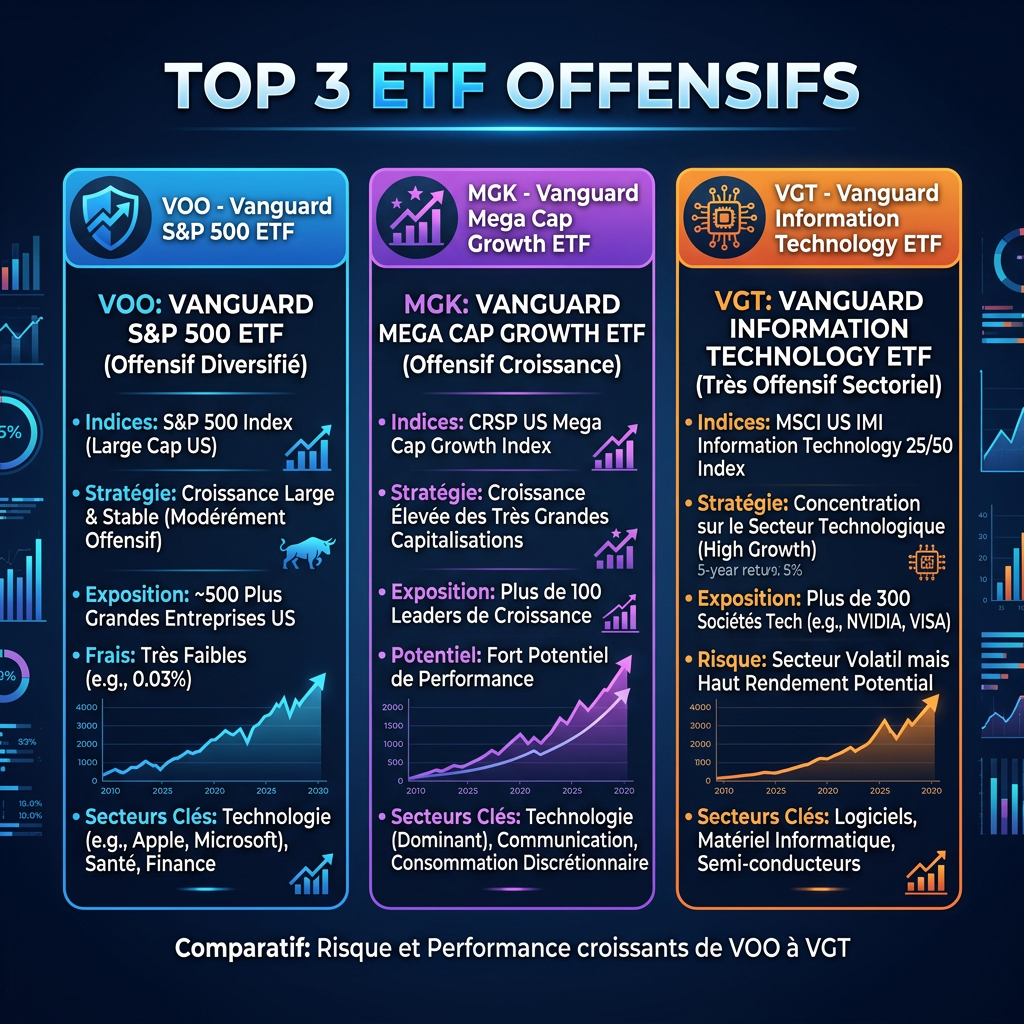
There are many ETFs for an aggressive strategy. In this article, I have analyzed, illustrated, and compared, in my opinion, the top 3 aggressive ETFs: VOO, MGK, or VGT?
Recommended products


Introduction: Top 3 offensive ETFs: VOO, MGK or VGT?
There are many ETFs that allow you to adopt a growth-oriented stock market strategy.
Among the best-known American ETFs, three Vanguard funds stand out: VOO, MGK and VGT.
These three ETFs have shown interesting historical performance and a fairly comprehensive portfolio, but they do not offer the same exposure and therefore, the same risks:
- VOO* invests in major American companies across several sectors
- MGK* focuses on very large, growth-oriented American companies
- VGT* primarily targets the information technology sector.
The best ETF therefore depends on your objective, your risk tolerance and the level of concentration you are willing to accept.
In this article, I compare VOO, MGK and VGT according to several criteria:
- historical yield
- diversification
- sectoral concentration
- the risk level
- dividends
- the costs (TER)
- Taxation for investors domiciled in Switzerland
- ease of management
By the end of the article, you will have a clearer understanding of the advantages and limitations of each ETF.
⚠️ This article does not constitute investment advice. Past performance is not indicative of future results. Investing in the stock market can result in losses, and each investor should analyze their personal situation before making a decision.

What is an offensive ETF?
An ETF is a fund listed on the stock exchange that allows you to invest in several companies through a single product.
The term «"Offensive ETF"» This is not an official category. In this article, I use it to refer to an ETF that primarily seeks to offer high long-term growth potential.
An aggressive strategy typically favors growth stocks over bonds or cash. It can therefore offer higher return potential, but it also involves significant fluctuations.
An offensive ETF can, in particular, be:
- heavily exposed to growth stocks
- geared towards large technology companies; ;
- less diversified than a global ETF.
It is important to understand that a high historical return does not necessarily mean that an ETF will perform well in the future.

Why invest in an aggressive ETF?
Over long periods, equity markets have historically offered significant growth potential. For an investor with a multi-year investment horizon, an equity-focused ETF can help grow their capital through company growth and the effects of compound interest.
However, an offensive strategy requires patience.
The value of an ETF can fall sharply during certain periods. A drop of 20, 30, or more is possible during a stock market crash. Investors must therefore be able to hold onto their investment without panicking and selling.
An offensive strategy may be suitable for investors who:
- have a long investment horizon
- accept significant fluctuations
- they primarily seek capital growth
- do not need to use the invested money quickly
The three ETFs compared
VOO: Vanguard S&P 500 ETF
VOO tracks the S&P 500 index, which includes the 500 largest American companies.
The ETF offers exposure to several sectors, including:
- technology
- finance
- health
- the industry
- consumption
- energy
VOO, however, remains entirely exposed to the American market. It is therefore diversified across several companies and sectors, but it is not globally diversified.
Its main advantage is to offer broad exposure to large American companies with low management fees.
MGK: Vanguard Mega Cap Growth ETF
MGK invests primarily in very large American companies considered to be growth companies.
It owns fewer companies than VOO and its portfolio is more concentrated. Technology represents a significant portion of the fund, but MGK also owns companies from other sectors.
MGK can therefore be considered an intermediate solution:
- more concentrated than VOO
- less specialized than a technology ETF like VGT
- heavily exposed to large US growth companies.
VGT: Vanguard Information Technology ETF
VGT is a sector ETF specializing in information technology.
He invests in companies active in:
- semiconductors
- software
- computer hardware
- technology services
- electronic equipment.
The fund is heavily concentrated in the technology sector. It therefore offers significant growth potential, but its performance depends more on the performance of a single sector.
Quick comparison
| Criteria | VOO | MGK | VGT |
|---|---|---|---|
| Type of exposure | Large American companies | Very large growth companies | American technology sector |
| Diversification | Raised among the three ETFs | Average | Weak at the sectoral level |
| Number of companies | Approximately 500 | Approximately 70 | approximately 320 |
| Exposure to technology | Important | Very important | Very high |
| Concentration | Moderate | High | High |
| Historical growth potential | Pupil | Very high | Very high |
| Risk level | Pupil | High to very high | Very high |
| Annual fund fees | Weak | Weak | Weak |
| Necessary management | Very weak | Very weak | Very weak |
The figures concerning the number of companies and the portfolio composition change regularly. It is therefore recommended to check the fund's official information sheet before investing.
Which one has historically achieved the best return?
Over the period studied in the first version of this article (2016-2025), VGT obtained the highest historical annualized return, followed by MGK and then VOO.
The historical ranking was approximately as follows:
- VGT: approximately 19 % per year
- MGK: approximately 16 % per year
- VOO: approximately 12.8 % per year
These results are impressive. However, it is important not to consider them as predictable future returns.
Performance can vary greatly depending on:
- the period analyzed
- the level of valuations at the start of the investment
- interest rates
- economic growth
- the results of major technology companies
The fact that VGT achieved the best return over a given period does not therefore mean that it will be the best investment over the next ten years.
👉 Best historical return over the period studied: VGT
Example with an investment of USD 10,000
To understand the effect of compound interest, let's imagine that an investor invested $10,000 for ten years and that the following annualized returns were maintained throughout the period:
| AND F | Hypothetical annual yield | Theoretical value after ten years |
|---|---|---|
| VGT | 19 % | Approximately USD 56,900 |
| MGK | 16 % | Approximately USD 44,100 |
| VOO | 12,8 % | Approximately USD 33,400 |
This example is purely mathematical. It does not take into account:
- taxes
- broker fees
- exchange fees
- inflation
- real market fluctuations
However, it shows that a difference in annual returns can create a significant gap over a long period.
Which one is the most diverse?
All three ETFs invest primarily in the United States. Therefore, none of the three constitutes, on its own, a globally diversified portfolio.
Diversification must be analyzed according to several criteria:
- the number of companies
- the distribution between sectors
- concentration in key positions
- geographical distribution
Of the three ETFs, VOO is undoubtedly the most diversified. It holds approximately 500 large American companies spread across several sectors.
MGK owns fewer companies (around 70) and focuses more on very large growth companies.
VGT owns many companies (approximately 320), but they mainly belong to the same economic sector.
Therefore, it is important not to look solely at the number of companies.
An ETF with 300 technology companies may be less diversified than an ETF with 500 companies spread across several sectors.
👉 Best diversification among the three ETFs: VOO
Which one presents the lowest risk of concentration?
No investment in stocks is without risk.
All three ETFs can lose a significant portion of their value during a stock market crash. They are also all exposed to the US market.
However, their concentration risks are different.
VOO is the least concentrated, as it invests in several sectors and in a large number of companies.
MGK is more focused on large growth companies. Its evolution therefore depends more heavily on the performance of a few major companies.
VGT specializes in technology. It is therefore particularly sensitive to developments in this sector.
VOO's diversification does not eliminate risk, but it reduces the risk associated with a single sector.
👉 Lowest risk of concentration: VOO

Which one is the most volatile?
Volatility cannot be determined solely from historical performance.
A high return does not automatically mean that an ETF is more volatile. To accurately compare volatility, one would need to analyze data such as:
- the standard deviation
- the beta
- the highest historical decline
- the frequency and magnitude of negative periods
However, due to its sectoral concentration, VGT may experience greater fluctuations than VOO.
MGK is probably somewhere in between in terms of concentration, although its actual behavior depends on market conditions.
Vanguard currently rates VOO in a lower risk category than VGT on its own scale. VGT also has a beta greater than 1 relative to the US market in historical data published by Vanguard.
👉 Historically the most diversified ETF, the least exposed to sector risk and the least volatile: VOO
Which one pays the most dividends?
All three ETFs typically pay dividends quarterly.
However, the dividend yield varies over time and should not be considered fixed.
VOO generally has a higher dividend yield than MGK and VGT.
This difference is mainly explained by the composition of the funds:
- VOO owns companies from several sectors, some of which pay significant dividends.
- MGK prioritizes large growth companies
- VGT focuses on technology companies, which often dedicate a very large portion of their profits to growth and investment.
Note that a higher dividend yield does not automatically mean an ETF is more profitable. Total return should not be confused with a higher dividend.
👉 ETFs generally offering the highest dividend yield: VOO
Which one distributes dividends most often?
The three ETFs generally distribute their dividends four times a year.
The frequency of distributions is therefore not a criterion for distinguishing between them.
👉 Frequency of distributions: equality
Which one has the lowest management fees?
The internal annual fees of an ETF are called expense ratio, Or expense ratio.
Note that the fees currently quoted by Vanguard are:
| AND F | Annual fund fees |
|---|---|
| VOO | 0,03 % |
| MGK | 0,07 % |
| VGT | 0,09 % |
Fees may change. Therefore, you should check the fund's official information sheet before investing.
VOO currently has the lowest cost ratio.
However, the difference between the three ETFs remains limited.
👉 ETF with the lowest internal charges: VOO
Which one is the easiest to manage?
All three ETFs are passive investments.
Once the purchase is made, the investor does not normally need to select the companies included in the fund himself.
In truth, the three ETFs require minimal management, 5 minutes per month is enough.
👉 Ease of management: equality
Which ETF offers the most tax advantages in Switzerland?
Taxation depends on each investor's personal circumstances.
For an investor domiciled in Switzerland, dividends are generally considered taxable income.
US ETFs are subject to withholding tax. Form W-8BEN allows non-US investors to benefit from the tax treaty rate between Switzerland and the United States.
It should be noted that in Switzerland, dividends are subject to higher taxation than capital gains. Therefore, the ETF with the highest growth and the fewest dividends will benefit from the most favorable tax treatment.
Historically, VGT has been the best-performing ETF while distributing the fewest dividends. As a result, it has historically been the least taxed for Swiss residents.
Which ETF should you choose based on your profile?
VOO may be more suitable for investors who are looking for:
- a relatively broad exposure to large American companies
- several economic sectors
- a lower risk of concentration than MGK or VGT
- very low management fees
- a dividend yield generally higher than MGK or VGT
- a simple strategy to maintain over the long term
However, VOO remains fully exposed to the United States. Therefore, it does not necessarily replace a global ETF.
MGK may be more suitable for investors looking for:
- a strong exposure to large American growth companies
- high growth potential
- a more concentrated portfolio than VOO (69 shares vs 500)
- significant exposure to technology without being exclusively invested in that sector
- a compromise between a generalist ETF and a technology ETF
MGK can experience significant fluctuations and is heavily dependent on the performance of the largest American companies.
VGT may be more suitable for investors looking for:
- a specialized exhibition on the technology sector
- very high growth potential
- a strong exposure to American technology companies
VGT is more sensitive to developments in the technology sector. It is therefore important to consider its place within the overall portfolio.

Why aren't the Nasdaq-100 and QQQ in the top 3?
The Nasdaq-100 is an index that primarily comprises large, non-financial companies listed on the Nasdaq. The QQQ ETF tracks this index.
QQQ is an interesting alternative for investors looking for a growth ETF that primarily invests in technology.
In reality, if I compared VOO, MGK and VGT and excluded the QQQ ETF from the top 3 of offensive ETFs, it is only because the Invesco site is different from that of Vanguard, which makes comparisons difficult for writing this article.
👉 On the other hand, I think the QQQ ETF is also an excellent offensive ETF!
In my opinion, a QQQ ETF is halfway between the MGK and VGT ETFs.
VOO, MGK or VGT?
| Criteria | Winning ETF |
|---|---|
| Best historical performance over the period studied | VGT |
| Highest diversification among the three | VOO |
| Lowest concentration risk | VOO |
| Highest exposure to technology | VGT |
| Compromise between VOO and VGT | MGK |
| Dividend yield generally the highest | VOO |
| Lowest internal costs | VOO |
| Ease of management | Equality |
| Frequency of dividend distributions | Equality |
| Best tax choice in Switzerland | VGT (historically) |
My opinion on VOO, MGK and VGT
The three ETFs have interesting characteristics, but they do not meet the same need.
- VGT has historically achieved the highest return over the period studied. However, its portfolio is very heavily concentrated in the technology sector.
- VOO is the most diversified of the three. It offers exposure to several sectors and has the lowest management fees. However, it remains entirely invested in the United States. Moreover, for the period compared, it was the ETF with the lowest return.
- MGK It lies somewhere in between. Indeed, it is more concentrated than VOO and strongly oriented towards large growth companies, however it is not exclusively technology-focused.
Therefore, there is no ETF that is objectively better for all investors.
The choice depends in particular on your tone:
- investment horizon
- current portfolio
- need for diversification
- tolerance for stock market declines
- ability to maintain investment during difficult times.
Don't forget to diversify your assets
An aggressive strategy can offer high return potential over the long term, but it is also generally accompanied by significant fluctuations and a higher level of risk.
Therefore, it may be wise not to invest all of one's assets in aggressive investments!
Depending on their objectives, investment horizon, and risk tolerance, an investor can diversify their assets by combining several types of investments:
- offensive positioning, primarily growth-oriented
- mixed investments, which generally combine growth and defensive investments; ;
- defensive positioning, who are more focused on reducing fluctuations and maintaining assets.
This diversification can help limit dependence on a single market or asset class. It also allows for more stable returns.
For example, an investor may choose to keep part of their assets in aggressive ETFs and another part in more diversified or defensive investments.
However, there is no ideal allocation for everyone. The right strategy depends in particular on age, financial situation, objectives, investment horizon, and the ability to withstand market downturns.
An offensive ETF can be an important part of a portfolio, but it should be diversified with mixed and defensive investments.
Conclusion
In conclusion, VOO, MGK and VGT all displayed interesting historical performances.
VGT achieved the best performance over the period analyzed, but it is also the most specialized.
VOO offers the best diversification and lowest volatility of the three ETFs, but also had the lowest return.
In truth, MGK represents an intermediate solution, as it is more oriented towards large growth companies, but is not a sector ETF.
Before investing, it is essential not to limit oneself to past performance.
A good investment isn't just the one with the best historical performance. It must also align with your strategy, risk tolerance, and investment horizon.
Past performance is not indicative of future results. An aggressive strategy may offer high growth potential, but it also involves periods of decline, sometimes significant.
Therefore, the goal is not to find the ETF that has historically been the most profitable, but to choose a strategy that you will be able to maintain over the long term.
FAQ: Top 3 offensive ETFs: VOO MGK or VGT?
Which is the best ETF between VOO, MGK and VGT?
There is no single best ETF for every investor. It's worth noting that VOO offers the highest diversification of the three ETFs and presents the lowest concentration risk. In reality, MGK represents a compromise between a generalist ETF and one heavily focused on growth. VGT offers the strongest exposure to the technology sector and has achieved the best historical performance over the period studied, but it is also more specialized.
What is the difference between VOO, MGK and VGT?
VOO invests in approximately 500 large US companies across multiple sectors. MGK focuses on a smaller number of very large, growth-oriented US companies. VGT is a sector ETF primarily exposed to US information technology companies.
What is an offensive ETF?
Generally speaking, an aggressive ETF is an exchange-traded fund (ETF) that primarily aims for long-term capital growth. It typically invests a large portion of its assets in equities and can offer high return potential. However, it can also experience significant fluctuations and declines during challenging periods.
Why invest in an aggressive ETF?
An aggressive ETF may be suitable for investors primarily seeking long-term capital growth. It may be appropriate for individuals with a long investment horizon, who are able to tolerate significant market fluctuations and do not need to access their invested capital quickly.
Which ETF has historically delivered the best performance: VOO, MGK or VGT?
Over the period studied in the article, from 2016 to 2025, VGT achieved the highest historical annualized return, followed by MGK and then VOO. Approximate historical returns were 19 % per year for VGT, 16 % for MGK, and 12.8 % for VOO. However, these results do not allow us to predict future performance.
Is VGT more profitable than VOO?
VGT has historically outperformed VOO over the period analyzed. However, VGT is more concentrated in the technology sector, while VOO is spread across several economic sectors. Therefore, a higher historical return does not guarantee that VGT will be more profitable in the future.
Which ETF is the most diversified between VOO, MGK, and VGT?
VOO is the most diversified of the three ETFs. In fact, it invests in approximately 500 large US companies across several sectors, including technology, finance, healthcare, industrials, consumer goods, and energy. MGK holds fewer companies, and VGT remains heavily concentrated in the technology sector.
Is VOO a global ETF?
No. VOO invests only in large US companies. The VOO ETF is diversified across several companies and sectors; however, it's important to note that it doesn't have direct exposure to international markets. Therefore, VOO doesn't necessarily replace a global ETF.
Which ETF presents the lowest concentration risk?
VOO presents the lowest concentration risk of the three ETFs, as it holds a large number of companies spread across multiple sectors. MGK is more focused on large growth companies, while VGT is more heavily dependent on the performance of the technology sector.
Which ETF is the riskiest: VOO, MGK or VGT?
All three ETFs are exposed to US equities and can suffer significant losses. However, VGT has a high sector concentration and may be more sensitive to developments in the technology sector. MGK is also concentrated in large growth companies. In my opinion, VOO is less exposed to concentration risk thanks to its greater sector diversification.
Which ETF is the most volatile: VOO, MGK, or VGT?
Volatility depends on the time period and market conditions. Due to its high concentration in the technology sector, VGT may experience greater fluctuations than VOO. MGK potentially falls between the two in terms of concentration, but its actual performance may vary depending on market developments.
Which ETF pays the most dividends?
VOO generally has a higher dividend yield than MGK and VGT. This difference is largely due to its diversification across several sectors, some of which include companies that pay higher dividends. However, a higher dividend yield does not automatically mean a better overall return.
How often do VOO, MGK and VGT pay dividends?
All three ETFs typically distribute their dividends four times a year. Therefore, the frequency of distributions is not a relevant factor in differentiating between them.
Which ETF has the lowest management fees?
According to the fees listed in the article, VOO has the lowest fee ratio, at approximately 0.03 per % per year. MGK has a fee of approximately 0.07 per % and VGT approximately 0.09 per %. Note that fees are subject to change and should be verified in official documents before investing.
Are VOO, MGK and VGT easy to manage?
Yes. All three ETFs are passive investments that generally require little management after purchase. Therefore, investors don't need to individually select the companies included in the funds. However, it remains important to monitor your strategy and regularly check that the allocation still aligns with your objectives.
Which ETF should I choose for a long-term growth strategy?
The choice depends on the desired level of diversification and concentration. VOO may be suitable for investors seeking broad exposure to large US companies. MGK, in my opinion, may be better suited to those looking for greater growth and strong exposure to large US companies. VGT may be suitable for investors seeking specialized exposure to the technology sector.
Is MGK a good compromise between VOO and VGT?
MGK can be considered an intermediate solution. It is more concentrated and growth-oriented than VOO, but it is not exclusively invested in the technology sector like VGT. It can therefore represent a compromise between a generalist ETF and a technology ETF.
Why are QQQ and the Nasdaq-100 not included in this comparison?
QQQ is an ETF that tracks the Nasdaq-100 and is also an interesting option for a growth-oriented strategy. It wasn't included in the top three in this article primarily because Invesco's information was presented differently from Vanguard's, making direct comparison more difficult. In my opinion, as presented in the article, QQQ falls roughly between MGK and VGT.
Which ETF offers the most tax advantages for a Swiss investor?
Taxation depends on each investor's individual circumstances. It's worth noting that in the analysis presented, VGT has historically distributed fewer dividends and achieved higher growth, which may have historically made it more tax-efficient for Swiss residents. However, tax regulations and individual circumstances should be analyzed before making any decisions.
Is it possible to invest solely in VOO, MGK or VGT?
These ETFs can form a significant part of a portfolio, but they all remain heavily exposed to the US market. VGT is also concentrated in a single sector. Therefore, it may be beneficial to complement an aggressive strategy with other investments to reduce reliance on a single market, sector, or asset class.
Should VOO, MGK or VGT be chosen solely based on historical performance?
No. Historical performance should not be the sole selection criterion. It is also important to consider diversification, concentration level, risk tolerance, investment horizon, existing portfolio, and the ability to maintain the investment during downturns.
Which ETF should I choose between VOO, MGK and VGT depending on my profile?
VOO may be more suitable for investors seeking broad exposure to large US companies, multiple economic sectors, and very low fees. MGK may be suitable for those who want significant exposure to large growth companies and a compromise between VOO and VGT. VGT may be suitable for investors seeking specialized exposure to technology and accepting a higher sector concentration.
Do the past performances of VOO, MGK and VGT guarantee future returns?
No. Past performance is not indicative of future results. Returns may vary depending on valuations, interest rates, economic growth, company earnings, and general market conditions. Investing in these ETFs may result in losses.
Top 3 offensive ETFs: VOO MGK or VGT?
Subscribe for the latest news
You have a frugalist or minimalist project and you want a training? Click ”here”.
My pages
- About me
- Saving / Frugalism
- Blog
- Shop
- Contact
- Training and E-book
- Invest
- Minimalism
- My account
- Newsletter
- Basket
- Order confirmation
Lastest Post
- After 10 years of investing in ETFs: which ETF would I choose?
- Financial freedom: why the first 100,000 are the hardest
- The best advice in the world to save
- The Neon bank, the summary
- How does digitalization influence minimalist?
How does this blog live?
Overall, this blog lives on sharing a frugal and minimalist lifestyle.
For a question of transparency towards the readers. All recommended products are in order to make life cheaper, simpler and to promote the essentials.
Basically, my only income with this blog comes:
- Trainings that I realize
- Promo codes for the products I use
- Donations that readers make in exchange for neutral information.
About me
I decided to create this blog to develop and help readers who are looking for a simpler and more economical life.
Compared to before, I was a person who consumed a lot until the day I realized that my consumption made me sadder and poorer 😑
Now I prefer the minimum of my needs to be happy and achieve my financial freedom.
Without realizingI started to focus on saving and investing to depend on a boss for as little time as possible and to speed up my personal projects.
As a result, I am getting richer in a way that I never imagined since I have an average salary in Switzerland.
It is for this purpose that I decided to create this blog. In order to share and learn with other people who seek freedom and simplicity 😉
Are you rather minimalist or frugal Jonny?
I am as minimalist as I am frugalist. However, there are situations where I lean more towards an art of life.
To conclude, I think the most important thing is to feel comfortable in your lifestyle 😊
Leave a Reply