
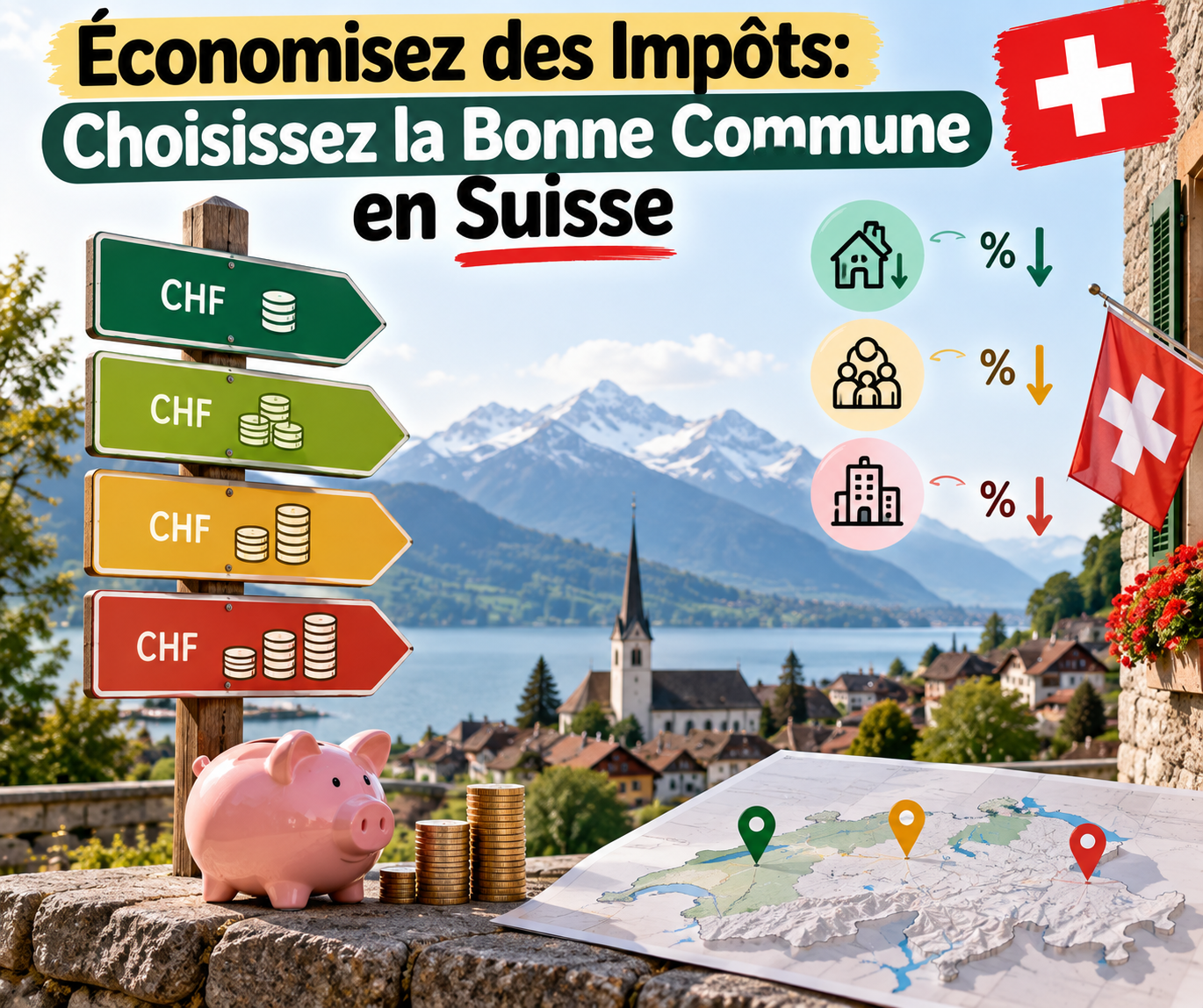
In Switzerland, you can save hundreds of Swiss francs (or thousands of Swiss francs) a year simply by choosing your place of residence. In this article, Save on Taxes: Choose the Right Municipality in Switzerland, We will understand Swiss taxation according to the municipality of residence.
Recommended products


Understanding Swiss taxation
In most countries around the world, taxpayers pay a single tax to the state. The state then distributes the taxpayer's tax on a pro rata basis to the regions and municipalities.
But this is not the case in Switzerland! Because Switzerland is a federal country.

As a result, each Swiss canton and each Swiss commune has a certain economic freedom and a certain political freedom.
🔍 For this reason, Each Swiss canton and each Swiss commune taxes their taxpayers differently!
Therefore, in Switzerland, when a citizen pays his taxes, in reality, the taxpayer has 3 taxes to pay:
- Cantonal
- Federal
- Communal
Cantonal tax

👉 Regarding cantonal tax, Swiss taxpayers are taxed according to their canton of residence. This is because cantonal tax funds the expenses of the taxpayer's canton of residence.
In Switzerland, cantonal taxes vary. In reality, some cantons have more "friendly" taxes than others.
Note that the higher the cantonal tax coefficient, the more tax the taxpayer will pay.
In 2024, for example, here is the taxation according to 4 Swiss cantons:
| Canton | Cantonal taxation (coefficient) |
|---|---|
| Bern | 302,5 |
| Vaud | 155 |
| Zurich | 98 |
| Basel (City) | 50 |
⚠️ Note that in the majority of cases, a coefficient difference of 100 means thousands of CHF of difference paid in taxes!
In my case, to give an example, I currently live in the canton of Vaud and in 2024, I paid 155 coefficient for my cantonal taxes (for a single person).
Unfortunately for me, as far as cantonal taxes are concerned, with 155 of the coefficient, The canton of Vaud is one of the highest taxing cantons in Switzerland! 👎
Indeed, in 2024, cantonal taxes varied between 50 and 302.5 coefficients depending on the canton of residenceHowever, the majority of cantons have requested a coefficient between 90 and 125.
Federal Tax

👉 Federal tax is a tax that the Swiss taxpayer pays for the functioning of the Swiss Confederation.
In reality, federal income tax is a low-cost tax at the time of the final tax return. Typically, federal income tax represents less than 15% of the total tax liability when filing a tax return.
Municipal tax

👉 Regarding municipal tax, Swiss taxpayers are taxed according to the municipality of residence. This is because the money from municipal tax finances the expenses of the municipality of residence.
It is difficult to say what the average Swiss rate is for municipal taxation, because municipal taxation varies greatly from one municipality to another.
For example, in Switzerland in 2024, the municipality with the lowest coefficient was 50, while the municipality with the highest coefficient was 525.
To give an example regarding the municipalities around my residence, I read that there are municipalities that tax with a coefficient of 55 and others that tax with a coefficient of 72.
🔍 Note thata coefficient difference of 10 may seem insignificant, but in reality, it is a difference of hundreds of CHF!
When filing the citizen's tax return, municipal taxes take a significant part of the taxpayer's final tax assessment. Moreover, in certain Swiss municipalities, municipal taxation is more pronounced compared to cantonal taxation.
Leo's Tax Return Example
I simulated on vaudtax (official site for declaring taxes in the canton of Vaud), the tax situation of Leo (imaginary person), which is:
- Bachelor
- Lives alone
- No children
- 25 years
- No religion
Regarding income, I noted that Leo is an employee with an annual income:
- Salary = 70,000 CHF net per year at 100% (employee)
Next, I simulated some typical deductions for a Swiss citizen. In order to lower Leo's tax burden a little. That is,
- Shipping costs = 1,669 CHF
- Meals out = 3,200 CHF
- Annual amount paid in health insurance = CHF 4,800
- Social deduction for housing = 11,000 CHF
Please note that in this article, I have not listed all possible deductions. I have only listed the main ones!
Example of Leo – Residence in Gland
With the simulation of Leo's tax situation. First, I simulated that Leo lives in Gland (VD). Therefore, here are the taxes:
- Canton of Vaud = 6,243 CHF
- Municipality of Gland = 2,546 CHF
- Federal tax = 695 CHF
👉 Which gives a final tax burden of CHF 9,484
Example of Leo – Residence in Prangins
Now, I've simulated that Leo has moved to Prangins. Note that Prangins is a neighboring town of Gland.
In this example, let's imagine that Leo moved 2 kilometers away, and he pays the same amount of rent that he paid in Gland.
Note that Prangins is still in the canton of Vaud.
To simplify this exercise, I noted that the distance to work is exactly the same compared to when Leo lived in Gland.
In reality, the real question is, “Will Leo pay less tax for simply moving 2 kilometers from his old apartment?”
- Canton of Vaud = 6,243 CHF
- Municipality of Prangins = 2,295 CHF
- Federal tax = 695 CHF
👉 Which gives a final tax burden of CHF 9,234
🔍 That is to say, yes, Leo will pay less taxes for living in Prangins! That is to say, 250 CHF of savings per year, for a simple move 2 kilometers away!
Why? Because at the time of writing, Prangins has a tax coefficient of 55, while Gland has a tax coefficient of 61.
👉 Therefore, this coefficient difference of 6 means hundreds of CHF saved in taxes. 😉
Example of Leo – Residence in the canton of Fribourg
Now let's pretend that Leo has moved to the canton of Fribourg.
I'm not an expert on Fribourg tax returns. However, I downloaded Fritax (the official Fribourg tax return software) and ran a simulation as close as possible to Leo's tax return in the canton of Vaud.
Here is the difference between Vaud and Fribourg:
- Taxable amount 58,200 CHF – Vaud cantonal tax with coefficient at 155 = 6,243 CHF tax
- Taxable amount 58,200 CHF – Fribourg cantonal tax with coefficient at 96 = 4,907 CHF tax
👉 In this case, there is a difference of more than CHF 1,200 in taxation between the two neighboring cantons for the same tax return. Which is incredible!
How to analyze municipal taxes?

👉 To analyze taxes for municipalities, there is a website that allows you to analyze the taxes of each municipality, from the official website of the Swiss Confederation. It is called the tax coefficient. Here is the link here.
Indeed, once the filters are selected, it is possible to analyze income taxes and wealth taxes from the site, as well as other important aspects, such as deductions or tax scales, for example.

This is super informative. However, it's a shame that there's currently no filter to analyze which municipalities tax in ascending order.
How to analyze cantonal taxes?
We use the same official comparator (Tax coefficient) that I used for municipalities, which I wrote before.
The difference is that in the filters, you have to select the filter ”all the county towns of the canton”.
Then, as in the case of Leo written previously, we analyze the taxes according to a possible canton of residence.
Wealth tax
👉 In Switzerland, income tax and wealth tax are taxed separately.
For example, if a person works and earns CHF 60,000 per year from a salary, in reality, they will not necessarily be taxed in the same way compared to the person who has CHF 60,000 in their bank account.
👉 Therefore, wealth tax and income tax can have a different financial impact on the taxpayer's pocket.
Wealth tax (stock market)
👉 Note that the wealth tax also applies to investors or shareholders who hold an ETF and who occasionally wish to sell part of their ETF (or stock market share) portfolio.
🔍 Indeed, in Switzerland, The sale of shares is considered a sale of fortune. However, be careful, dividends received from a stock market investment are considered income!
For example, under Swiss law, selling CHF 100 of a stock means selling a fortune, while receiving CHF 100 of a dividend is considered an income gain.
| Sell 100 CHF of a share | Wealth tax | Low Tax |
| Receive 100 CHF from a dividend | Income tax | Taxable at approximately 15% once the tax return is completed |
🔍 Therefore, Analyzing the place of residence according to taxation, wealth and income can have a big economic impact on tax burden!
An example of wealth tax
To give an example, let's imagine Peter (an imaginary character), who has 1 million CHF in his bank account, and he wants to spend 50,000 CHF per year for 20 years.
As I write these lines, in order to give 3 examples, I have researched and analyzed 3 tax differences in 2024. Depending on the place of residence in Switzerland.
| Commune | Sagogn (80%) | Sage (190%) | Vionnaz (110%) |
| Canton | Glarus (95%) | Bern (302.5%) | Valais (100%) |
| Total concerning cantonal and municipal taxation | 175% | 492.5% | 220% |
In this example, we conclude that wealth taxes are much more favorable in the municipality of Sagogn in Glarus compared to the municipality of Sauge in Bern.
👉 Note that this 200 kilometer trip means a saving of thousands of CHF in taxes each year.
Therefore, if Peter has the same expenses in Sauge or Sagogn, he will be able to live longer with his fortune if he lives in Sagogn compared to if he lives in Sauge.
Save on Taxes: Choose the Right Municipality in Switzerland
Conclusion
In Switzerland, each canton and each municipality has a different tax system. Because there are different taxes depending on each municipality and canton in Switzerland.
Therefore, in Switzerland, The place of residence has a significant impact on the taxes of the Swiss taxpayer.
Indeed, sometimes moving your place of residence a few kilometers can save the taxpayer thousands of Swiss francs per year!
Note that there may be tax differences between a wealth tax and an income tax. Indeed, according to Swiss law, owning money does not necessarily have the same tax rate as earning money.
If you're thinking of digging deeper into taxes, you can check out the tax differences by municipality or canton on the official website of the Swiss Confederation. Here's the link here.
Save on Taxes: Choose the Right Municipality in Switzerland
Subscribe for the latest news
You have a frugalist or minimalist project and you want a training? Click ”here”.
My pages
- About me
- Saving / Frugalism
- Blog
- Shop
- Contact
- Training and E-book
- Invest
- Minimalism
- My account
- Newsletter
- Basket
- Order confirmation
Lastest Post
- After 10 years of investing in ETFs: which ETF would I choose?
- Financial freedom: why the first 100,000 are the hardest
- The best advice in the world to save
- The Neon bank, the summary
- How does digitalization influence minimalist?
How does this blog live?
Overall, this blog lives on sharing a frugal and minimalist lifestyle.
For a question of transparency towards the readers. All recommended products are in order to make life cheaper, simpler and to promote the essentials.
Basically, my only income with this blog comes:
- Trainings that I realize
- Promo codes for the products I use
- Donations that readers make in exchange for neutral information.
About me
I decided to create this blog to develop and help readers who are looking for a simpler and more economical life.
Compared to before, I was a person who consumed a lot until the day I realized that my consumption made me sadder and poorer 😑
Now I prefer the minimum of my needs to be happy and achieve my financial freedom.
Without realizingI started to focus on saving and investing to depend on a boss for as little time as possible and to speed up my personal projects.
As a result, I am getting richer in a way that I never imagined since I have an average salary in Switzerland.
It is for this purpose that I decided to create this blog. In order to share and learn with other people who seek freedom and simplicity 😉
Are you rather minimalist or frugal Jonny?
I am as minimalist as I am frugalist. However, there are situations where I lean more towards an art of life.
To conclude, I think the most important thing is to feel comfortable in your lifestyle 😊
Save on Taxes: Choose the Right Municipality in Switzerland
Save on Taxes: Choose the Right Municipality in Switzerland
Leave a Reply