
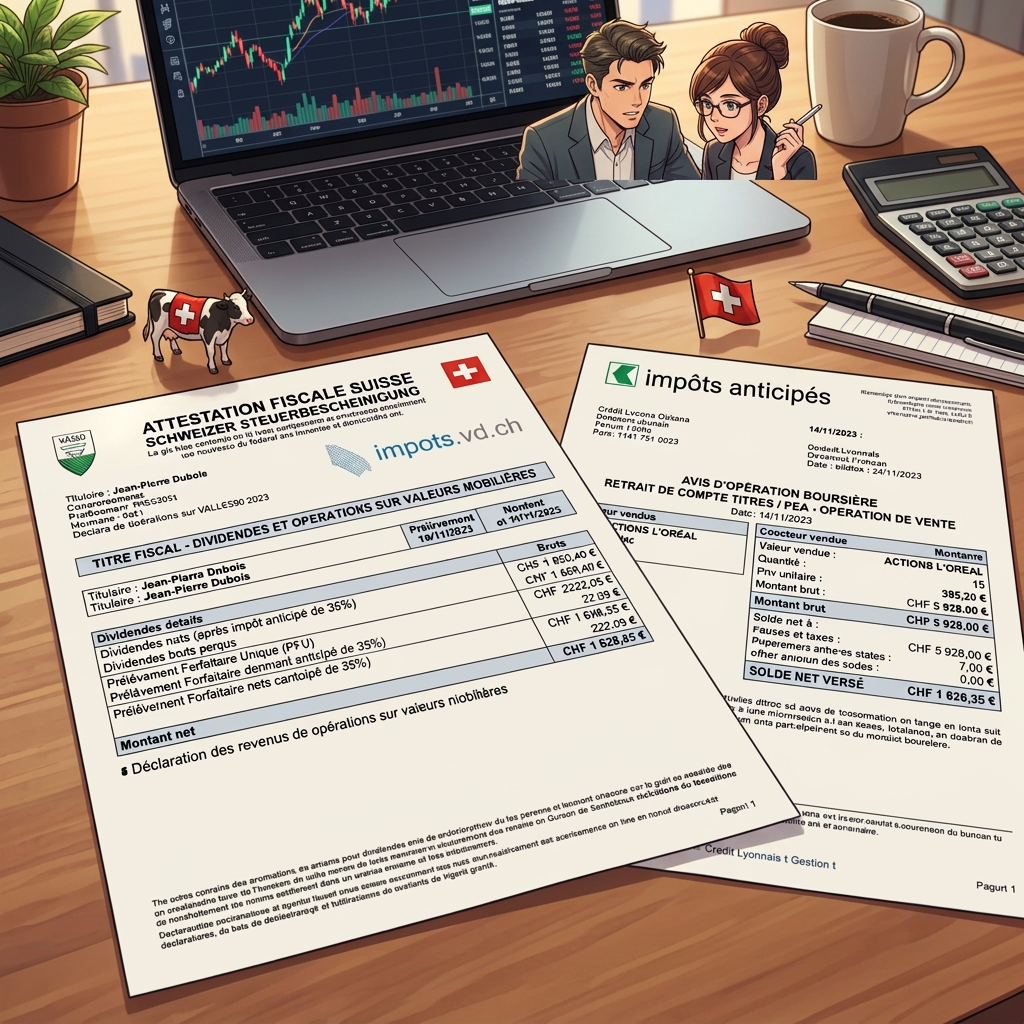
We all enjoy dividends or occasionally withdrawing stock market capital. But from a tax perspective. What is the best tax option: Dividends or Stock Market Withdrawal? ? 🤔
Recommended products


⚠️ The tax amounts shown in the simulations are specific to the chosen example. They may vary depending on the canton, municipality, deductions, personal circumstances, and investments held.
Introduction: What is the Best Tax Choice: Dividends or Stock Market Withdrawal?
We all like to receive dividends or occasionally withdraw money from our stock portfolio.
But from a tax perspective, one question often comes up:
Is it more advantageous to receive dividends or to sell part of one's investments to withdraw capital? 🤔
The answer is a little more nuanced than one might think.
In this article, I will revisit a concrete example with 1,000,000 CHF of stock market assets, in order to compare three situations: Paul, Lara and Joe.
Taxation = as important as stock market gains
I have always maintained that stock market fees are extremely important when investing. But taxation is also important.
So I wanted to run a simulation based on Vaud Tax*, the tax reporting system of the canton of Vaud, to understand what happens when an investor receives dividends or sells part of their portfolio.
And there is an important difference between the two.
Stock market taxation in Switzerland: dividends and share sales
For a private investor who manages their wealth normally:
- Dividends are taxable income.
- The sale of shares or ETFs is not subject to capital gains tax.
- The securities held are part of taxable wealth. and are therefore taken into account for wealth tax.
In the canton of Vaud, wealth tax is based in particular on the market value of movable property, after deduction of debts.
This is therefore a crucial distinction:
- Receiving CHF 30,000 in dividends creates taxable income.
- Selling CHF 30,000 worth of securities from one's private wealth is, in principle, not taxable income.
However, be aware that this last rule concerns private wealth and the management of private wealth. A person considered a professional investor may be taxed differently.
Let's now see what this looks like with three examples.
🔺 Example 1: Paul owns 1,000,000 CHF without dividends
Let's imagine Paul.
He is single, born in 1990, and owns 1,000,000 CHF invested in a Swiss ETF.
To simplify, let's assume that he receives no dividends during the year and makes no withdrawals.
In my original simulation, without taking into account other tax deductions and focusing on the stock market portion, the calculated tax was approximately:
5,954 CHF.

His net worth after this tax would therefore be:
1,000,000 CHF – 5,954 CHF = 994'046 CHF
This first situation will serve as our reference.
🔺 Example 2: Lara owns CHF 970,000 and receives CHF 30,000 in dividends
Let's move on to Lara now.
It has:
- CHF 970,000 in investments
- CHF 30,000 in dividends received during the year
This leads to CHF 1,000,000 in financial assets before taking taxes into account.
Let's analyze the taxation of dividends:
Understanding withholding tax on dividends
This is where we need to be careful about a common confusion.
When a Swiss dividend is paid, it may be subject to the advance tax of 35 %.
Based on a dividend of CHF 30,000, this represents:
30,000 × 35 % = 10,500 CHF
In this case, the investor initially receives:
30,000 – 10,500 = 19,500 CHF
But this CHF 10,500 does not necessarily constitute a final tax.
Indeed, for a person domiciled in Switzerland who correctly completes their tax return and meets the conditions, the Swiss withholding tax can be refunded or credited against taxes owed.
In my case, for example, when I receive a Swiss dividend, the state initially levies 35% in tax. But after my Vaudtax tax return, the actual tax is reduced to approximately 15%.
That's why it's essential to declare your securities and income correctly. Because sometimes, there's a possibility of recovering some money from dividends.
Simplified example
| Amount | |
|---|---|
| Gross dividend | +30,000 CHF |
| Advance tax of 35 % | -10,500 CHF |
| Amount initially received | 19,500 CHF |
But the tax mechanism concerning dividends does not stop there: the gross dividend of CHF 30,000 can still be recovered by reducing taxes.
| Amount | |
|---|---|
| Gross dividend | +30,000 CHF |
| Advance tax of 35 % | -10,500 CHF |
| Amount initially received | +19,500 CHF |
| Recovering 20 % of the dividend via the tax return | + 6,000 CHF |
| Total | +25,500 CHF |
In this example, the final tax on dividends is CHF 4,500.
And what about foreign dividends?
For foreign dividends, the situation may be different, as withholding tax may be levied in the country of origin. Part of this withholding tax may be recoverable depending on the applicable tax treaty.
However, it should be noted that for a private investor, regardless of the origin of the dividend, once all the forms have been completed, the final tax will almost always be around 15% of the dividend received.
And what about Lara's case?
In Lara's case, she pays two different taxes:
- approximately CHF 4,500, concerning the CHF 30,000 in dividends received
- approximately CHF 3,110, regarding his stock market fortune of CHF 970,000
The actual amount depends in particular on the person's total income, deductions, municipality of residence, and the exact characteristics of the securities held. This example is purely illustrative.
The important idea to remember is this: Earning CHF 30,000 in dividends is a more taxable income than earning CHF 30,000 in stock market growth. It is this characteristic that distinguishes Paul from Paul in tax terms.
According to Vaudtax, Lara's final tax is:
- 7,610 CHF
Therefore, the total yield is:
1,000,000 CHF – 7,610 CHF = 992,390 CHF
Paul with no dividends vs. Lara with 30,000 CHF in dividends
| Situation | Financial assets | Dividend income |
|---|---|---|
| Paul | 1,000,000 CHF | 0 CHF |
| Lara | 970,000 CHF | 30,000 CHF |
In reality, with comparable financial assets, A person who receives CHF 30,000 in dividends adds taxable income to their tax return..
This is where the main tax issue lies. It is preferable to choose stock market growth over dividend distribution.
🔺 Example 3: Joe sells 30,000 CHF from his portfolio
Now, let's imagine Joe.
At the beginning of the year, he owned: CHF 1,030,000 in investments.
During the year, he decided to sell some of his shares to recover: 30,000 CHF in cash.
30,000 CHF in cash.
He receives no dividends. But he sells part of his stock holdings.
At the end of the year, his portfolio is therefore worth: 1,000,000 CHF, like Lara or Paul.
To put it simply:
- Beginning of the year: 10,300 shares at 100 CHF = 1,030,000 CHF
- Sale during the year: 300 shares = 30,000 CHF
- Year-end: 10,000 shares at CHF 100 = 1,000,000 CHF
Is selling securities better than receiving dividends?
The question is therefore: Does Joe have to pay tax on the 30,000 CHF he withdrew?
In the case of a private investor, No, because he sold his shares..
The sale of an investment of private wealth constitutes in principle a private capital gain, which is exempt from income tax in Switzerland.
This obviously does not mean that Joe escapes all taxation: his remaining securities continue to be part of his wealth, which is taxable. The withdrawal of CHF 30,000 from the sale is not, in itself, an income of CHF 30,000 subject to income tax..
According to VaudTax, in this example, in the end, Joe will pay the same amount of tax as Paul: 5,934 CHF
In summary, its total yield is:
CHF 1,030,000 – sale of CHF 30,000 = CHF 1,000,000 – CHF 5,934 in taxes = 994'046 CHF
So, dividends or withdrawals?
This is where our comparison becomes interesting.
- Paul has 1,000,000 CHF in his portfolio.
- Lara receives 30,000 CHF in dividends, but ultimately she has 1,000,000 CHF in her portfolio
- Joe sells 30,000 CHF worth of securities, but he ultimately has 1,000,000 CHF in his portfolio.
From a tax perspective, the three operations are therefore not equivalent:
| Strategy | Main tax treatment |
|---|---|
| Paul: to keep his titles | Wealth tax |
| Lara: to receive 30,000 CHF in dividends | Dividend tax + wealth tax |
| Joe: sell 30,000 CHF of private securities | No tax on the sale of securities, just wealth tax |
Taking into account the results of this article, here is the final tax assessment for Paul, Lara, and Joe.
| Stock market heritage | Total taxation | Stock market wealth after taxes |
|---|---|---|
| JOE CHF 1,030,000 in stock market assets – withdrawal of CHF 30,000 ( | 5'954 CHF | 994'046 CHF ✔ |
| PAUL 1,000,000 CHF without dividends | 5'954 CHF | 994'046 CHF ✔ |
| LARA 970,000 CHF of market capital + 30,000 CHF of dividends | 7,610 CHF | 992,390 CHF |
Ultimately, Lara is the loser in this comparison, as she loses approximately 1,600 CHF in taxes due to her dividends.
Conclusion: What is the best tax choice: Dividends or Stock Market Withdrawal?
So, what is the best tax option? Dividends or stock market withdrawals?
For a private investor in Switzerland, the general answer is:
- A dividend is taxable income.
- The sale of securities from private assets is generally not subject to capital gains tax.
- The securities held remain subject to wealth tax

In our example, Lara receives CHF 30,000 in dividends: this CHF 30,000 must be declared as income. This makes her pay approximately CHF 1,600 more in taxes than the others.
That is why, in certain situations, Selling part of your portfolio can be more tax-efficient than specifically seeking dividend-paying investments..
But be careful: This is not a universal rule and it is not investment advice.
Taxation depends on the canton, the municipality, the type of securities, their country of origin, the taxpayer's personal situation and the classification of the investment activity.
FAQ: What is the Best Tax Choice: Dividends or Stock Market Withdrawal?
Are dividends taxable in Switzerland?
Yes. For a private investor domiciled in Switzerland, dividends generally constitute a taxable income. They must therefore be declared in the tax return, in addition to the value of the securities which is included in the calculation of wealth tax.
The amount of tax actually paid depends in particular on the canton, the municipality, other income and deductions of the taxpayer.
Is it more tax-efficient to receive dividends or to sell shares?
From a tax perspective, Selling securities from one's private wealth can be more advantageous than receiving a dividend., because dividends are taxable income, whereas private capital gains are in principle exempt from income tax in Switzerland.
This does not mean that selling stocks is always better. The choice also depends on the investment strategy, transaction costs, expected return, diversification, and personal circumstances.
Do you have to pay taxes when you sell shares in Switzerland?
For a private investor, The gain realized from the sale of shares is in principle exempt from income tax..
For example, if you buy a share for 100 CHF and sell it for 130 CHF, the gain of 30 CHF is generally not subject to income tax if you are considered a private investor.
On the other hand, the securities you hold are part of your wealth and may therefore be subject to wealth tax.
Is it possible to withdraw money from a stock portfolio without paying tax?
Yes, under certain conditions.
If you are a private investor and you sell some of your shares or ETFs, the amount withdrawn is not automatically considered taxable income.
However, a distinction must be made the amount withdrawn of profit made on the sale. Taxation depends in particular on your tax status and the nature of the transaction.
How does the withholding tax of 35 % on Swiss dividends work?
In Switzerland, Swiss dividends are generally subject to a advance tax of 35 %.
This tax is levied at the time the dividend is paid. For a person domiciled in Switzerland who correctly declares their income and securities, the withholding tax can generally be recovered or credited against taxes owed, subject to applicable conditions.
Therefore, one should not confuse the 35 % withholding tax with the final dividend tax rate.
Can the withholding tax on dividends be recovered?
Yes, in part, for a taxpayer domiciled in Switzerland who correctly completes their tax return and complies with the conditions stipulated.
Withholding tax is primarily designed as a mechanism to guarantee tax compliance. It can be credited or refunded when the taxpayer correctly declares the relevant income and assets.
That is why it is important to declare your dividends and securities in his tax return.
What is the tax on 30,000 CHF of dividends in Switzerland?
There is no single tax amount applicable to CHF 30,000 of dividends.
Tax depends in particular on the canton and municipality of residence, other income, deductions and the personal situation of the taxpayer.
In the example presented in this article, a simulation performed with VaudTax results in a tax burden of approximately CHF 4,500 out of CHF 30,000 in dividends. This figure is for illustrative purposes only and should not be considered as a general tax rate.
Are foreign dividends taxable in Switzerland?
Yes. Foreign dividends must in principle be declared in Switzerland and may be subject to income tax.
In addition to Swiss tax, the country of origin may levy a withholding tax. Depending on the country and the applicable tax treaty, a portion of this withholding tax may be recoverable or taken into account.
The taxation of foreign dividends can therefore be more complex than that of Swiss dividends.
Are dividend ETFs less tax-efficient in Switzerland?
Not necessarily.
An ETF that distributes income generally generates taxable income for the investor. However, an ETF that reinvests its income does not necessarily eliminate all taxation: taxable income may also have to be declared according to the tax treatment applicable to the fund.
Therefore, it is best not to choose an ETF solely because it distributes or does not distribute dividends.
Taxation must be analyzed in conjunction with the precise structure and tax treatment of the ETF.
Is it better to invest in dividend-paying stocks or growth stocks in Switzerland?
There is no universal answer.
Dividend-paying stocks may be suitable for an investor who wants to receive regular distributions. Growth-oriented stocks or ETFs may be attractive for someone who prioritizes wealth accumulation.
From a tax perspective, however, dividends constitute taxable income, while private capital gains are in principle exempt from income tax.
The choice must therefore take into account taxation, expected return, risk, fees and the investor's objectives.
Is a stock market withdrawal considered income?
In principle, A withdrawal from the sale of securities from private wealth is not taxable income simply because you are withdrawing money..
For example, selling CHF 30,000 worth of shares to obtain CHF 30,000 in cash does not automatically mean that you have earned CHF 30,000 of taxable income.
We must distinguish the capital withdrawal of income from capital, such as a dividend or interest.
What is the tax difference between a dividend and a capital gain on a stock market?
The main difference is as follows:
Dividend: In principle, it constitutes taxable income.
Private capital gain: The gain realized from the sale of a security is in principle exempt from income tax for a private investor.
This is an important distinction in Swiss stock market taxation and one of the reasons why a strategy based on periodic withdrawals can, in certain situations, be fiscally advantageous.
Is it possible to live off your stock portfolio without receiving dividends?
Yes.
An investor may, for example, maintain a portfolio composed of stocks or ETFs and periodically sell a small portion of their positions to finance their expenses.
For a private investor, capital gains realized from these sales are in principle exempt from income tax.
This approach is sometimes called systematic withdrawal from the portfolio.
However, it must be adapted to the portfolio's return, the level of risk, the investment horizon, and the amount needed each year.
Does a private investor pay tax on stock market gains in Switzerland?
As a general rule, No.
Capital gains realized by a private investor on securities from their private wealth are in principle exempt from income tax.
However, there are criteria that allow us to distinguish between a private investor and one considered a professional investor. In the latter case, the tax treatment may differ.
It is therefore important not to generalize this rule to all people who invest in the stock market.
When is a stock market investor considered a professional in Switzerland?
The distinction between private investor and professional investor depends on several criteria.
The tax authorities examine, in particular, how the activity is carried out, its frequency, the duration of ownership, the financing of the operations and other circumstances.
The conditions for qualifying as a private investor are therefore important to know before implementing a strategy of frequent withdrawals or trading.
Dividends or stock market withdrawal: which to choose in Switzerland?
For a private investor who wants to generate regular cash flow, Selling part of your portfolio can be more tax-efficient than receiving the same amount as dividends., since dividends are taxable as income while private capital gains are in principle exempt.
However, taxation should not be the sole criterion for decision-making.
The best choice depends on the overall strategy: asset allocation, risk, expected return, fees, liquidity needs and personal tax situation.
Which is the better tax option: dividends or stock market withdrawals?
Within the general framework of Swiss taxation, Withdrawals from the sale of securities from private wealth may be more tax-efficient than a dividend of the same amount..
In the example in this article:
- Paul retains CHF 1,000,000 in investments without dividends; ;
- Lara holds CHF 970,000 and receives CHF 30,000 in dividends; ;
- Joe holds CHF 1,030,000 then sells CHF 30,000 worth of securities.
The simulation shows that Lara bears a higher tax burden in this example, mainly because the CHF 30,000 in dividends constitutes taxable income.
But the results can be very different depending on each taxpayer's situation.
What is the best tax choice: Dividends or Stock Market Withdrawal?
Subscribe for the latest news ✍
You have a frugalist or minimalist project and you want a training? Click ”here”.
My pages
- About me
- Saving / Frugalism
- Blog
- Shop
- Contact
- Training and E-book
- Invest
- Minimalism
- My account
- Newsletter
- Basket
- Order confirmation
Lastest Post
- Investing Abroad: What the Exchange Rate Doesn't Tell You
- How to optimize your 2nd pillar?
- 2nd pillar: The basics to understand
- Top 5 tips to make money from home
- How to invest 1200 CHF – Simplified version
How does this blog live?
Overall, this blog lives on sharing a frugal and minimalist lifestyle.
For a question of transparency towards the readers. All recommended products are in order to make life cheaper, simpler and to promote the essentials.
Basically, my only income with this blog comes:
- Trainings that I realize
- Promo codes for the products I use
- Donations that readers make in exchange for neutral information.
About me
I decided to create this blog to develop and help readers who are looking for a simpler and more economical life.
Compared to before, I was a person who consumed a lot until the day I realized that my consumption made me sadder and poorer 😑
Now I prefer the minimum of my needs to be happy and achieve my financial freedom.
Without realizingI started to focus on saving and investing to depend on a boss for as little time as possible and to speed up my personal projects.
For several years I have felt happy and I have become richer in a way that I would never have imagined given that I have an average salary in Switzerland.
What is the objective of this blog?
The goal is to share and learn with others who seek freedom and simplicity 😉
Are you rather minimalist or frugal Jonny?
I am as minimalist as I am frugalist. However, there are situations where I lean more towards an art of life.
To conclude, I think the most important thing is to feel comfortable in your lifestyle 😊
What is the best tax choice: Dividends or Stock Market Withdrawal?
Leave a Reply