
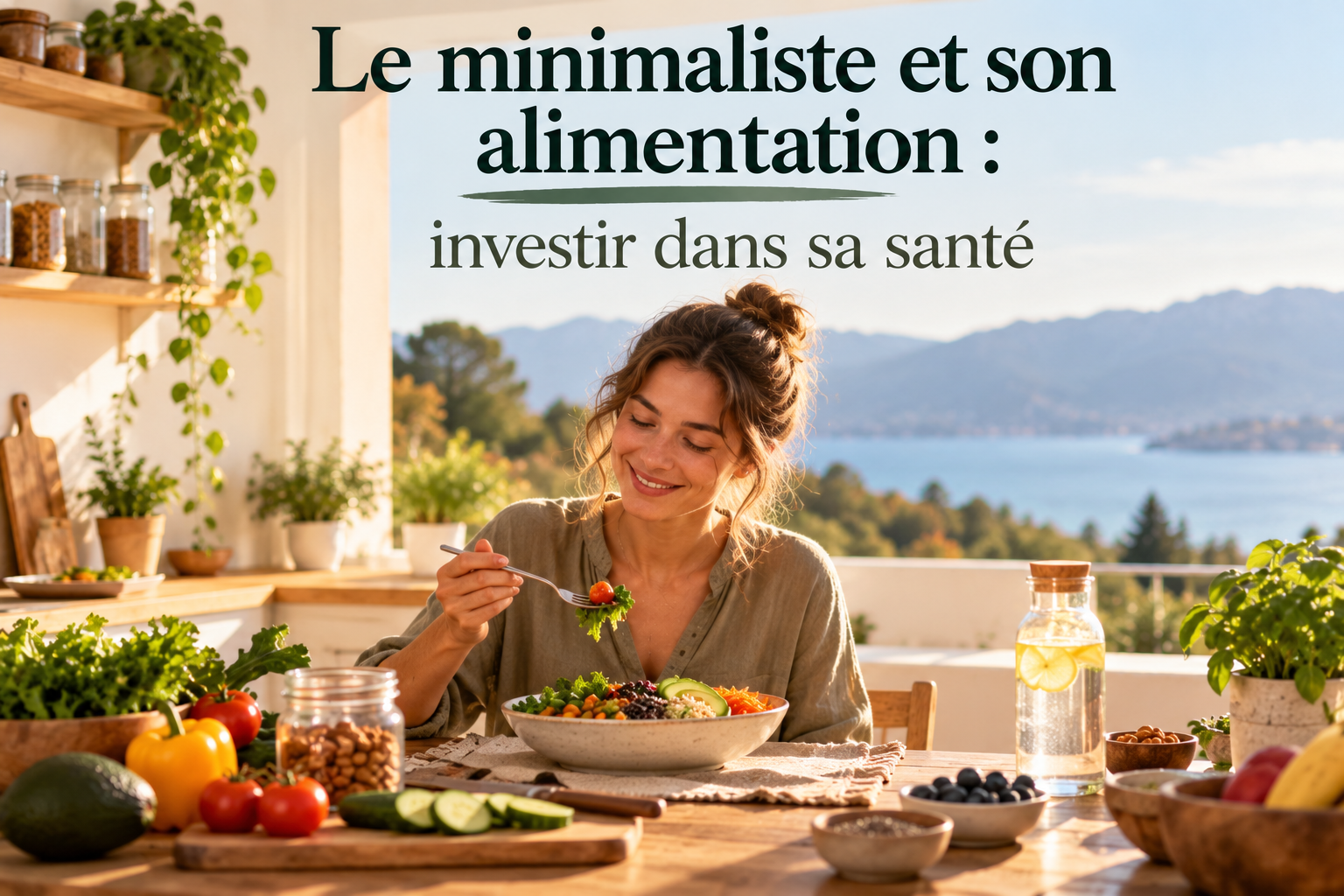
To live a minimalist life, you need to live a healthy life. Here's an article to understand how essential food is for a minimalist and frugal person: The minimalist and their diet: investing in your long-term health 😉
Recommended products


Introduction: The minimalist and their diet: investing in their health
When you decide to live in a minimalist and frugal, We often think about the long term.
Spending less, avoiding unnecessary things, saving more and finding more time are all ways to build a freer life.
But there is one element that is sometimes forgotten: our health.
What is the point of having built up a large fortune, having plenty of free time and having reduced expenses if, at 60 or 70 years old, our health prevents us from fully enjoying this freedom?
For me, taking care of one's diet is therefore an integral part of a minimalist and frugal approach.
Good nutrition: a long-term investment
We often try to save a few euros today. But we sometimes forget that certain daily habits can have much more significant long-term consequences.
Food is part of it.
Some research suggests that a significant improvement in diet could be associated with a significant gain in life expectancy.
Indeed, a study published by researchers from the University of Bergen1. concluded that a good balanced diet increases the chances of living longer and healthier (approximately 10 years).
However, we must remain cautious with these figures: These are not guaranteed years of life.. Life expectancy depends on many factors: genetics, physical activity, environment, sleep, access to healthcare, socioeconomic status, alcohol or tobacco consumption, etc.
But this is important to remember:
Sustainably improving one's diet can help increase one's chances of living longer and, above all, staying healthy for longer.
For a minimalist, this seems particularly interesting to me.
We seek to simplify our lives in order to make the most of our time. Preserving our health allows us to make the most of this time.
The problem is: we haven't necessarily learned how to eat well.
There is a fairly simple difficulty: most of us have not received a proper nutrition education.
We have learned to read, to write, to work, to manage a budget… but much less to understand what we put on our plate every day.
For a long time, I thought I knew enough about the subject myself. Then I started to take a greater interest in nutrition and discovered that some of my ideas were incomplete.
For example, a product marketed as "healthy" is not necessarily the best choice. A pretty label, a marketing promise, or the presence of the word "natural" is not enough to determine the nutritional quality of a food.
Conversely, a simple and minimally processed food generally does not require particularly sophisticated marketing.
This led me to adopt a very simple rule:
Look more closely at what a product actually contains rather than what its packaging wants us to believe.
Foods I limit
I prefer to talk about’foods I limit rather than "forbidden" foods.
Here are some of the things I try to limit my consumption of:
- alcohol
- ultra-processed products
- crisps and other very salty snacks
- very sugary biscuits and cereals
- sodas and sugary drinks
- energy drinks
- desserts and products very high in added sugars
- industrial sauces
- the delicatessen
- excessive consumption of red meat
- very sweet spreads

The general principle could be summarized as follows:
The more a food is regularly ultra-processed and consumed in large quantities, the more I try to limit its place in my diet.
This obviously does not mean that an occasional bag of chips will "destroy" our health.
If I feel like eating some chips during an evening with friends, I can do it.
The problem arises when this type of food becomes the basis of the daily diet.
The foods I prefer
Conversely, I try to build my diet around simple and varied foods, known to be beneficial to health if consumed in reasonable quantities:
- seasonal vegetables
- seasonal fruits
- legumes (lentils)
- unsalted nuts (walnuts, cashews)
- eggs
- white fish (cod, sardines),
- goldfish (trout, salmon)
- olive oil
- banana
- spinach
- water as the main drink

I also appreciate local products when possible.
For example, a salad made with seasonal vegetables, lentils, an egg and a drizzle of olive oil can make a relatively simple, economical and nourishing meal.
This is also where minimalism and food can come together.
You don't need a kitchen full of dozens of different products. A few simple and inexpensive ingredients are enough to prepare a huge number of healthy meals.
Why I am moving towards a pesco-vegetarian diet
I think you've understood, my diet is mainly pesco-vegetarian.
This means that I mainly eat plant-based foods and fish.
I absolutely do not consider this feeding method to be a universal rule.
Each person must find a diet adapted to their needs, preferences, culture and possibly their medical constraints.
My goal is therefore not to convince anyone to become vegetarian, vegan or pesco-vegetarian.
The objective is much simpler: think about what we eat and try to gradually improve our habits.
In my case, I realized that this diet is a very good balance between taste and the nutritional intake I need.

Let's not become food extremists
This is a point that seems essential to me.
Eating healthily does not mean striving for perfection.
I prefer a generally healthy diet with occasional indulgences rather than an extremely restrictive diet that is impossible to maintain.
Imagine someone who mainly eats simple foods, fruits, vegetables, legumes and fish, but who eats pizza with friends once a month.
Is this really a problem?
In my opinion, what you really need to look at is all of our habits over several months and several years, rather than a single meal.
Health is not a competition.
Origin also matters
I also pay attention to the origin of the food.
A local and seasonal product can be very interesting, especially because it allows us to better know its origin and to favour short supply chains.
But here again, we must avoid shortcuts.
«"Local" does not automatically mean "healthy" and "organic" does not automatically mean "perfect".
Ideally, several criteria should be considered: nutritional quality, level of processing, origin, seasonality, quantity consumed and diversity of diet.

And above all: the quantity
Even an interesting food must be consumed in appropriate proportions.
It's a concept I sometimes tend to forget: A food is not necessarily good or bad in itself. Context and quantity matter enormously.
Water is essential for our bodies. This does not mean that we should drink absurd amounts.
Nuts are nutritionally valuable. However, eating several hundred grams a day is not optimal.
Variety, moderation and common sense are therefore essential.
Let's not judge other people's diets
It's a mistake I made myself.
When we discover a new way of eating, we can quickly think that we have found "the right method".
Then we look at others and wonder why they don't do the same as us.
I now think it's better to avoid this attitude.
We can share our knowledge, explain why we have changed certain habits, and discuss the documented benefits or risks.
But We don't need to judge others.
Each person has their own history, habits, constraints, and preferences.

Conclusion: protect what we already own
Minimalism is about focusing on what truly has value. And what could be more precious than our health?
- Our money can be invested.
- Our time can be freed up.
- Our house can be decluttered.
But our health also deserves to be considered as an asset to be preserved.
It's not about eating perfectly, eliminating all pleasures, or becoming obsessed with every ingredient.
It's simply a matter of doing better food choices over the long term
I am not a nutritionist and this article obviously does not replace the advice of a healthcare professional.
But I am convinced of one thing:
If our goal is to build a minimalist and frugal life over several decades, taking care of our diet is part of the investment.
Because ultimately, the real objective is not simply to live longer. It's mainly about being able to Make the most of these extra years.
The minimalist and their diet: investing in their health
Subscribe for the latest news ✍
Do you have a frugalist project and would you like training? Click”here” and filled out the form
I suggest you read my tab”Frugalist” to read the main changes to save and become financially independent as quickly as possible.
My pages
- About me
- Saving / Frugalism
- Blog
- Shop
- Contact
- Training and E-book
- Invest
- Minimalism
- My account
- Newsletter
- Basket
- Order confirmation
Lastest Post
- After 10 years of investing in ETFs: which ETF would I choose?
- Financial freedom: why the first 100,000 are the hardest
- The best advice in the world to save
- The Neon bank, the summary
- How does digitalization influence minimalist?
How does this blog live?
Overall, this blog lives from sharing a frugal and/or minimalist lifestyle.
For the sake of transparency towards readers, all the products recommended are intended to make life cheaper and simpler.
Essentially, my only income from this blog comes from the training courses I conduct, promo codes for products I use, and donations readers make in exchange for neutral information.
About me
Faced with not very effective financial education, as was my case before. I actually decided to create this blog following a change in my life since my early adult life.
Compared to before, I was a person who consumed a lot until the day I understood that my consumption was making me sadder and poorer. From now on, I prioritize the minimum of my needs to be happy and achieve financial freedom.
Without realizing it, I also began to prioritize savings and investments to depend on a boss for as short a time as possible and to accelerate my personal projects.
For several years I have felt happy and I have become richer in a way that I would never have imagined given that I have an average salary in Switzerland.
It is for this purpose that I decided to create this blog. To share, learn and teach with others who seek freedom, simplicity and long-term wealth.
Are you rather minimalist or frugal Jonny?
I am both a minimalist and a frugalist. However, there are situations where I lean more towards an art of living.
To conclude, I think the most important thing is to feel comfortable in your life and I have found a balance between these lifestyles without reaching the extremes.
Leave a Reply