
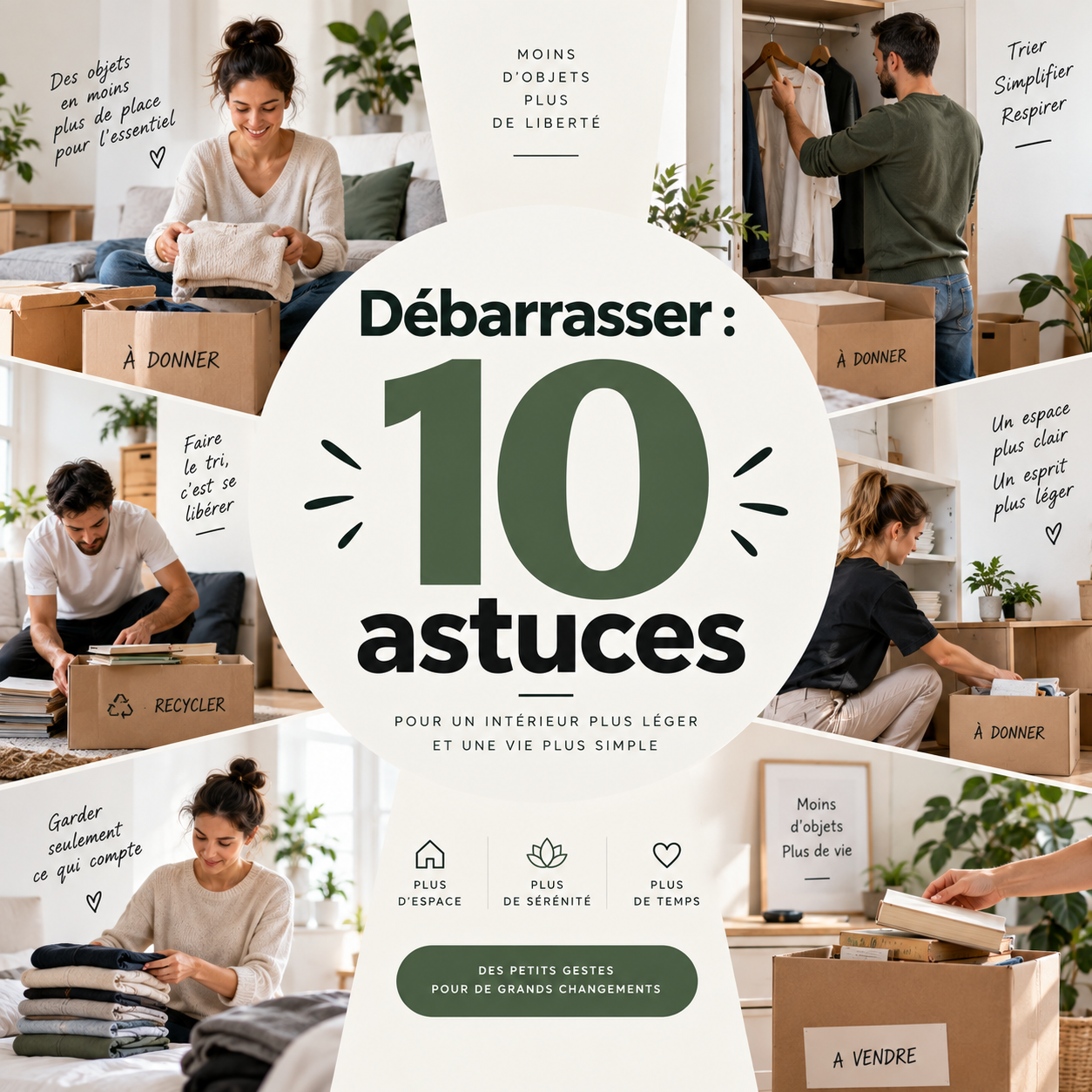
When we become minimalists. One of the first steps is to want to get rid of bulky or useless objects. In my opinion, here are the top 10 tips to get rid of them.
Recommended products


One in two French people believe they own too many possessions.
According to an article from HuffPost1, one in two French people admit that they own too many objects.
The problem isn't necessarily knowing that you need to declutter. The most difficult thing is often knowing how to do it. where to begin, or to succeed in parting with objects that one keeps "just in case".
Why declutter your home?
Getting rid of unnecessary items allows you to:
- make storage easier
- save space
- clean faster
- to have a calmer and more pleasant interior
- reduce the time spent looking for your belongings
- visually lighten your home
The goal is not to live with nothing. It's more about keep what is useful or important and to eliminate what clutters our lives and causes frustration.
So here it is 10 categories to sort to start decluttering your home simply.
10 tips for decluttering
1. Sort through the electronic equipment

Electronic devices are particularly easy to accumulate. An old phone, an MP3 player, headphones that no longer work, or an old speaker often end up at the bottom of a drawer.
Before keeping a device, simply ask yourself this question:
«"Do I still use it, or do I have good reason to believe I actually will?"»
This allows you to sort and discard:
- old phones and MP3 players
- old cables and chargers
- unused headphones
- old speakers
- defective or obsolete devices
However, be careful not to throw away electronic devices with ordinary waste: take them to an appropriate recycling facility.
2. Reduce hygiene and care products

The bathroom is a place where things quickly accumulate: shampoos, soaps, creams, beauty products, household products…
Start by eliminating what is expired, empty, unused or that you no longer appreciate.
A more minimalist bathroom is also easier to tidy and clean.
3. Sort through the spices

Spices take up little space individually, but their accumulation can quickly become problematic.
Sometimes we buy a spice for a single recipe, then forget about it. A few months later, we buy the same one again without remembering that it's already in the cupboard.
Regularly take inventory of your spices and prioritize keeping those you actually use.
The goal is not to have a complete collection, but a selection tailored to your kitchen.
4. Get rid of uncomfortable clothes

A garment can be very beautiful and yet never be worn.
Shoes that hurt, uncomfortable pants, a T-shirt that doesn't make you feel good… If you systematically avoid wearing them, why keep them?
A garment that remains constantly in the wardrobe takes up space without actually serving a purpose.
Keep the clothes that make you feel good and that you actually wear.
5. Limit the number of kitchen utensils

The kitchen is another major source of accumulation.
Garlic press, potato masher, kitchen gadgets, utensils in multiple copies… Some can be very practical, but others remain at the bottom of a drawer for years.
Ask yourself:
«"When did I last use this utensil?"»
Items that are rarely used take up space, complicate storage, and make drawers harder to clean.
6. Declutter the office

A cluttered desk can quickly become a source of distraction.
Start by removing:
- pens that no longer work
- dry felt-tip pens
- duplicates
- old, useless papers
- the supplies you never use
The goal is simple: Keep only what you need for work within easy reach.
A clearer workspace also makes it easier to find your belongings.
7. Keep two sets of bedding per bed

For many households, two sets of bedding per bed are more than enough:
- a game currently in use
- a spare set during washing
Of course, needs vary from person to person and situation to situation. But if your closet is overflowing with sheets and covers, it's a category worth sorting through.
Bedding is particularly bulky and can take up a lot of storage space.
8. Sort through the memories

Souvenirs are probably the most difficult items to declutter, as they have emotional value.
But An object is not necessarily essential to preserve a memory..
If you have a box or a cupboard full of memories, take each item and ask yourself:
«"Does this object still represent something important to me?"»
You can keep the memories that have real sentimental value and let go of those whose origin you no longer even remember.
9. Get rid of furniture that is no longer needed

There is a vicious cycle in accumulation:
The more items you own, the more furniture you need to store them.
Then, once the unnecessary items have been eliminated, some furniture itself becomes superfluous.
An empty or almost unused piece of furniture can therefore be an excellent candidate for decluttering.
Less furniture also generally means More floor space and less surface area to dust.
10. Don't decorate solely to fill empty spaces.

Decorating your home is a matter of taste. There are no rules saying that an interior must be minimalist.
On the other hand, the problem arises when we add objects simply because a space seems "too empty".
An empty wall isn't necessarily a problem. On the contrary, The empty space also allows you to highlight the few decorations that you choose to keep.
Remember, an interior doesn't need to look like a museum to be pleasant to live in.
Decluttering also makes cleaning easier
One of the main benefits of decluttering is often underestimated: Cleaning is easier when surfaces are clear.
Fewer items means:
- fewer surfaces to dust
- fewer objects to move before cleaning
- faster storage
- easier access to different areas of the house
However, a word of caution is needed: decluttering alone does not guarantee a dust-free, odor-free, or pest-free home. On the other hand, A less cluttered home makes regular maintenance much easier.

Bonus: a few more tips for decluttering
Before concluding this article, I wanted to share some other tips for decluttering. For example:
- throw away excess rags and sponges
- Dispose of unused or expired household products
- eliminate duplicate tools
- sell the purchased products "just in case"«
Conclusion: Don't postpone decluttering.
Don't see decluttering your home as a punishment, but as an opportunity.
After you've sorted everything, you'll finally:
- better find your things
- to have a cleaner interior
- to have a more zen interior
- be proud of the interior of your home
Often, getting rid of our belongings is the solution to problems, but ironically, we create problems by keeping our belongings.

Subscribe for the latest news
You have a frugalist or minimalist project and you want a training? Click ”here”.
My pages
- About me
- Saving / Frugalism
- Blog
- Shop
- Contact
- Training and E-book
- Invest
- Minimalism
- My account
- Newsletter
- Basket
- Order confirmation
Lastest Post
- After 10 years of investing in ETFs: which ETF would I choose?
- Financial freedom: why the first 100,000 are the hardest
- The best advice in the world to save
- The Neon bank, the summary
- How does digitalization influence minimalist?
How does this blog live?
Overall, this blog lives on sharing a frugal and minimalist lifestyle.
For a question of transparency towards the readers. All recommended products are in order to make life cheaper, simpler and to promote the essentials.
Basically, my only income with this blog comes:
- Trainings that I realize
- Promo codes for the products I use
- Donations that readers make in exchange for neutral information.
About me
I decided to create this blog to develop and help readers who are looking for a simpler and more economical life.
Compared to before, I was a person who consumed a lot until the day I realized that my consumption made me sadder and poorer 😑
Now I prefer the minimum of my needs to be happy and achieve my financial freedom.
Without realizingI started to focus on saving and investing to depend on a boss for as little time as possible and to speed up my personal projects.
For several years I have felt happy and I have become richer in a way that I would never have imagined given that I have an average salary in Switzerland.
It is for this purpose that I decided to create this blog. In order to share and learn with other people who seek freedom and simplicity 😉
Are you rather minimalist or frugal Jonny?
I am as minimalist as I am frugalist. However, there are situations where I lean more towards an art of life.
To conclude, I think the most important thing is to feel comfortable in your lifestyle 😊
Getting Rid: Top 10 Tips
Leave a Reply