

Many people want to save money but don't know how to do it in the long term. In this article, FIRE Tax: Savings and Financial Balance, we will analyze a simple way to save and invest.
Recommended products


How to find financial balance?
First, we are all the same.
On the one hand, there is this desire to become financially free and on the other hand, there is this desire to live a life without worrying too much about the money spent.
In addition, if you are not careful, you can quickly lose hundreds or thousands of CHF per year in futile expenses.
👉 The question is how to find a simple method to balance savings, investment and spending? 🤔
➡️ An interesting method is FIRE Tax.
What is the FIRE tax?
👉 It is a percentage of savings of an income
In reality, with this technique, your income is divided into 2 categories:
- % for your expenses
- % for TAX Fire
Then the tax is divided between savings and investments! According to each person's desire.
What is the purpose of the FIRE tax?
Note that the goal of the FIRE tax is to save and grow your money.
To achieve this technique, it's very simple!
👉 Simply create a monthly standing order into your savings account to pay a percentage of your income.
Nowadays, it is easy to create a savings account. For example, some banking applications allow you to create a savings account in less than 30 seconds.
👉 Note that the most effective regarding the FIRE tax. It is to make the agenda based on income.
For example, if you receive your salary on the 25th. Just make a monthly bank order for the 26th. Note that this can be done in 1 minute. And in reality, this technique helps avoid spending temptations.
➡️ The goal is to give yourself a minimum goal that you want to save!
Why set a goal to save?
For several reasons. For example:
1) Carry out personal projects
2) If you leave your money in your main account, you risk spending it quickly without realizing it.
3) We are much more respectful with our budget when we have a limit.
👉 Here is a diagram to summarize the usefulness of creating the FIRE tax 😉
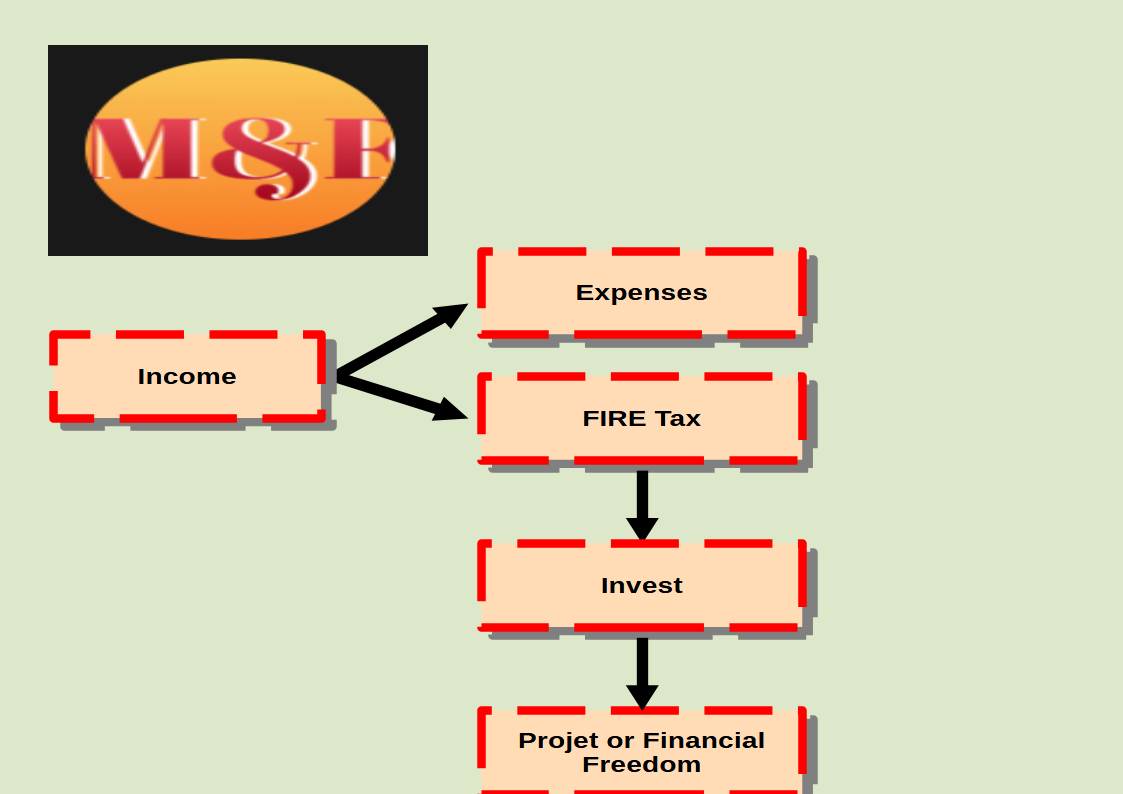
Goal = 50% savings 😉
Regarding the ideal percentage to save per month. This question will depend on each person's personal finances.
On the other hand, if it is possible. I propose to make a FIRE tax of 50%. That is, half of what you earn.
Example with a table.
| net income | Fire Tax |
|---|---|
| 5000 CHF | 2500 CHF |
| 4400 CHF | 2200 CHF |
➡️ I really like the 50% method! In reality, just divide the income by 2.
Indeed, with this financial technique. It is not complicated to calculate! It is:
- Half goes to expenses you consider essential.
- The other half goes to savings and investments
But.. 50% is huge for me!
If 50% is a lot for you, save the maximum according to your needs.
In reality, there is nothing stopping you from doing a FIRE tax of 25, 30 or 40% to start. And increasing it gradually.
Why would you want to save so much?
In reality, if you make financial investments with a good return. The more you invest your money, the more likely you are that your money will give you financial freedom 🤗.
Financial Freedom
First, if you don’t know what financial freedom is. Just read my articles on the tab ”Financial Independence FIRE'' in my page Saving / Frugalism.
In fact, according to fugalistefutée, a Canadian frugalist, here is an estimate of the number of years to work before becoming financially free.
Calculating an investment with an average of:
- 5% net annualized return
- 4% monthly expenses
- An average savings rate of 30, 40 or 50%
| Savings and investment rates | Years to become financially free |
|---|---|
| 30% | 28 |
| 40% | 21.6 |
| 50% | 16.6 |
We see that for every 10% of savings, there is approximately 6 more years to wait to achieve financial freedom.
Note that each additional year means one more year of being subject to the money of an employer or clients 😶
FIRE savings rate simulations
To give an example. Let's imagine that we earn with our passive income (for example, an ETF in the stock market) an average of 5% net annualized. How much will we have to save by saving monthly from 200 to 2000 CHF?
👉 So, here is what we earn in 10 years, if I base myself on the compound interest calculator from moneyland1.
| monthly saving | Amount saved after 10 years (out of pocket) | Amount earned just with interest | Total amount earned |
|---|---|---|---|
| 2000 CHF | 240,000 CHF | 70,045 CHF | 310,045 CHF |
| 1500 CHF | 180,000 CHF | 52,533 CHF | 232,533 CHF |
| 1000 CHF | 120,000 CHF | 35,022 CHF | 155,022 CHF |
| 500 CHF | 60,000 CHF | 17,511 CHF | 77,511 CHF |
| 200 CHF | 24,000 CHF | 7,004 CHF | 31,004 CHF |
As can be seen from the table. We can quickly save pretty money 😉 (310,000 CHF in 10 years, that’s not bad).
👉 In reality, the return is incredible if we only analyze the compound interest over the long term 🤩.
The 3a also counts in this savings 😉
If you invest your 3a on the stock exchange. For example, with the global strategy 100 at Viac or Finpension. You are already entering to contribute in this category of personal savings (FIRE tax) 😉
Note that on the day I write these lines, the annualized return has an average of 7% annualized over 10 years (this is not a guarantee for the future). That is, if in the future performance will be similar with past performance. The client will earn more money compared to my example at 5% 😉.
Apply the 4% rule
I wrote an article about the 4% rule.
In broad terms, the FIRE rule shows that a shareholder with a portfolio of US stocks, such as the SP500 for example, by spending 4% per year, he can maintain the same amount in his portfolio after 25 years (with a probability of success greater than 95 %).
Therefore, if we base ourselves on the rule of 4%. Based on the example from before:
| monthly saving | Total amount earned after 10 years Annual return of 5% | 4% Rule (spending capacity) |
|---|---|---|
| 2000 CHF | 310,045 CHF | 12’401 CHF per year |
| 1500 CHF | 232,533 CHF | 9’301 CHF per year |
| 1000 CHF | 155,022 CHF | 6’200 CHF per year |
| 500 CHF | 77,511 CHF | 3’100 CHF per year |
| 200 CHF | 31,004 CHF | 1’240 CHF per year |
➡️ As you can see, in this example, 10 years of savings and investments at 2,000 CHF per month with 5% of annualized return. Will correspond to more than 1,000 CHF per month of purchasing power for at least 25 years 😉 (according to the 4% rule)
What to invest in to become financially free?
This article is not investment advice. Investing may involve risk of losing money.
In reality, there are several financial investments to invest your savings. For example:
- Stock market investments (e.g. stocks or growth ETFs)
- Buying your main residence
- ETF with high dividend stocks
- Crowdfunding
- SCPI
Note that the majority of these investments are passive! On the other hand, it is advisable to have several investments in order to diversify your financial assets.
Note that each investment I have written has advantages and disadvantages. It is up to the investor to inform himself in order to have a good overview.
Conclusion
👉 The most important thing to understand with this article is that the FIRE tax is a good method to save and invest!
The basic principle is that with every earned income, a percentage must be put into a savings account! This money must then be invested or saved for an important project.
👉 Obviously, we need to find a balance regarding the % to save in the FIRE tax! In reality, the goal is to neither spend too much nor save too much.
I really like the principle of saving at 50% of income! It is simple and easy to calculate. just divide the income by 2
On the other hand, if you think that your expenses are at least and that your income does not allow you to save 50%. You can do the same strategy with 25, 30 or 40%.
👉 Remember, the sooner you start saving and investing, the sooner you will start enjoying the returns of compound interest.. That is, the less you will have to save out of your own pocket to achieve your financial goals!
Subscribe for the latest news
You have a frugalist or minimalist project and you want a training? Click ”here”.
My pages
- About me
- Saving / Frugalism
- Blog
- Shop
- Contact
- Training and E-book
- Invest
- Minimalism
- My account
- Newsletter
- Basket
- Order confirmation
Lastest Post
- After 10 years of investing in ETFs: which ETF would I choose?
- Financial freedom: why the first 100,000 are the hardest
- The best advice in the world to save
- The Neon bank, the summary
- How does digitalization influence minimalist?
How does this blog live?
Overall, this blog lives on sharing a frugal and minimalist lifestyle.
For a question of transparency towards the readers. All recommended products are in order to make life cheaper, simpler and to promote the essentials.
Basically, my only income with this blog comes:
- Trainings that I realize
- Promo codes for the products I use
- Donations that readers make in exchange for neutral information.
About me
I decided to create this blog to develop and help readers who are looking for a simpler and more economical life.
Compared to before, I was a person who consumed a lot until the day I realized that my consumption made me sadder and poorer 😑
Now I prefer the minimum of my needs to be happy and achieve my financial freedom.
Without realizingI started to focus on saving and investing to depend on a boss for as little time as possible and to speed up my personal projects.
As a result, I am getting richer in a way that I never imagined since I have an average salary in Switzerland.
It is for this purpose that I decided to create this blog. In order to share and learn with other people who seek freedom and simplicity 😉
Are you rather minimalist or frugal Jonny?
I am as minimalist as I am frugalist. However, there are situations where I lean more towards an art of life.
To conclude, I think the most important thing is to feel comfortable in your lifestyle 😊
Leave a Reply