
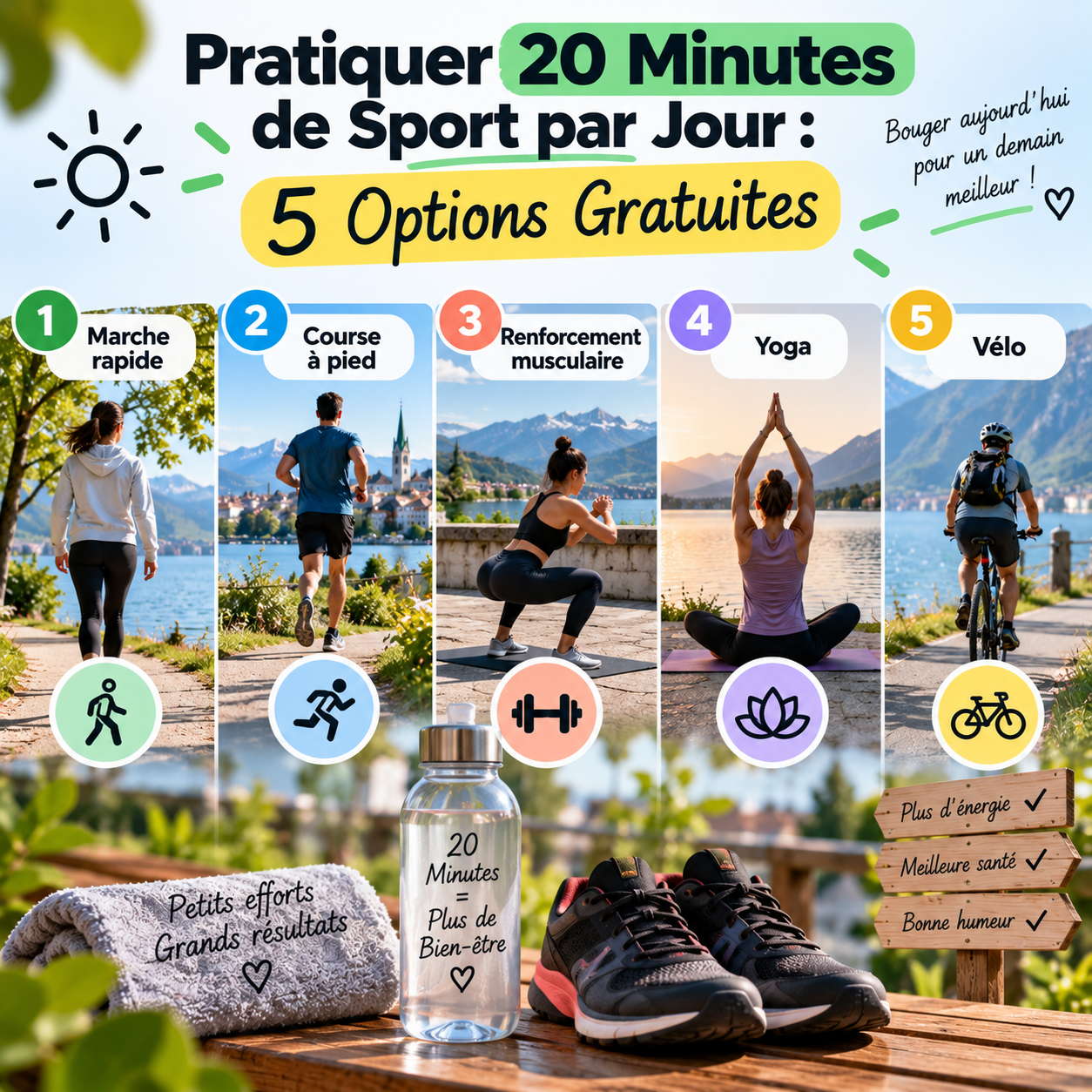
Exercise for 20 Minutes a Day: 5 Free Options 😊🏃♀️
Recommended products


Introduction: 20 Minutes of Exercise a Day: 5 Free Options
Practicing at least 20 minutes of sport per day is one of the best habits you can put in place to improve your physical and mental health.
Many people think that you need to spend several hours a week in a gym to be in shape.
However, just a few minutes of regular physical activity is enough to obtain numerous benefits.
In this article, we will see why sport is essential and discover 5 free physical activities that you can easily practice, without a subscription and with very little equipment.
Why is sport essential?
Physical activity is one of the pillars of good health.
According to numerous scientific studies, engaging in regular physical activity helps to:
- Reduce the risk of cardiovascular disease
- Reducing the risk of type 2 diabetes
- Preserve muscle mass
- Maintaining a healthy weight
- Improving sleep quality
- Reduce stress and anxiety
- Increase healthy life expectancy
Conversely, a sedentary lifestyle is now considered a major risk factor for health.

Avoid a sedentary lifestyle
We are spending more and more time sitting:
- At the office
- In transport
- In front of the television
- In front of the screens
Even a person who exercises several times a week can be considered sedentary if they remain seated for the majority of the day.
👉 That's why it's important to move regularly and do physical activity several times a week.
What is the ideal amount of exercise time?
According to WHO and ANSES recommendations, an adult should practice:
- 150 to 300 minutes of moderate physical activity per week or 75 to 150 minutes of intense physical activity
- Muscle strengthening at least twice a week
- Improve body flexibility at least twice a week
This represents approximately 20 to 40 minutes of physical activity per day.
👉 If you are currently sedentary, starting with 20 minutes a day is already an excellent goal.
The important thing is not to be perfect from the start, but to be consistent over the long term.
How much time should be spent on each exercise?
A complete physical activity should ideally combine three elements:
- cardio for the heart
- muscle strengthening for strength and muscle mass
- Mobility or flexibility exercises to maintain proper joint function.
One question comes up frequently: How much exercise should you do each week to stay healthy?
| Type of exercise | Weekly recommendation | Examples |
|---|---|---|
| Cardio | 150 to 300 minutes per week | Fast walking, running, cycling, swimming |
| Muscle strengthening | 2 sessions per week minimum | Push-ups, squats, planks, weight training, swimming |
| Flexibility and mobility | 2 to 3 sessions per week | Stretching, yoga, joint mobility, aqua gym |
| Balance (especially after 50) | 2 sessions per week | Yoga, one-legged exercises, tai chi |
To put it simply, here is a goal that is achievable for most people:
✅ 30 minutes of cardio, 5 days a week
✅ 20 to 30 minutes of muscle strengthening, twice a week
✅ 10 to 20 minutes of stretching or mobility exercises, 2 to 3 times a week
In total, this represents approximately 3 to 4 hours of physical activity per week, that is less than 35 minutes per day on average.

Sport and mental health
Sport not only improves physical fitness and promotes a longer, healthier life, but it also has a positive effect on the brain.
Physical activity notably promotes:
- Stress reduction
- Anxiety reduction
- An improvement in mood
- Better concentration
After a workout, many people experience a feeling of well-being thanks to the release of endorphins.
The purpose of this article
Since this blog is geared towards frugality and financial freedom, I've decided to share 5 physical activities:
✅ Free or almost free
✅ Easy to set up
✅ Accessible to the widest possible audience
✅ Available without a subscription
The goal is to show that it is not necessary to pay for a gym membership to stay healthy.
5 free physical activities
1. Fast walking 🚶

Brisk walking is probably the most underrated physical activity.
However, it improves:
- The cardiovascular system
- Endurance
- Blood circulation
Benefits
- Free
- Accessible to all
- Low risk of injury
- Accessible all year round
- Suitable for use anywhere (city or countryside)
Objective
Cardiovascular activity.
2. Running 🏃

Running remains one of the most effective sports for quickly improving endurance.
A few comfortable shoes are all you need to start.
There's no need to be fast. Even a slow jog provides numerous health benefits.
Benefits
- Very little equipment
- Excellent for cardio
- High energy expenditure
- Practicable everywhere
Objective
Cardiovascular activity.
3. Muscle strengthening at home 💪

Muscle strengthening is often neglected even though it is part of the official recommendations.
However, it is possible to work the entire body without any equipment. From the comfort of your own home.
For example :
- Pumps
- Squats
- Slots
- Sheathing
- Burpees
A 20-minute session can already be very effective.
Benefits
- Free
- Can be done at home
- Very little space required
- Develops strength and muscle mass
Objective
Muscle strengthening and body flexibility
4. The bicycle 🚴

If you already own a bicycle, it's one of the best physical activities possible.
Cycling allows you to:
- To improve endurance
- To work the lower body
- To limit the impact on the joints
It is also an excellent and economical means of transportation.
Benefits
- Very good cardio
- Low stress on the joints
- Allows you to discover new places
Objective
Cardiovascular activity.
5. Swimming 🏊

Swimming is probably one of the most complete sports.
She requests:
- The arms
- The legs
- The abdominal muscles
- The back
If you have access to a lake, river or the sea, it can be practiced for free.
If you have to go to a public swimming pool, the price should be acceptable if you go once or twice a week.
Benefits
- Works the whole body
- Little stress on the joints
- Excellent for endurance
Objective
Cardio, muscle strengthening, and body flexibility
Which sport should you choose based on your goal?
| Objective | Recommended activity |
|---|---|
| Lose weight | Fast walking, running |
| Improve your cardio | Running, cycling, swimming |
| Develop strength | Muscle strengthening |
| Protecting the joints | Walking, cycling, swimming |
| Reduce stress | Walking, swimming, cycling |
| Body flexibility | swimming, dancing, muscle strengthening |

Example of a simple sports program
Here is an example of a free weekly schedule.
| Day | Activity |
|---|---|
| Monday | Running (20 min) |
| Tuesday | Muscle strengthening (20 min) |
| Wednesday | Brisk walk (30 min) |
| THURSDAY | Muscle strengthening (20 min) |
| Friday | Cycling or brisk walking (30 min) |
| SATURDAY | Swimming (30 min) |
| Sunday | Leisurely walk (30 minutes) |
With this type of program, you can easily meet public health recommendations. However, in some cases, this program may not be sufficient.
Conclusion
Engaging in regular physical activity does not necessarily require an expensive subscription or sophisticated equipment.
Brisk walking, running, home strength training, cycling and swimming are simple, accessible and very effective activities.
👉 If you are currently sedentary, simply start with 20 minutes of physical activity per day. That's already an excellent start.
It may not be perfect, but it's already infinitely better than doing nothing.
In the long term, a few minutes a day can improve your health, energy, mood and quality of life.
As is often the case with personal finance or health, it's the small habits repeated over years that produce the biggest results. 😊
FAQ: How to do 20 minutes of exercise per day
Is 20 minutes of exercise a day enough?
Yes, in many cases. 20 minutes of exercise a day is an excellent starting point for improving your health and reducing sedentary behavior. While some recommendations suggest up to 150 minutes of physical activity per week, 20 minutes daily already helps improve endurance, fitness, and overall well-being.
However, doing 35 to 40 minutes of sport per day is more advisable.
What is the minimum recommended amount of exercise per week?
Health organizations generally recommend at least 150 minutes of moderate physical activity per week, or about 30 minutes per day for 5 days. It is also advisable to add muscle-strengthening and flexibility exercises.
What are the best free sports to stay in shape?
The most accessible free sports are:
- The brisk walk
- Running
- Muscle strengthening at home
- Swimming in lakes, rivers or the sea
- Aqua gym
- Stretching and mobility exercises
These activities require little or no equipment.
How long should you walk each day?
To maintain good health, many recommendations suggest between 30 and 60 minutes of brisk walking per day. Walking is one of the simplest and most effective physical activities for combating a sedentary lifestyle.
Should you do strength training every week?
Yes. Experts recommend at least two strength training sessions per week. Exercises like push-ups, squats, planks, and pull-ups help maintain muscle mass and strength as we age.
Why is flexibility important for health?
Flexibility helps maintain good joint mobility, reduces the risk of injury, and improves everyday movements. Stretching exercises, yoga, or mobility sessions are particularly beneficial after sitting for several hours.
How many times a week should you work on flexibility?
Ideally, you should practice flexibility or mobility exercises 2 to 3 times a week for 10 to 20 minutes. This is usually enough to maintain a good range of motion.
Is it possible to stay healthy without going to the gym?
Yes. It is perfectly possible to maintain good physical fitness without a gym membership. Walking, running, bodyweight exercises, and water activities already cover most of your physical needs.
What is the best sport for losing weight?
Cardiovascular activities such as brisk walking, running, swimming, or cycling are particularly effective for increasing energy expenditure. However, a balanced diet remains essential for sustainable weight loss.
Does sport improve mental health?
Yes. Regular physical activity helps reduce stress, anxiety, and depressive symptoms. It also promotes better sleep and improves mood through the release of endorphins.
What exercises can be done at home without equipment?
Among the most effective exercises:
- Pumps
- Squats
- Sheathing
- Slots
- Burpees
- Mountain climbers
- Stretching
- Mobility exercises
These exercises work the whole body without requiring any equipment.
What is the best time of day to exercise?
The best time is the one you can maintain in the long term. Some people prefer the morning to start the day with energy, while others prefer the evening to relieve stress.
How much time should you dedicate to cardio each week?
Current recommendations suggest between 150 and 300 minutes of moderate cardio per week. This corresponds to approximately 30 minutes of brisk walking or jogging five times a week.
Is it better to do 20 minutes of exercise every day or one long session?
In most cases, engaging in regular physical activity several times a week is more beneficial than a single intense session. Regularity helps develop healthy exercise habits and reduces the risk of injury.
Is it possible to improve one's physical condition after 40 or 50 years of age?
Absolutely. It's never too late to start physical activity. Combining cardio, strength training, and flexibility exercises can improve health, balance, mobility, and quality of life at any age.
Exercise for 20 Minutes a Day: 5 Free Options
Subscribe for the latest news
You have a frugalist or minimalist project and you want a training? Click ”here”.
My pages
- About me
- Saving / Frugalism
- Blog
- Shop
- Contact
- Training and E-book
- Invest
- Minimalism
- My account
- Newsletter
- Basket
- Order confirmation
Lastest Post
- After 10 years of investing in ETFs: which ETF would I choose?
- Financial freedom: why the first 100,000 are the hardest
- The best advice in the world to save
- The Neon bank, the summary
- How does digitalization influence minimalist?
How does this blog live?
Overall, this blog lives on sharing a frugal and minimalist lifestyle.
For a question of transparency towards the readers. All recommended products are in order to make life cheaper, simpler and to promote the essentials.
Basically, my only income with this blog comes:
- Trainings that I realize
- Promo codes for the products I use
- Donations that readers make in exchange for neutral information.
About me
I decided to create this blog to develop and help readers who are looking for a simpler and more economical life.
Compared to before, I was a person who consumed a lot until the day I realized that my consumption made me sadder and poorer 😑
Now I prefer the minimum of my needs to be happy and achieve my financial freedom.
Without realizingI started to focus on saving and investing to depend on a boss for as little time as possible and to speed up my personal projects.
For several years I have felt happy and I have become richer in a way that I would never have imagined given that I have an average salary in Switzerland.
It is for this purpose that I decided to create this blog. In order to share and learn with other people who seek freedom and simplicity 😉
Are you rather minimalist or frugal Jonny?
I am as minimalist as I am frugalist. However, there are situations where I lean more towards an art of life.
To conclude, I think the most important thing is to feel comfortable in your lifestyle 😊
Leave a Reply