
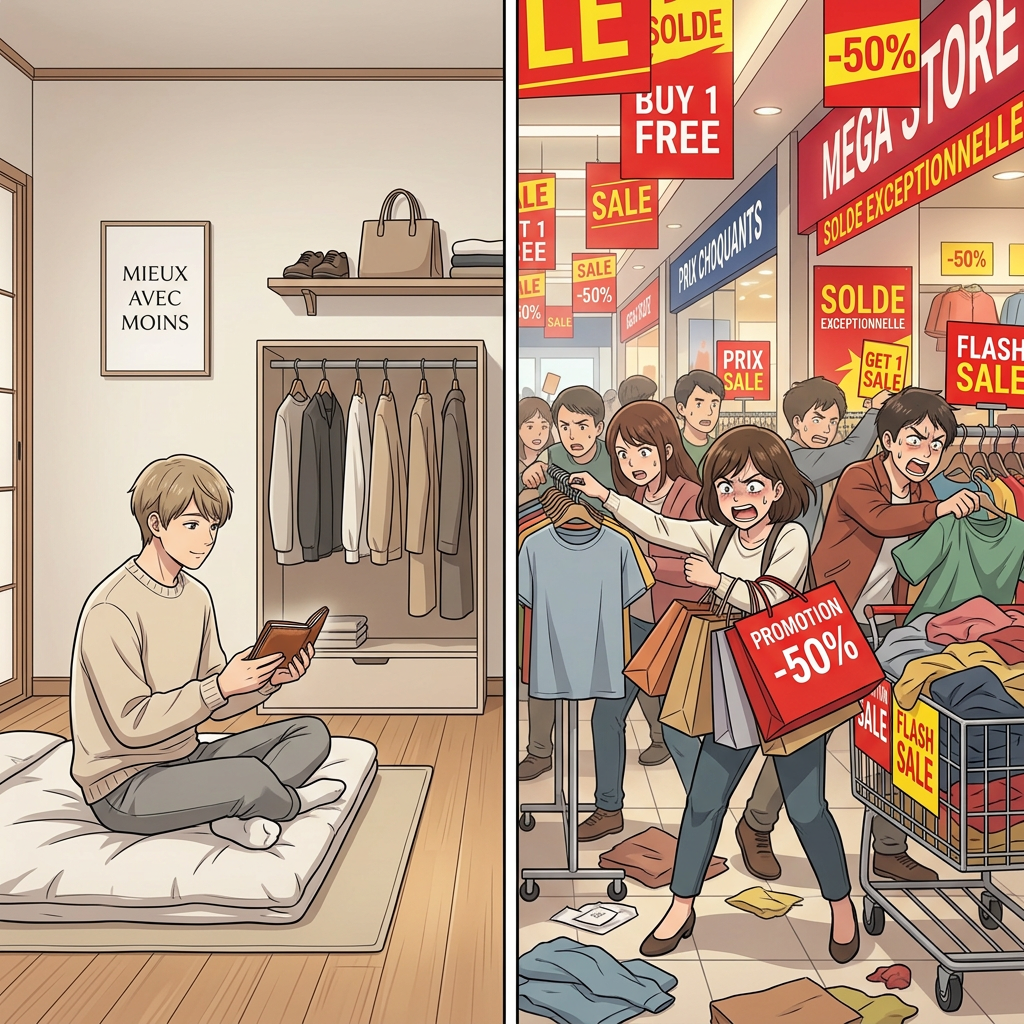
Discover how the minimalist reacts to the trap of promotions 😉
Introduction
Every day, you are exposed to promotions that seem, at first glance, very interesting.
For example :
- Buy one pair of leggings and get a discount code for a pair of slim jeans
- 30% off if you've been a member of a loyalty program for three years
- Free delivery on orders over CHF 40
- 20% off a pair of pyjamas if you buy a bra over 30 CHF
On paper, you think you're getting a good deal.
But ask yourself a simple question: Did you really need this product before you discovered the promotion?
This is precisely where minimalism brings another way of thinking about consumption.

A promotion is not necessarily a saving
A discount is only worthwhile if it relates to something you actually need.
Imagine you find a sweater for 50 CHF instead of 100 CHF. You effectively save 50 CHF… but only if you had planned to buy this sweater !
On the other hand, if you buy this sweater solely because it's 50 CHF off (%) and then don't use it, you haven't actually saved 50 CHF; you've simply spent 50 CHF on a product that's not very useful.
That's an important difference.

When a promotional product costs you a lot
Marketing likes to play on this confusion between «"pay less"» And «"save"».
For example: I sell you a subscription with a discount of 40 %.
You buy the subscription to take advantage of the promotion. But in the end:
- In 6 months, you only used this subscription for 3 days.
In this case, we see that this promotion did not save you any money.
For a minimalist, the question is therefore not:
«"How much can I save with this promotion?"»
But rather:
" Do I really need to buy this? »
This is the best advice for saving money 🤭.

Promotions: a manipulator of your emotions
The second problem with promotions is less visible: They can give you the impression that you need to buy quickly.
- «"Offer valid until this evening."»
- «"Only 2 hours left to take advantage of -40 %."»
- «"Last few items available."»
These messages create a sense of urgency.
This is, in fact, a classic marketing tactic.*.
The goal is to announce a product '‘‘'rare”"with a promotion that suggests this is truly an opportunity not to be missed.
In this case, you no longer have time to decide if you want to buy. You have to decide. quickly !
The objective is simple: to push you to consume without thinking!
Let's take an example: you're looking at a clothing website without planning to buy anything. You suddenly discover a jacket at -60% %, valid for only a few hours.
You start to think to yourself:
«"She's really interesting."»
Then :
«"At that price, it would be a shame not to buy it."»
And finally:
«"I might need it someday. Since the offer is temporary, I'll buy it."»
In truth, the initial need was nonexistent. You didn't need an extra jacket. But the fear of scarcity and the limited supply drove you to buy the jacket.
Minimalism is precisely about taking a step back from this type of situation. Because in reality, a minimalist ignores promotions and discounts. They prefer to listen to their needs, not those of marketing.

Minimalism: owning less, but above all, choosing more
Being a minimalist doesn't necessarily mean living with ten objects in an empty room.
The principle is rather to Keep what is truly useful or important to you and avoid superfluous possessions.
This directly relates to purchases.
Before buying something, you can ask yourself a few questions:
- Do I really need it?
- Do I already own something that performs the same function?
- Would I have bought it without the promotion?
- Will I actually use it regularly?
- Is this purchase worth the money and time I'm going to spend on it?
In minimalism, Money is not the only resource to protect: your time also counts.
Example: Paula and Sara: two ways of reacting to a promotion
Let's imagine two women, Paula and Sara.
They are the same age, both live in Moudon, wear the same size clothes and have exactly the same need: buy a jacket for winter.
They also have the same budget: 120 CHF maximum.
| Paula | Sarah | |
|---|---|---|
| Need | 1 jacket | 1 jacket |
| Maximum budget | 120 CHF | 120 CHF |
However, their consumption patterns vary:
Paula: attracted by the promotion
Paula finds a jacket online in Lausanne with a discount of 30%. She decides to take the train to go and buy it.
Once in the store, a pleasant surprise: the jacket was finally available at -50%, or 60 CHF.
Paula then thought to herself:
«"I saved 60 CHF. So I can buy something else!"»
She looks around and finds a belt for 30 CHF and a pair of shoes for 50 CHF.
Therefore, she leaves with all three items.
Result :
- jacket: 60 CHF
- belt: 30 CHF
- shoes: 50 CHF
- transport: 30 CHF
Total: 170 CHF. And an hour wasted in transit.
In addition, she returned home with two extra items that she did not initially need.
A few months later, she notices that she almost never uses the belt and that she no longer likes her shoes.
The promotion allowed her to pay less for certain items, but above all, it encouraged her to buy more. And ultimately, cluttering up his home with a few useless items.
Sara: stay focused on the need
Sara takes a different approach.
She first looks for a jacket that meets her needs, without focusing on promotions.
She happens to find a jacket in a shop near her home. The jacket costs 120 CHF and is not on sale.
Sara tries it on and likes it.
When it came time to pay, the shopkeeper, whom she knew, finally gave her a discount of 20 CHF.
The jacket therefore costs him 100 CHF.
Sara walks home and doesn't try to use the 20 CHF she "saved" to buy anything else. She keeps it.
A few months later, she's still using her jacket. She wore it all winter and is happy with it.

The real gain isn't always what you think it is.
Let's compare the two situations:
| Paula | Sarah | |
|---|---|---|
| Initial need | 1 jacket | 1 jacket |
| Money spent on clothes | 140 CHF | 100 CHF |
| Transport | 30 CHF | 0 CHF |
| Total spent | 170 CHF | 100 CHF |
| Bulky extra items | 2 | 0 |
| Time wasted in transport | 1 hour by train and bus | 10 minutes walking |
Paula wanted to take advantage of a good deal and ended up losing money. Sara simply wanted solve his need, and she solved it while spending less than Paula.
That makes all the difference.
Minimalism, therefore, doesn't mean systematically refusing sales. If you need to buy a jacket and it's genuinely on sale, why not take advantage of it?
The problem arises when The promotion becomes the reason to buy.
This is often the case: people often listen more to promotions than to their needs.

The tactical overview for the next two weeks: still as effective as ever
Have you spotted a product on sale and immediately want to buy it?
Before you pull out your bank card, try this very simple method: the 15-day rule.
The principle is simple: You wait 15 days before making your purchase.
During this period, you do not order the product and you avoid regularly returning to its page to convince yourself that you need it.
Why 15 days? Because a desire can be very strong when you discover a product or a promotion, then disappear a few days later.
Example
Imagine you are browsing the Internet and you find a jacket for 80 CHF instead of 160 CHF.
You immediately think to yourself:
«"This is a great deal! At -50 %, I can't pass it up."»
Instead of buying it immediately, you simply note the product and wait.
Most of the time, after a few days, you hardly think about it anymore.
After 15 days, ask yourself the question:
«"Do I still need this jacket?"»
If you answer no, you've probably just avoided an impulse purchase.
But if, after 15 days, you are still thinking about this jacket and you realize that you really need it, then you can reassess the purchase more calmly.

Conclusion
The next time you see a promotion, don't immediately ask yourself:
«"How much will I save?"»
Instead, ask yourself:
«"Would I have bought this product if it hadn't been on sale?"»
If the answer is no, there is a good chance that you are facing an additional expense rather than a real saving.
And if you're still hesitating, try the 15-day tactic. I think you'll save more by avoiding certain promotional purchases than by actually buying them.
Minimalism simply invites you to slow down, reflect, and distinguish a real need, a desire created by marketing.
Because in the end, the best purchase is not necessarily the one with the biggest discount.
In truth, sometimes the best purchase is the one you decide not to buy.
Subscribe for the latest news
You have a frugalist or minimalist project and you want a training? Click ”here”.
My pages
- About me
- Saving / Frugalism
- Blog
- Shop
- Contact
- Training and E-book
- Invest
- Minimalism
- My account
- Newsletter
- Basket
- Order confirmation
Lastest Post
- After 10 years of investing in ETFs: which ETF would I choose?
- Financial freedom: why the first 100,000 are the hardest
- The best advice in the world to save
- The Neon bank, the summary
- How does digitalization influence minimalist?
How does this blog live?
Overall, this blog lives on sharing a frugal and minimalist lifestyle.
For a question of transparency towards the readers. All recommended products are in order to make life cheaper, simpler and to promote the essentials.
Basically, my only income with this blog comes:
- Trainings that I realize
- Promo codes for the products I use
- Donations that readers make in exchange for neutral information.
About me
I decided to create this blog to develop and help readers who are looking for a simpler and more economical life.
Compared to before, I was a person who consumed a lot until the day I realized that my consumption made me sadder and poorer 😑
Now I prefer the minimum of my needs to be happy and achieve my financial freedom.
Without realizingI started to focus on saving and investing to depend on a boss for as little time as possible and to speed up my personal projects.
For several years I have felt happy and I have become richer in a way that I would never have imagined given that I have an average salary in Switzerland.
It is for this purpose that I decided to create this blog. In order to share and learn with other people who seek freedom and simplicity 😉
Are you rather minimalist or frugal Jonny?
I am as minimalist as I am frugalist. However, there are situations where I lean more towards an art of life.
To conclude, I think the most important thing is to feel comfortable in your lifestyle 😊
Leave a Reply