
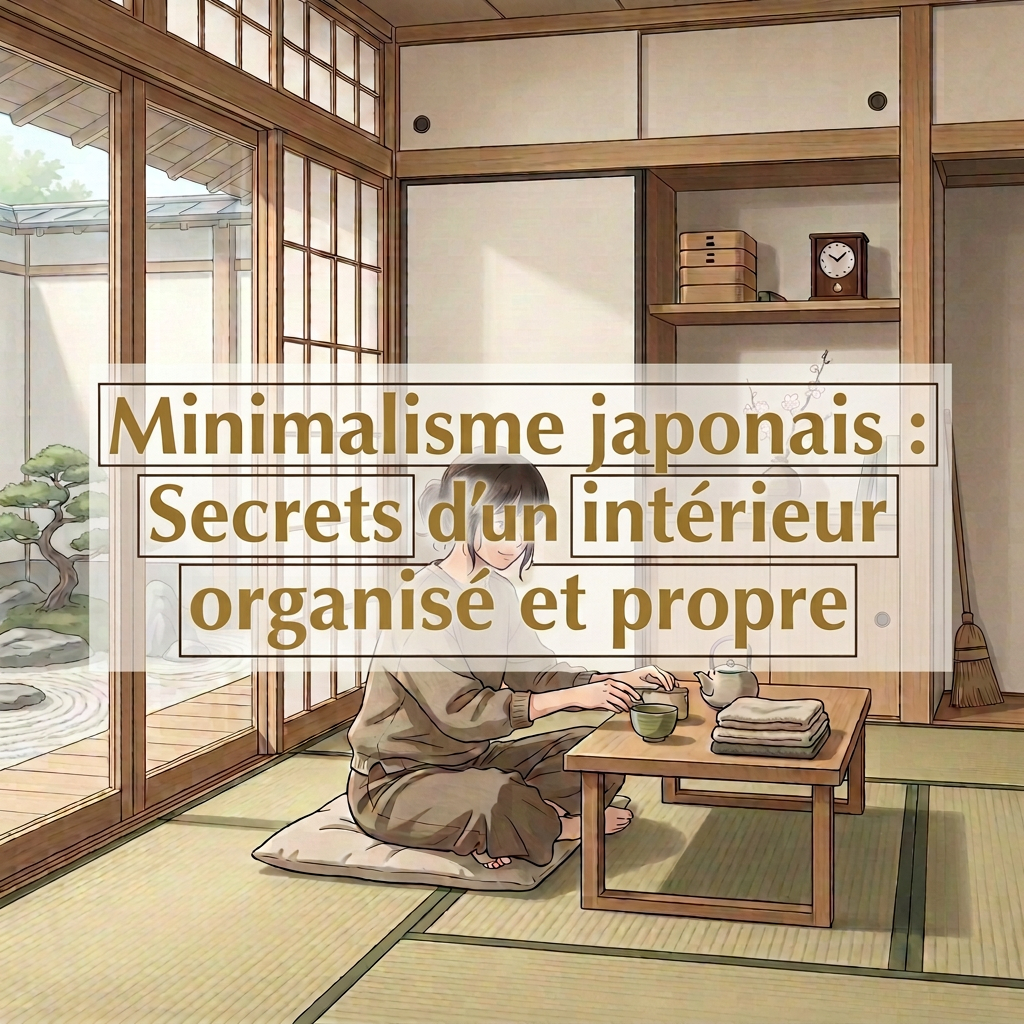
Japanese Minimalism: Secrets to an Organized and Clean Interior
Recommended products


Introduction
In Europe, the accumulation of objects and disorder often seem inevitable; Japanese interiors are distinguished by their simplicity, order, and often impeccable cleanliness.
For a European, tidying and cleaning can sometimes seem like a chore, a tedious task to be postponed indefinitely. Yet, in Japan, this is not the case for the majority of Japanese people. But why such a difference?
What strikes you when you discover a Japanese house is the lack of clutter. No useless objects accumulating, no dust settling, no feeling of suffocation in the face of a cluttered space.

For a European, this rigor can seem impressive, even intimidating. How do they do it? Why do they place so much importance on order and cleanliness? And above all, how can we draw inspiration from them to transform our own relationship with tidying and cleaning?
1. Minimalism: a philosophy of life rooted in Japanese culture
1.1. The concept of My : the art of empty space
In Japan, minimalism is not limited to an aesthetic trend. It is a philosophy of life rooted in concepts such as My (間)*, which refers to the space between objects, but also the space between sounds, words, or even thoughts.
In reality, the My is not simply emptiness: It is an active presence, a breathing that allows each element to breathe and take on its full meaning.
For example, Europeans often decorate their walls with numerous paintings and decorations, creating a colorful and cluttered environment. In contrast, the Japanese opt for a simpler style, keeping a single painting that becomes the focal point of the room.
Indeed, in a Japanese house, THE My This is manifested by simple interiors, often with understated colors, where each object has a specific function and location..
This minimalist approach not only reduces physical clutter but also clarifies the mind. Fewer objects mean fewer distractions, less stress, and more space for what truly matters: human connection, creativity, and well-being.

1.2. The Wabi-Sabi : the beauty of imperfection and simplicity
Another key concept in Japanese culture is the Wabi-Sabi (侘寂)*, a philosophy that celebrates the beauty of imperfection and simplicity.
A Western perspective tends to seek absolute perfection. But conversely, the Wabi-Sabi teaches that beauty resides in simple, natural, and imperfect things.
For example, if a cup is cracked, a European tends to replace it immediately, while a Japanese person analyzes this imperfect crack as a story to tell and keeps the cup.
In a Japanese home, this translates into natural materials (wood, stone, paper), neutral colors, and objects that age gracefully. Rather than hiding the marks of time, they are accepted as part of the object's history. This approach encourages owning less, but better, and above all, taking care of what one owns.
THE Wabi-Sabi This also influences the way the Japanese clean their homes. Cleaning is not seen as a punishment, but as an act of respect for one's environment and for oneself. Cleaning is also about purifying space and mind, creating a harmonious setting where one can recharge.
1.3. The Danshari The art of getting rid of the unnecessary
THE Danshari (断捨離) is a popular decluttering method in Japan, based on three principles:
- Dan (断): To refuse what is useless.
- Sha (捨): To get rid of what is superfluous.
- Ri (離): To detach oneself from what burdens us.
This method, popularized by organizing consultant Yamashita Hideko, encourages regularly decluttering to keep only the essentials. Unlike a European approach where one might accumulate items "just in case," the Danshari advocates a constant questioning of one's possessions.
For the Japanese, decluttering is not a chore, but a liberation. By getting rid of what is unnecessary, one makes room for what truly matters. This practice is often associated with a feeling of lightness and serenity.

2. Regular cleaning: a daily ritual
2.1. The Soji : Cleansing as a spiritual practice
In Japan, cleaning, called Soji (掃除), goes far beyond a simple household chore. It is a daily practice that is often associated with spiritual values.
In Japanese schools, for example, students clean their own classrooms every day, almost without supervision from the teacher.
This activity, called Sōji Time, teaches them respect, responsibility and the importance of taking care of their environment.
THE Soji It is not seen as a punishment, but as an opportunity to cultivate discipline, humility, and gratitude. Cleaning one's home also means cleaning one's mind, refocusing, and preparing a welcoming space for oneself and others.

2.2. The Oosouji : the big seasonal cleaning
In addition to daily cleaning, the Japanese practice the Oosouji (大掃除), a major deep cleaning that usually takes place at the end of the year, before the New Year. This ritual purifies the home to welcome the new year in the best possible conditions.
THE Oosouji It's a family activity where everyone participates. Every corner of the house is cleaned, belongings are tidied, things are gotten rid of, and offerings are prepared for Shinto deities, such as the Kami, who are supposed to visit homes during the holiday season.
This major cleanup is not just a matter of hygiene: it is a symbolic act that allows us to turn the page, take stock of the past year and prepare for a new beginning.
2.3. Natural and appropriate tools and methods
The Japanese use natural cleaning tools and methods that make this task easier and more efficient. For example:
- Microfiber mops and brooms Lightweight and easy to handle, they allow for quick and effortless cleaning.
- Natural products Vinegar, baking soda and Marseille soap are often used to avoid harsh chemicals.
- Smart storage solutions : Cupboards, storage boxes and shelves are designed to optimize space and facilitate access to items.
While in Europe, people often think that without the latest Dyson vacuum cleaner costing 700 CHF, you can't properly clean your home…
Furthermore, it's worth noting that the Japanese have developed ingenious storage techniques, such as the method KonMari Marie Kondo's method involves organizing by category (clothes, books, papers, etc.) and keeping only what "sparks joy." This greatly simplifies cleaning your home.

3. The collective spirit: cleaning as a shared responsibility
3.1. A society founded on group harmony
In Japan, the individual is not conceived of independently of the group. Japanese society is deeply marked by a collective spirit (wa (和), which values harmony, cooperation and common well-being.
This mentality is reflected in all aspects of daily life, including the way Japanese people maintain their spaces, whether public or private.
Contrary to a Western perspective that often emphasizes autonomy and individual expression, the Japanese believe that the good of the group takes precedence over personal desires. Cleaning one's home, neighborhood, or even workplace is not just a matter of personal hygiene: it is a act of contribution to the community.
By maintaining a clean environment, we show respect for others and contribute to creating a pleasant living environment for all.
3.2. Cleaning as a social duty
This idea of collective responsibility is particularly visible in schools, businesses, and public spaces. For example:
- In schools Japanese students clean their own classrooms, hallways and in some schools, even the toilets.
- In companies Employees often participate in cleaning sessions (Soji) at the end of the day. This not only helps to maintain a pleasant working environment, but also strengthens team cohesion.
- In public spaces Streets, parks, and public transportation in Japan are renowned for their cleanliness. This is largely due to citizens considering it their duty to avoid littering and to contribute to the cleanliness of the places they frequent.
3.3. The link between cleanliness and respect
In Japan, cleanliness is inseparable from respect (kei (敬). Cleaning is a sign of respect for:
- Oneself A clean environment promotes physical and mental well-being.
- The others : By maintaining a clean space, we show that we care about the comfort and health of the people who share this space with us.
- Nature The Japanese have a special relationship with nature, marked by Shintoism, a religion that considers the deities (Kami) inhabit all natural elements. Cleaning is also a way to honor these deities and live in harmony with one's environment.
This collective view of cleaning explains why the Japanese do not see this task as a chore, but as a natural, collective and rewarding responsibility. By cleaning, they are not only doing it for themselves, but for the common good.
4. Why do Europeans see tidying and cleaning as a punishment?
4.1. A question of cultural perception
In Europe, tidying and cleaning are often perceived as tedious, even punitive, tasks.
In Japan, cleaning is integrated into daily, seasonal, and even traditional rituals. In fact, cleaning and tidying are part of the daily lives of a large majority of Japanese people.
Therefore, the vision of cleaning and tidying is simply not the same.
4.2. A different relationship to space and objects
In Europe, the accumulation of objects can be perceived as a sign of success or security. Many see the accumulation of objects as a symbol of prosperity.
Whereas in Japan, the Japanese value air circulation and airy spaces, symbols of simplicity and self-control.

4.3. Lack of time and priority given to other activities
In modern European societies, the pace of life is often hectic. Between work, leisure, and family and social obligations, time spent tidying and cleaning can seem like wasted time. Many prefer to spend their free time on more "enjoyable" activities, such as going out, watching television, or pursuing a hobby.
In Japan, on the other hand, cleaning is integrated into daily life and doesn't necessarily take more time. Thanks to efficient methods, a disciplined cleaning routine, and optimized organization, the Japanese manage to keep their homes clean and tidy without spending hours or thinking about it.

5. How can we draw inspiration from the Japanese to transform our relationship with tidying and cleaning?
5.1. Adopt a minimalist philosophy
It is possible to draw inspiration from Japanese concepts such as the My, THE Wabi-Sabi and the Danshari to rethink one's relationship with objects. Here are some suggestions:
- Sort regularly Make it a habit to take stock of your possessions at least once a year. Ask yourself: “Does this item really serve me? Does it make me happy?”
- Wait 15 days before buying Write down your purchase desire on your phone and wait 15 days. In 90% cases, this desire disappears, reducing unnecessary purchases and preventing clutter at home.
- Create empty spaces : Leave space between objects to avoid a suffocating effect and promote the flow of energy.
5.2. Integrating cleaning into your daily routine
Rather than viewing cleaning as a chore, you can try to integrate it into your daily routine as a ritual. Here are a few ideas:
- Clean a little each day Spending 10 to 15 minutes a day tidying and cleaning helps prevent the accumulation of clutter.
- Associate cleaning with a pleasant moment For example, cleaning while listening to music or a podcast, or turning this task into a moment of meditation.
- Involve the whole family As in Japan, involving everyone in household chores allows the burden to be shared and makes this activity more convivial and family-oriented.
5.3. Use effective methods and tools
Drawing inspiration from Japanese methods can make tidying and cleaning more efficient and less tedious:
- The method KonMari Organize by category and keep only what brings joy.
- The right tools : Use lightweight, efficient brooms and natural products to clean faster and effortlessly.
- Optimized storage Invest in smart storage solutions (boxes, shelves, cupboards) to make it easier to access items and avoid clutter.
5.4. Changing your perception of tidying and cleaning
Finally, and perhaps most importantly, it's about changing your perception of tidying and cleaning. Rather than seeing them as punishments, you can try to consider them as:
- An act of respect Respect for one's environment, for oneself and for others.
- A way to cultivate discipline Regular tidying and cleaning help develop rigor and perseverance.
- A source of well-being A clean and organized interior promotes serenity, concentration, zen-like calm and happiness.


6. The benefits of a minimalist and clean interior
Adopting a minimalist and regular approach to tidying and cleaning has many advantages:
6.1. A clearer mind
A cluttered interior can generate stress and anxiety. Conversely, a clean and organized space promotes mental clarity, concentration, and creativity.
6.2. More time for what matters
Note that by spending less time looking for lost items or cleaning up accumulated clutter, you gain time for what really matters: relationships, passions, projects.
6.3. Better health
A clean home reduces the risk of allergies, asthma, and other health problems related to dust or dust mites. Furthermore, a healthy environment promotes better sleep.
6.4. A feeling of control and well-being
Taking care of your home is also taking care of yourself.
In truth, a clean and organized space reinforces the feeling of control over one's life and contributes to general well-being and zen-like calm.
6.5. Strengthening group cohesion
A clean and tidy common area strengthens group cohesion and improves work efficiency.
Conclusion
The Japanese have managed to transform tidying and cleaning into a daily, almost spiritual practice that goes far beyond simple hygiene.
Thanks to deep cultural values, such as the My, THE Wabi-Sabi or the Danshari, They have developed a minimalist and methodical approach to their interior, where every object has its place and every place has its object.
For a European, adopting this philosophy may seem difficult at first. However, by drawing inspiration from Japanese rituals, changing one's perception of tidying and cleaning, and integrating these practices into daily life, it is possible to transform these tasks into moments of serenity and well-being.
So why not give it a try? Start small: tidy a shelf, clean a corner of your home, or sort through a drawer. You'll see that the pleasure of a clean and organized home is well worth it.
In conclusion, do you prefer to live like this?

Or like this?

Subscribe for the latest news
Do you have a frugalist project and would you like training? Click”here” and filled out the form
I suggest you read my tab”Frugalist” to read the main changes to save and become financially independent as quickly as possible.
My pages
- About me
- Saving / Frugalism
- Blog
- Shop
- Contact
- Training and E-book
- Invest
- Minimalism
- My account
- Newsletter
- Basket
- Order confirmation
Lastest Post
- After 10 years of investing in ETFs: which ETF would I choose?
- Financial freedom: why the first 100,000 are the hardest
- The best advice in the world to save
- The Neon bank, the summary
- How does digitalization influence minimalist?
How does this blog live?
Overall, this blog lives from sharing a frugal and/or minimalist lifestyle.
For the sake of transparency towards readers, all the products recommended are intended to make life cheaper and simpler.
Essentially, my only income from this blog comes from the training courses I conduct, promo codes for products I use, and donations readers make in exchange for neutral information.
About me
Faced with not very effective financial education, as was my case before. I actually decided to create this blog following a change in my life since my early adult life.
Compared to before, I was a person who consumed a lot until the day I understood that my consumption was making me sadder and poorer. From now on, I prioritize the minimum of my needs to be happy and achieve financial freedom.
Without realizing it, I also began to prioritize savings and investments to depend on a boss for as short a time as possible and to accelerate my personal projects.
For several years I have felt happy and I have become richer in a way that I would never have imagined given that I have an average salary in Switzerland.
It is for this purpose that I decided to create this blog. To share, learn and teach with others who seek freedom, simplicity and long-term wealth.
Are you rather minimalist or frugal Jonny?
I am both a minimalist and a frugalist. However, there are situations where I lean more towards an art of living.
To conclude, I think the most important thing is to feel comfortable in your life and I have found a balance between these lifestyles without reaching the extremes.
Japanese Minimalism: Secrets to an Organized and Clean Interior
Leave a Reply