
You don't need a complicated strategy to invest well. In this article, here's how to invest 1200 CHF per month with a simplified approach!
Recommended products


Introduction
After writing an example of a diversified investment strategy, I also wanted to propose another approach: How to invest 1,200 CHF per month with a much simpler strategy.
The goal of this article is not to find the investment that will yield the highest return.
The goal is rather to build a strategy simple, automatable and suitable for a long-term investment, spending a maximum of 5 minutes per month on asset management.
⚠️ Avant de lire cet article
This article does not constitute not investment advice. This is simply an example of a strategy based on my opinion and research.
All investments carry risks and can result in a loss of money.
Before investing, it's also important to have a sufficiently solid financial situation. Personally, before investing, I would particularly prioritize:
- the establishment of an emergency reserve (at least 3 months' worth of reserves)
- the repayment of costly debts
I will consider regular investment only after these steps.
The strategy presented here is therefore not necessarily suitable for everyone. Note that past results mentioned in this article do not guarantee future returns.
Investing with a simplified strategy
Do you need to own a multitude of different investments to be properly diversified? No.
A portfolio can be simple while still providing access to thousands of companies in many countries.
The advantage of a simple strategy is also psychological: The fewer decisions there are to make, the easier it is to maintain the same strategy for 10, 20 or 30 years.
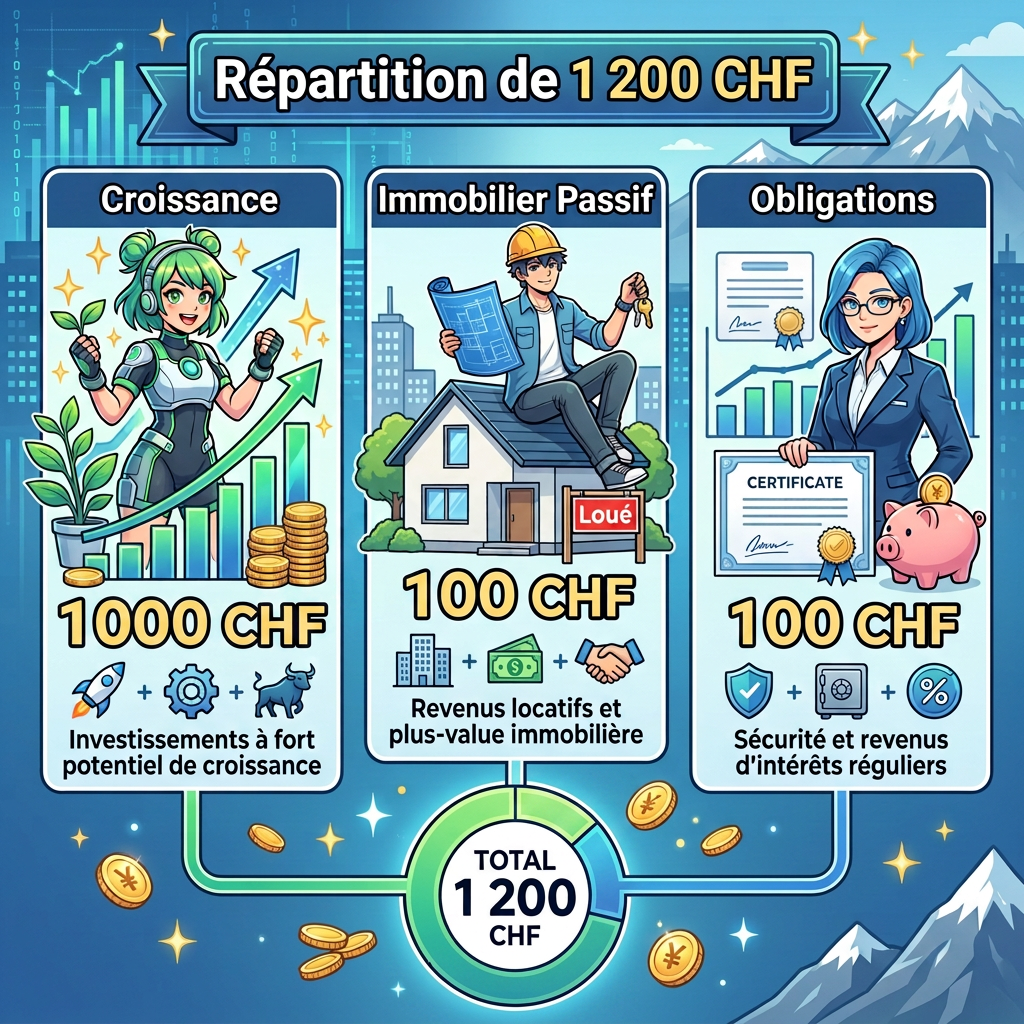
So I came up with the following example for someone who wants to invest 1,200 CHF per month simply.
How to invest 1,200 CHF per month?
| Amount | Investment type | Objective |
|---|---|---|
| 500 CHF | Pillar 3a invested in stocks (3a global 100) | Growth + tax advantage |
| 500 CHF | Global ETF | Growth |
| 100 CHF | Global REIT ETF | Passive real estate |
| 100 CHF | BNDW Global Bond ETF | Secure the wallet |
This distribution means that:
- 1,000 CHF, that is approximately 83 %, are intended for long-term growth
- 100 CHF, that is approximately 8,5 %, are intended for passive real estate
- 100 CHF, that is approximately 8,5 %, are intended for portfolio stabilization via a BNDW bond ETF
This is obviously just one example. Everyone has different financial goals.
500 CHF: Pillar 3a invested in shares

The first part of this strategy involves investing 500 CHF per month in a pillar 3a account with significant exposure to global equities, but also a part in Switzerland (total 100).
In Switzerland, pillar 3a is of particular interest because it allows you to benefit from a tax advantage on 3a contributions.
Solutions like VIAC* Or Finpension* They allow, in particular, the use of strategies heavily exposed to global equities via the Global 100 strategy. This is a strategy that promotes long-term growth.
Therefore, with a monthly standing order paid into a 3a global 100 account, it is possible to:
- invest each month in stocks that have historically achieved good growth
- benefit from tax advantages
- To manage nothing on one's own
Why invest in shares in the 3a?
Because the objective of 3a is generally long-term.
If the money is not needed for several decades, it may be worthwhile to accept more fluctuations in exchange for a potential return higher than that of a cash investment that yields very little money.
Historical performances?
Equity markets have historically generated significant returns over very long periods. However, I strongly advise against using past performance as a forecast.
At the time of writing this article, the annualized return over 10 years is 9% per year, but this does not guarantee future returns.
500 CHF: A global ETF

The second part of my strategy would be to invest 500 CHF per month in a global ETF.
The idea is extremely simple:
I'm not trying to figure out which country or company will be the best investment in 10 years. I own a significant portion of the global market, which is trending upwards.
A global ETF allows you to invest indirectly in a large number of companies and countries through a single product.
In my opinion, this is particularly interesting for someone who wants a simple and diversified strategy.
Global ETF: Simplicity above all
One of the main advantages of a global ETF is therefore its simplicity.
Instead of choosing:
- an American ETF
- a European ETF
- a Japanese ETF
- an emerging market ETF
- a Swiss ETF
- etc.
It is possible to use a single global ETF to achieve very broad geographical exposure.
I particularly like the VT ETF* from Vanguard.
Moreover, it is a completely passive management for the client, as the fund updates the strategy.
Historical performances?
Past performance is not indicative of future results. At the time of writing, the 10-year annualized return is 12% (dividends reinvested).
100 CHF: Global real estate ETF (REIT)

After investing 500 CHF in my Pillar 3a Global 100 and 500 CHF in a global ETF like the Vanguard Total World Stock ETF (VT), I think it is better to add a little exposure to passive real estate.
That is why I would dedicate 100 CHF per month to a global real estate ETF based on REITs (Real Estate Investment Trusts).
Why invest in real estate?
Real estate is an important asset class in the global economy.
When buying an apartment or house to rent out, our return on investment can come from various sources, including:
- rents
- of the potential increase in the value of the property
Furthermore, real estate is known for its stable and slightly increasing value.
However, real estate also has several drawbacks:
- A significant amount of capital is generally required.
- the asset is not very liquid
- We need to manage the tenants.
- there may be construction work
With a global real estate ETF, I can gain exposure to many real estate companies around the world, in various real estate sectors, without having to buy an apartment myself and with 100% passive management.
Why a global REIT ETF?
REITs are companies that own or operate different types of real estate and whose income comes primarily from real estate.
A global REIT ETF therefore allows me to spread my investment across many markets and different types of real estate.
For example :
- residential real estate
- shopping centers
- offices
- industrial real estate
- hotels
- data centers
With only 100 CHF per month, This allows me to add diversified real estate exposure to my portfolio without having to directly purchase property. And I receive rental income via dividends every three months.
As with the Global REIT ETF, I particularly appreciate the REET ETF.* from iShares.
Furthermore, all this management is passive. That is to say, the shareholder of a REIT stock does not have to do anything.
Why only 100 CHF?
I do not wish to allocate too large a portion of my portfolio to REITs.
My main objective remains long-term growth.
THE 100 CHF per month Investing with a TEIT Global ETF offers a little diversification and income stability through high dividends, but I want my portfolio to remain primarily focused on growth stocks.
Historical performances?
I repeat that past performance does not guarantee future performance.
At the time of writing, the 10-year annualized return is 4%. This equates to approximately 3.5% per year on average in dividends.
100 CHF: BNDW Global Bond ETF

For the next 100 CHF, I would like to invest in an asset class completely different from stocks: obligations.
That's why I chose the following as an example: Vanguard Total World Bond ETF (BNDW*).
The objective is very simple:
Having invested primarily in stocks and real estate, I would like to add a portion of my portfolio composed of global bonds in order to stabilize it..
Why invest in bonds?
A bond, broadly speaking, is a loan granted to a state, a company, or another institution.
In return, the investor generally receives interest and recovers the capital at maturity, subject to the risks related to the issuer and the investment.
Bonds therefore function differently from shares.
With my 500 CHF invested in my 3a Global 100 and my 500 CHF invested in my Global VT ETF, my portfolio is highly exposed to equities, growth and fluctuation.
THE 100 CHF invested in BNDW This allows for the addition of another source of monthly income, more stable and different from real estate and stocks.
Why BNDW?
BNDW is an ETF that provides exposure to a very large number of bonds in different regions of the world.
The benefit is therefore similar to that of my global equity ETF: I'm not trying to determine which country or which bond will be the best. I own a significant portion of the bond market.
In reality, a BNDW ETF is historically:
- stable
- diversified in bonds
- very low volatility
- distributes dividends (coupons) every month
Historical performances?
Past performance is not indicative of future results. At the time of writing, the 10-year annualized return is 0%. However, this is based on an average annual dividend of 2.5%.
Strategy Summary

With just four placements, I get multiple sources of exposure:
| Amount | Investment | Placement category | Main Exhibition |
|---|---|---|---|
| 500 CHF | 3a Global 100 | globally diversified stocks | Growth + Tax Deductions |
| 500 CHF | ETF Global VT | globally diversified stocks | Growth |
| 100 CHF | Global REIT ETF | Globally diversified real estate | Listed real estate, quarterly revenues |
| 100 CHF | BNDW | Globally diversified loans | Bonds, monthly income |
My portfolio therefore remains extremely simple.
I don't need to select:
- thousands of individual actions
- hundreds of properties
- obligations one by one
- or dozens of ETFs
I can simply automate my monthly payments and the four ETFs do the work.
A simple strategy rather than a perfect strategy
John Bogle, the founder of Vanguard and a respected figure in finance, stated:
”"The main enemy of a good plan is the dream of a perfect plan. Be content with the good plan."”
I agree.
I'm not trying to build the perfect portfolio. In fact, I'm more interested in build a simple and sufficiently diversified portfolio so that it grows over the long term.
I calculated this portfolio for the period 2015-2025, here is the past annualized return (estimated growth + dividends reinvested):
- 3a overall 100 Viac = approximately 7.5%
- Global VT ETF = approximately 12%
- ETF REET (REIT Global) = approximately 4%
- BNDW ETF (Global Bonds) = approximately 2.5%
This portfolio has obtained approximately 10% annualized over 10 years (2015-2025).
To give a simple example, if someone had invested 50,000 CHF 10 years ago and added 1,200 CHF per month, that would have given… 371,617 CHF.
Ce portefeuille n’est pas le meilleur portefeuille du monde, mais il est très diversifié et il a été plus rentable que la plupart des investisseurs que je connais. Et il ne demande que 5 minutes par mois comme temps de gestion😉
FAQ: How to invest 1200 CHF – Simplified version
Why is the annualized return of this portfolio estimated at ~10 % per year?
This portfolio combines global stocks, of the’real estate and obligations. The weighting of these assets, based on their historical performance, allows us to estimate an average annualized return of approximately 10 % per year over the period analyzed. But this return is not a guarantee for the future.
What are the main risks of this type of portfolio?
A portfolio primarily composed of’shares is sensitive to market fluctuations. THE obligations and the’real estate can also be affected by the interest rate fluctuations. A focus on developed markets can limit geographical diversification.
How can you reduce portfolio volatility without sacrificing too much return?
To reduce volatility, it is possible to’increase the share of bonds or to add less volatile assets such as gold or cash. A more balanced allocation can stabilize the portfolio, but returns may be affected by this rebalancing.
Should a portfolio be rebalanced regularly?
Once per semester is sufficient. It is recommended to rebalance a portfolio at least once a year. This helps to maintain the initial allocation and limit the risks associated with overweighting an asset.
What are the applicable tax rules for this type of portfolio in Switzerland?
In Switzerland, Dividends and capital gains are taxable., However, the rules vary from canton to canton. pension accounts (3a) They benefit from tax advantages, as gains are not taxed until the funds are withdrawn. For tax optimization, it is advisable to consult an expert.
How to invest 1200 CHF – Simplified version
Subscribe for the latest news ✍
You have a frugalist or minimalist project and you want a training? Click ”here”.
My pages
- About me
- Saving / Frugalism
- Blog
- Shop
- Contact
- Training and E-book
- Invest
- Minimalism
- My account
- Newsletter
- Basket
- Order confirmation
Lastest Post
- 2nd pillar: The basics to understand
- Top 5 tips to make money from home
- How to invest 1200 CHF – Simplified version
- How to invest on a small budget?
- REIT: Investing in Passive Real Estate
How does this blog live?
Overall, this blog lives on sharing a frugal and minimalist lifestyle.
For a question of transparency towards the readers. All recommended products are in order to make life cheaper, simpler and to promote the essentials.
Basically, my only income with this blog comes:
- Trainings that I realize
- Promo codes for the products I use
- Donations that readers make in exchange for neutral information.
About me
I decided to create this blog to develop and help readers who are looking for a simpler and more economical life.
Compared to before, I was a person who consumed a lot until the day I realized that my consumption made me sadder and poorer 😑
Now I prefer the minimum of my needs to be happy and achieve my financial freedom.
Without realizingI started to focus on saving and investing to depend on a boss for as little time as possible and to speed up my personal projects.
As a result, I am getting richer in a way that I never imagined since I have an average salary in Switzerland.
What is the purpose of this blog?
The goal is to share and learn with others who seek freedom and simplicity 😉
Are you rather minimalist or frugal Jonny?
I am as minimalist as I am frugalist. However, there are situations where I lean more towards an art of life.
To conclude, I think the most important thing is to feel comfortable in your lifestyle 😊
How to invest 1200 CHF – Simplified version
How to invest 1200 CHF – Simplified version
Leave a Reply