
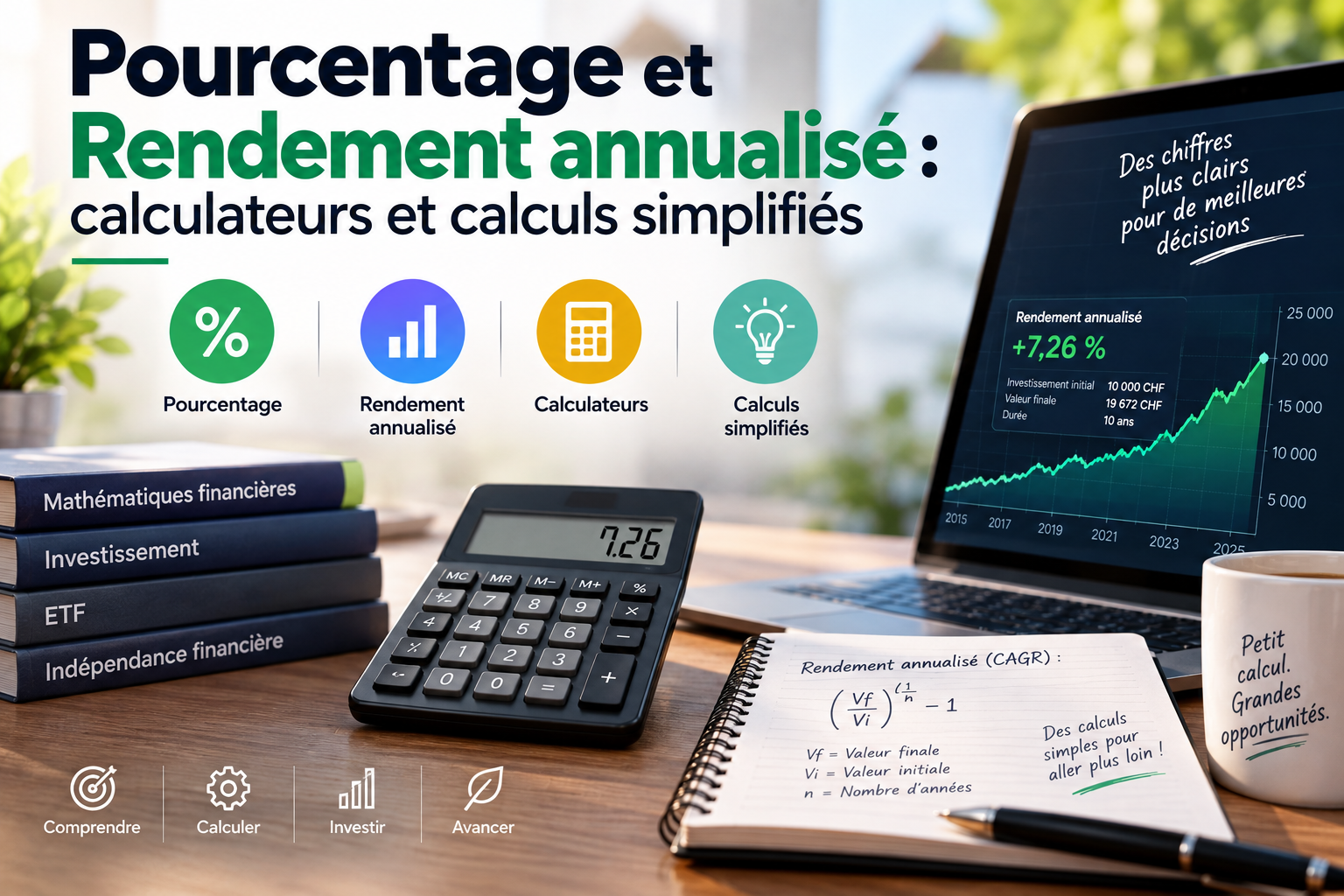
The conversion and calculation of percentage or annualized return can be complex. Here is an article to simplify this process. Percentage and Annualized Return: Calculators and Simplified Calculations 😉
Recommended products


The common error of converting percentage – annualized return?
Many people get confused about converting a percentage to an annualized return.
For example, the number of times I have heard:
- “I invested $10,000 10 years ago and I have $20,000 today. I earned $10% per year!”
Actually, this calculation is wrong. Note that earning 100% in 10 years does not mean 100:10.
To answer this question, the answer is 7.18% annualized return. Indeed, far from the 10% that many people think!
Annualized return or percentage?
When analyzing the history of an investment, it is often displayed as a percentage or annualized return. But not always both.
Which can lead to questions. For example:
- 150% in 5 years. How much does that correspond to in annualized return?🤔
Indeed, when it comes to converting a percentage into an annualized return, it is not easy to calculate.
👉 But if you read this article carefully, you will have answers very quickly. With simple mental arithmetic tips 😉
The Official Calculation – Annualized Percentage Return
If you want to convert a percentage into an annualized return, there is a calculation, but it is not at all simple.

Note that the not means the number of years.
For example. For 49.53% in 3 years. The calculation is:
Annualized return = (1+0.4953)1/3−1=14.35%
In this example, the answer is 14.35% annualized return.
▶️ On the other hand, there are simpler and faster tricks depending on the calculation you want to perform. Here are some examples.
Return on Investment Calculator – Artificial Intelligence
Hardbacon is a financial website originating from Canada. I like the calculator.” return on investment2 ". It's simple and very effective.
I used it a lot before artificial intelligence became part of our daily lives.
Nowadays, you just need to ask your favorite artificial intelligence about performance, and the answer is instantaneous.
Doubling an amount? – Einstein – The rule of 72

For example, let's say you expect your investment to earn an annual return of $6.%. And you ask yourself how many years it takes to double your amount?
For example:
| Current amount | $100,000 |
| Annualized return | 6% |
| Years needed to double the initial amount ($200,000) | ? |
Einstein published a very simple rule to quickly answer this question. With Rule 72.
Doubling an annualized return = 72: annualized return
To answer the previous question: 72:6 = 12 years to double the amount to get $200,000!
| Current amount | $100,000 |
| Annualized return | 6% |
| Years needed to double the amount ($200,000) | 12 years old |
Tip 🔍
Personally, I use an estimation trick to estimate an annualized return, based on this Einstein rule.
| % annualized | Years to double the initial amount (rounded) |
|---|---|
| 10% | 7 years old |
| 7% | 10 years |
Having memorized these numbers, I can estimate in a few seconds, estimate in how much time a percentage will double according to the annualized return.
For example:
- 12% = In less than 7 years (more than 10%)
- 5% = Approximately 14 years (1/2 of 10%)
- 3% = Over 20 years (Less than half of 7 %)
Moneyland – Return Calculator with inflation
Note that Moneyland is a Swiss financial site with many financial calculators.
In order to convert an annualized return into money. I really like the very easy to use calculator ”compound interest calculator3”
For example, let's imagine that you have 100,000 CHF in the stock market. And you want to pay 200 CHF every month. Hoping to earn 7% of annual return. How much will you have in 10 years? 🤔
In 10 seconds you will know the answer.

Moneyland – Return Calculator with inflation
Moneyland has developed a more complex yield calculator.
With the ” yield calculator1 ”.
In addition to having the same bases as the compound interest calculator. With this calculator, it is possible to add certain criteria that will lower the gross yield.
For example:
- inflation
- Management fees
For example, let's simulate an investor who has:
- 100,000 CHF of initial capital
- 200 CHF monthly payment
- 7% annualized return (credited monthly)
- 2% inflation per year
- 400 CHF management fees per year
In 10 years, how much money will this person have?
Therefore, by wasting 30 seconds on the calculator, the result is:
- Final capital – CHF 229,794
- Capital adjusted for inflation – 198,006
- Performance Performance – 61%
- Annualized return (net) – 4.94%

Conclusion
Percentage and Annualized Return: Calculators and Simplified Calculations
Contrary to what many people think. It is not enough to divide the performance by the number of years to know the annualized return. In reality, it is a more complex calculation!
👉 In order to convert or calculate simply the performance and the annual yield. It is possible to use 2 easy-to-use calculators.
Regarding the annual yield, if you want to know in how many years the amount will double. You can do the annual yield divided by 72.
🔍 One trick I use is to have 2 annualized return calculations and then make estimates from those numbers.
- 10% annualized = 7 years
- 7% annualized = 10 years
Therefore, I have a relatively accurate estimate without using a calculator.
To conclude, if you are looking for a performance calculator or annual return by removing some important costs such as inflation for example. You can use this calculator:
- Yield Calculator1
Subscribe for the latest news
You have a frugalist or minimalist project and you want a training? Click ”here”.
My pages
- About me
- Saving / Frugalism
- Blog
- Shop
- Contact
- Training and E-book
- Invest
- Minimalism
- My account
- Newsletter
- Basket
- Order confirmation
Lastest Post
- After 10 years of investing in ETFs: which ETF would I choose?
- Financial freedom: why the first 100,000 are the hardest
- The best advice in the world to save
- The Neon bank, the summary
- How does digitalization influence minimalist?
How does this blog live?
Overall, this blog lives on sharing a frugal and minimalist lifestyle.
For a question of transparency towards the readers. All recommended products are in order to make life cheaper, simpler and to promote the essentials.
Basically, my only income with this blog comes:
- Trainings that I realize
- Promo codes for the products I use
- Donations that readers make in exchange for neutral information.
About me
I decided to create this blog to develop and help readers who are looking for a simpler and more economical life.
Compared to before, I was a person who consumed a lot until the day I realized that my consumption made me sadder and poorer 😑
Now I prefer the minimum of my needs to be happy and achieve my financial freedom.
Without realizingI started to focus on saving and investing to depend on a boss for as little time as possible and to speed up my personal projects.
Are you rather minimalist or frugal Jonny?
I am as minimalist as I am frugalist. However, there are situations where I lean more towards an art of life.
To conclude, I think the most important thing is to feel comfortable in your lifestyle 😊
Percentage and Annualized Return: Calculators and Simplified Calculations
Leave a Reply