
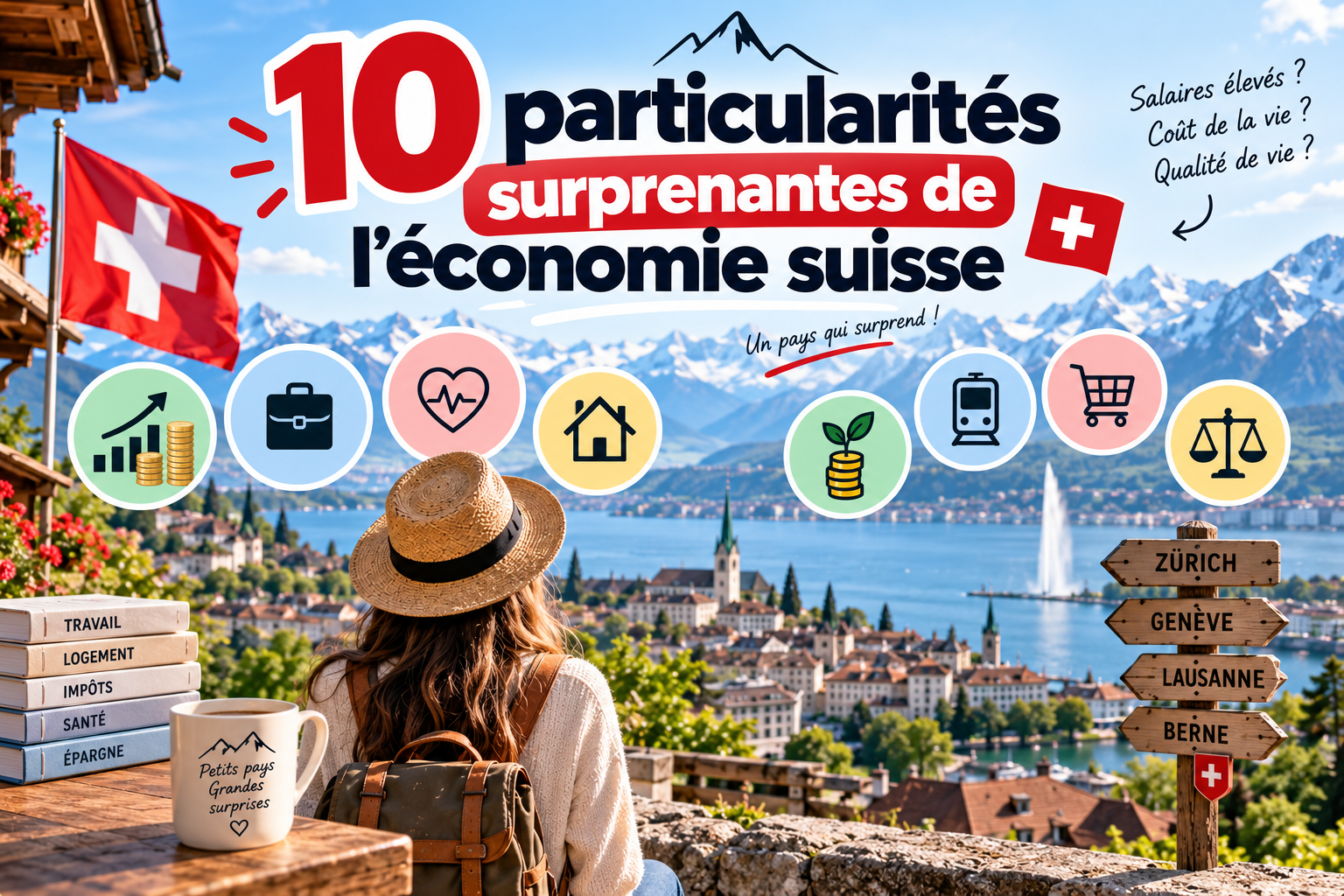
Having lived in several countries and having spent half of my life in Switzerland. I have noted 10 surprising peculiarities of the Swiss economy. In this article, I mention 5 positive points and 5 negative points.
Recommended products


Introduction: 10 surprising features of the Swiss economy
Note: This article primarily reflects my personal experience of living in Switzerland. The aim is neither to criticize nor to promote the country, but to present economic peculiarities that may be surprising to those who live there.
Switzerland is often associated with its mountains, lakes, chocolate, banks, and… high salaries. But living in a wealthy country doesn't necessarily mean that everything is financially easy.
After several years of living in Switzerland, here is 5 economic aspects that I find particularly interesting and 5 that can be much more difficult to live with on a daily basis.
🇨🇭 Switzerland as seen from abroad
Switzerland is a relatively small country, but very well known in Europe. It has four national languages: German, French, Italian and Romansh.
Economically, its reputation rests in particular on high salaries, a stable economy, and an attractive labor market. Data from the Federal Statistical Office (FSO) also shows that Swiss wages remain significantly higher than those of several neighboring countries, even when price differences are taken into account.
But behind these figures lies a more nuanced reality: Revenues are high, but so are expenses.
Here are 10 unique characteristics of Switzerland, 5 positive and 5 negative:

👍 5 positive economic features

1. Relatively low unemployment
Switzerland has traditionally benefited from a strong labor market.
In July 2026, the unemployment rate recorded by SECO was 3,0 %.
This obviously does not mean that everyone finds a job easily. The difficulties can be significant in certain sectors or for certain skill sets.
But for personal finances, a dynamic job market represents a significant advantage: Having a stable job makes it easier to build up savings and assets.
2. Pillar 3a: an attractive tax tool
Pillar 3a is one of the mechanisms that I find particularly interesting in Switzerland.
In particular, it allows you to contribute part of your income to a linked individual pension plan and to benefit from tax deduction, within the limits prescribed by law.
Some 3a products also allow a significant portion of savings to be invested in financial assets. Historically, this has increased the potential for long-term returns.
The benefit is therefore twofold: preparing for retirement while potentially optimizing one's tax situation.
3. Special taxation for investments
Swiss investment taxation can be attractive for a private investor.
In principle, capital gains realized on securities held as part of private wealth are exempt from income tax. However, the securities themselves must be declared as assets, and certain income, such as dividends and interest, is taxable.
This can make long-term holding of growth stocks or ETFs particularly attractive from a tax perspective.
However, be aware that tax treatment depends on the taxpayer's situation and the classification of their activity. An investor considered a professional may be subject to different rules.
4. Relatively sound public finances
Switzerland has a mechanism called debt brake, intended to limit the Confederation's structural deficits.
Public finances remain relatively sound. According to the most recent data from the Federal Finance Administration, the public administration sector is expected to have recorded a financing surplus of approximately 4 billion francs in 2025, with gross debt representing approximately 40.7 % of GDP according to the IMF definition.
This does not mean that Switzerland has no debt or budgetary problems. But the situation remains different from that of many other developed countries.
5. High purchasing power… despite prices
Switzerland combines high salaries with a high cost of living.
This is important because comparing only salaries can give a misleading picture. When price differences are taken into account, the gap with neighboring countries narrows, but Swiss compensation levels generally remain higher.
For me, this is one of the great distinguishing features of the Swiss economy: You can earn much more than in France or Italy, but you also spend much more.
👎 5 more challenging economic characteristics
To speak only of the positive aspects without mentioning the negative ones would be misleading. Therefore, I have written, in my opinion, the 5 most negative aspects in Switzerland.

1. A very high cost of living
This is probably the first thing you notice when you arrive in Switzerland.
Accommodation, restaurants, services, insurance, transport or certain everyday expenses can quickly put a strain on your budget.
A salary of several thousand francs may therefore seem enormous on paper, but much less impressive once rent, health insurance, taxes and current expenses have been paid.
2. Health insurance represents a very large portion of the budget
Basic health insurance is mandatory for people domiciled in Switzerland, with some exceptions. Each family member is insured individually.
And the premiums only represent part of the cost: you must also take into account the deductible and the co-payment.
For an adult, you should budget at least CHF 4,500 per year for health insurance alone. And that's not including any medical expenses if you have any medical benefits.
Therefore, this is an expense that you absolutely must include in your annual budget.
3. The free movement of people: a controversial economic issue
The free movement of people between Switzerland and the EU/EFTA facilitates access to the Swiss labor market for the nationals concerned. The agreement has been in force since 2002.
Its economic consequences are the subject of debate.
Some highlight the workforce needs of businesses and the contribution of foreign workers to the economy. Others are particularly concerned about pressure on housing, infrastructure, and unfair competition on wages.
What is certain is that this cross-border competition:
- increases worker pressure to obtain fair wages
- increases the unemployment rate
4. Real estate may be unaffordable in some areas
Housing prices are another major challenge.
In particularly sought-after areas, buying a home often requires significant capital and a high income.
Even for rentals, rent can represent a considerable portion of the monthly budget.
The consequence is simple: The more expensive your accommodation is, the less money you have to save, invest or finance your leisure activities.
5. A multitude of taxes and fees
Switzerland has many different levies, sometimes federal, sometimes cantonal or communal.
The radio and television license fee is one example. Some taxes are also specific to cantons or municipalities, such as the dog tax or certain vehicle-related taxes.
I personally find some of these taxes difficult to accept when the corresponding service is not directly useful to me.
According to a website*, Switzerland is the ninth country in Europe that applies the most taxes. 98 taxes in total in 2024.
🇨🇭 Conclusion: being rich doesn't necessarily mean having a good quality of life
Switzerland presents an interesting paradox.
Wages are high, unemployment remains relatively low, and public finances are sound. The country also has attractive tax mechanisms for savings and investment.
But at the same time, The cost of living, housing, health insurance and cross-border competition can absorb a large portion of income.
That is why I think we should avoid looking solely at salary when comparing Switzerland with another country.
The real question is rather:
How much do you actually have left after paying for your housing, insurance, taxes, and living expenses?
Ultimately, it is this difference between high income and high cost of living which makes the Swiss economy particularly interesting… and sometimes not.
10 Surprising Peculiarities of the Swiss Economy
Subscribe for the latest news
You have a frugalist or minimalist project and you want a training? Click ”here”.
My pages
- About me
- Saving / Frugalism
- Blog
- Shop
- Contact
- Training and E-book
- Invest
- Minimalism
- My account
- Newsletter
- Basket
- Order confirmation
Lastest Post
- After 10 years of investing in ETFs: which ETF would I choose?
- Financial freedom: why the first 100,000 are the hardest
- The best advice in the world to save
- The Neon bank, the summary
- How does digitalization influence minimalist?
How does this blog live?
Overall, this blog lives on sharing a frugal and minimalist lifestyle.
For a question of transparency towards the readers. All recommended products are in order to make life cheaper, simpler and to promote the essentials.
Basically, my only income with this blog comes:
- Trainings that I realize
- Promo codes for the products I use
- Donations that readers make in exchange for neutral information.
About me
I decided to create this blog to develop and help readers who are looking for a simpler and more economical life.
Compared to before, I was a person who consumed a lot until the day I realized that my consumption made me sadder and poorer 😑
Now I prefer the minimum of my needs to be happy and achieve my financial freedom.
Without realizingI started to focus on saving and investing to depend on a boss for as little time as possible and to speed up my personal projects.
For several years I have felt happy and I have become richer in a way that I would never have imagined given that I have an average salary in Switzerland.
It is for this purpose that I decided to create this blog. In order to share and learn with other people who seek freedom and simplicity 😉
Are you rather minimalist or frugal Jonny?
I am as minimalist as I am frugalist. However, there are situations where I lean more towards an art of life.
To conclude, I think the most important thing is to feel comfortable in your lifestyle 😊
10 Surprising Peculiarities of the Swiss Economy
10 Surprising Peculiarities of the Swiss Economy
Leave a Reply