
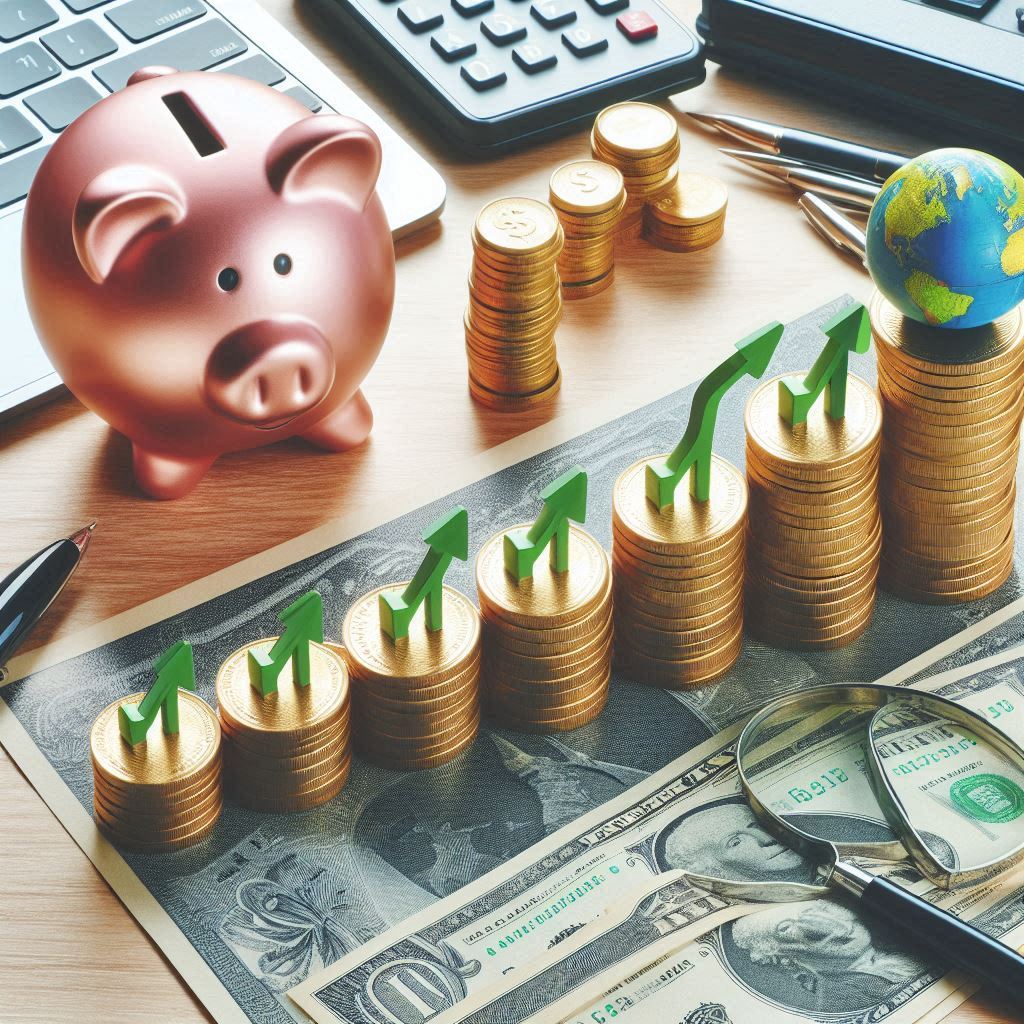
The multiplier effect of compound interest is a very important topic. Most people do not understand the meaning. However, This is an essential concept for investing your savings. ⚠️
Recommended products


Compound interest, such a powerful method!
➡️ CThis method of investing is so powerful that’Einstein considered it the eighth wonder of the world.
And if Einstein says so, we should listen carefully. 🧐
⚠️ Investing involves a risk of losing money.
The concept compound interest
To summarize this concept in one sentence, these are the interests on the interests that we received previously.
Indeed, money multiplies by itself like a virus. I think you will understand with simple simulations.

The Multiplier Effect of Compound Interest
Note that it is possible to call compound interest “The multiplier effect“.
In reality, most of us are more accustomed to counting by adding than by multiplying.
For example, if I ask for the result of 8 + 8 + 8 + 8 + 8. Most people will instantly know that the result is 40! Without using the calculator.
On the other hand, if I ask for the result of 8 x 8 x 8 x 8 x 8. Few people will know that the result is 32,768. Unless they calculate with a calculator.
👉 This is why most people are more attracted to big numbers than to the multiplier effect of compound interest.

Multiplier salary or high salary?
Let's imagine you have a choice between two job offers:
- 95,000 $ annual salary, without any increase.
- 60,000 $ annual salary, with an increase in 10 % each year.
👉 The majority of people would probably choose the salary of 95,000 $.
And yet…
With a starting salary of 60,000 ($ + 10% annual increase), your salary increases significantly each year thanks to compound interest.
- Year 1: 60,000 $
- Year 2: 66,000 $
- Year 3: 72,600 $
- Year 4: 79,860 $
- Year 5: 87,846 $
- Year 6: 96'631 $
👉 Starting from the 6th year, your salary exceeds that of 95,000 $.
This example perfectly illustrates the power of compound growth.
Of course, in reality, few companies grant a 10% raise every year. But this principle is exactly the one that applies to long-term investments.
When you invest regularly and your gains generate further gains, your wealth can grow exponentially.
This is precisely why starting to invest early is often more important than investing large sums later.
The example of Warren Buffett
Warren Buffett is, at the time of writing this article, one of the 10 richest people in the world.
Known for his talent as a stock market investor, in my opinion, his main talent was understanding very early on the multiplier effect of compound interest.
Currently, on average, do you know how long it takes Warren Buffett to earn 1 million?
➡️ In less than an hour
How is this possible? 🧐
In fact, Warren Buffet started the multiplier effect over 80 years ago.
When you start this early, the benefits are incredible!
For example, $1,000 invested once 80 years ago at a rate of 6% per year is worth… CHF 104,796 today. 🧐
🔺As you can see. The more time the compound interest multiplier effect has to reproduce. The more incredible the profits are 😉
Don't forget inflation!
👉 One aspect to keep in mind with a return is inflation ❗
For example, an investment with an annual rate of 10% on average. Does not correspond to 10% net.
Why? Because returns are eroded by inflation.
For example, if an investor earns an average of 10% per year with annual inflation of 2%, the actual net interest received is 8%.
Don't forget the fees!
When you invest, you also incur fees. For example:
- Taxes on the return on your investment
- The Ter of your ETF
- The commission on your stock market investment
- The work on your property
For example, if you earn 10% per year but have average expenses of 3%, you get an annualized gain of 7%.

Investment simulations with 100 CHF per month over 40 years
I rely on the compound interest calculator on the moneyland website.
➡ I simulated an investment of 100 CHF per month and a net return of 5% per year. Over 10, 20, 30 and 40 years.
| Years | Amount saved in cash | Final amount | Interest earned |
|---|---|---|---|
| 10 | 12,000 | 15,502.25 | 3,502.25 |
| 20 | 24,000 | 40,753.80 | 16,753.80 |
| 30 | 36,000 | 81,885.90 | 45,885.90 |
| 40 | 48,000 | 148,885.70 | 100,885.70 |
🔍We can see that time is clearly on our side.

➡ As we can see, 100 CHF per month with 5% annualized after 30 years gives … 81,885 CHF 🧐
Investment simulations with 300 CHF per month
Now let's imagine with 300 CHF per month with a yield of 5% annualized.
| Years | Amount saved in cash | Final amount | Interest earned |
|---|---|---|---|
| 10 | 36,000 | 46,506.75 | 10,506.75 |
| 20 | 72,000 | 122,261.35 | 50,261.35 |
| 30 | 108,000 | 245,657.65 | 137,657.65 |
| 40 | 144,000 | 446,657.15 | 302,657.15 |
We conclude that the profitability of compound interest depends primarily on 4 factors:
- The duration
- The annual yield
- The amount saved each month
- The fees
Which investments should I choose to benefit from compound interest?
No investment can guarantee a profit! Investing involves risks of losing money!
However, there are a few simple investments that I trust to increase my savings. For example:
- Growth ETF with low management fees (TER)
- dividend-focused ETFs in growth
- Real estate with the purchase of a primary residence
Conclusion
Let us mention that there are 4 very interesting aspects with the multiplier effect of compound interest.
- By investing 300 CHF per month with a net interest of 5% per year. We are not far from half a million after 40 years of saving.
- By investing 675 CHF per month with a net interest of 5% per year. We exceed a million after 40 years.
- The duration is more important than the amount saved.
➡ Indeed, just compare the 2 examples with 36,000 CHF saved in cash.
Here is a table comparing an investor who saves 100 CHF per month for 30 years, and another who invests 300 CHF per month for 10 years. Both have a net return of 5% per year.
| Amount invested | Pay | Interest earned | |
|---|---|---|---|
| 100 CHF per month for 30 years | 36,000 CHF | 81,885.90 CHF | 45,885.90 CHF |
| 300 CHF per month for 10 years | 36,000 CHF | 46,506.75 CHF | 10,506.75 CHF |
Even though both examples invested 36,000 CHF, Someone who saves 100 CHF per month for 30 years has more money than someone who invests 300 CHF every month for 10 years.
To benefit from compound interest, it's essential to start investing early. The sooner you start, the more your money can grow.
Time is an investor's best ally 😊
FAQ: The Multiplier Effect of Compound Interest
What is compound interest?
Compound interest refers to the interest generated not only on your initial capital, but also on the interest already earned. Over time, your wealth can therefore grow exponentially thanks to the multiplier effect.
Why is compound interest so powerful?
Compound interest allows your money to generate new gains each year. The longer your investment horizon, the greater this effect becomes. This is one of the main reasons why it's advisable to start investing as early as possible.
How do you calculate compound interest?
The calculation is based on a mathematical formula that takes into account the initial capital, the annual rate of return, the investment period, and regular payments. Numerous compound interest calculators are also available to quickly obtain an estimate.
How much does an investment of 100 CHF per month yield?
The final amount depends primarily on the return obtained and the investment period. With an average annual return of 5% over 40 years, investing CHF 100 per month can represent nearly CHF 150,000 in capital.
How much does an investment of 300 CHF per month yield?
With an average annual return of 5% over 40 years, an investment of CHF 300 per month could exceed CHF 440,000. This result is a simulation and does not constitute a guarantee of performance.
What is the best age to benefit from compound interest?
The best time to start is as early as possible. The longer the investment period, the more time compound interest has to take effect. However, it's never too late to start investing.
Are compound interest payments guaranteed?
No. Compound interest describes a growth mechanism, but the return depends on the investment chosen. No investment guarantees a gain, and there is always a risk of capital loss.
Which investments allow you to benefit from compound interest?
ETFs, shares, certain investment funds, the third pillar (in Switzerland) or even certain real estate investments can benefit from compound interest when they generate reinvested returns.
Why is it necessary to take inflation into account?
Inflation gradually reduces the purchasing power of your money. To know your true return, you must therefore deduct inflation as well as the fees associated with your investments.
Do fees have an impact on compound interest?
Yes. Even low management fees can significantly reduce the final capital over several decades. Choosing investments with limited fees generally allows you to benefit more from the multiplier effect.
Should you invest a large sum of money or invest regularly?
In most cases, investing regularly is an excellent strategy. Monthly payments help smooth out market fluctuations while fully benefiting from compound interest over the long term.
Why is time more important than the amount invested?
Over time, interest generates further interest. This is why someone who invests a small amount for 30 or 40 years often achieves a better return than someone who invests more for only a few years.
What is the most famous example of compound interest?
Investor Warren Buffett is often cited as one of the best examples. Much of his fortune comes from decades of investing and the power of compound interest.
Can compound interest make you rich?
Compound interest doesn't make you rich overnight. However, combined with regular saving, a good return, and an investment horizon of several decades, it can allow you to build significant wealth.
What is the main lesson of compound interest?
The main lesson is simple: start as early as possible, invest regularly, keep costs down, and let time work in your favor. When it comes to investing, patience is often one of your greatest assets.
The Multiplier Effect of Compound Interest
Subscribe for the latest news
You have a frugalist or minimalist project and you want a training? Click ”here”.
My pages
- About me
- Saving / Frugalism
- Blog
- Shop
- Contact
- Training and E-book
- Invest
- Minimalism
- My account
- Newsletter
- Basket
- Order confirmation
Lastest Post
- 2nd pillar: The basics to understand
- Top 5 tips to make money from home
- How to invest 1200 CHF – Simplified version
- How to invest on a small budget?
- REIT: Investing in Passive Real Estate
How does this blog live?
Overall, this blog lives on sharing a frugal and minimalist lifestyle.
For a question of transparency towards the readers. All recommended products are in order to make life cheaper, simpler and to promote the essentials.
Basically, my only income with this blog comes:
- Trainings that I realize
- Promo codes for the products I use
- Donations that readers make in exchange for neutral information.
About me
I decided to create this blog to develop and help readers who are looking for a simpler and more economical life.
Compared to before, I was a person who consumed a lot until the day I realized that my consumption made me sadder and poorer 😑
Now I prefer the minimum of my needs to be happy and achieve my financial freedom.
Without realizingI started to focus on saving and investing to depend on a boss for as little time as possible and to speed up my personal projects.
For a few years now, I have been feeling happy and enriched in a way that I would never have imagined given that I have an average salary in Switzerland.
It is for this purpose that I decided to create this blog. In order to share and learn with other people who seek freedom and simplicity 😉
Are you rather minimalist or frugal Jonny?
I am as minimalist as I am frugalist. However, there are situations where I lean more towards an art of life.
To conclude, I think the most important thing is to feel comfortable in your lifestyle 😊
Leave a Reply